Such Anger

by John Gilstrap
www.johngilstrap.com

Last week, Michelle Gagnon reported on Joe Konrath’s presumably groundbreaking deal with AmazonEncore. In essence, his next book will be published first as a Kindle-only edition, and then as a traditional book, with Joe pocketing more attractive royalties than are offered by any mainstream publishers. It was presented as a really big deal. Maybe even a game changer.

Earlier this week, Publishers Weekly posted a story on its website that refuted most of the claims made in Konrath’s press release. The tone of the PW piece was snarky at best, and maybe even a little bit mean. Konrath posted a retaliatory blog encouraging his legions of fans to let PW know that the magazine’s reporter got a lot of facts “wrong.” I put “wrong” in quotation marks here because I’ve got no dog in this fight, and I don’t know any of the facts. I’m certainly not in a position to take sides, and deep down inside, I don’t much care.

What I find startling about the whole thing is the level of anger out there focused on the publishing industry. Publishers, you’ll learn, wouldn’t know quality writing if it kissed them on the nose, and agents are evil incarnate, allegedly in cahoots with the evil publishers to make sure that the world’s most talented writers are never allowed to have a voice in print.

It’s like stepping through some twisted version of Alice’s looking glass. The publishing world alleged by some of the most spun-up of these sites and others represent the exact opposite of my own experience. In the publishing world I know, every agent is desperately hungry for the next great voice in authordom, and every publisher is betting the corporate treasury every day on new talent. They might now be doing it millions of dollars at a time as they were in the 1990s, but they’re certainly doing it tens of thousands of dollars at a time. New careers are being launched every day.

According to many of the posters on the screaming websites, the publishing industry as we know it is locked in denial of the fact that they are dinosaurs that refuse to accept that they’re dying. In their death throes, they refuse to admit that the future lies in self-published novels and ebooks.

It’s hard for me to imagine a more foul-smelling steaming crock of bull poop. Alternative publishing will certainly change the business model—who knows, it might derail it completely—but if that happens, it won’t happen because publishers are evil; it will happen because readers change their habits.

Which leaves us with the anger. Where is this coming from? Isn’t it remotely possible that the preponderance of the rejected manuscripts out there are in fact rejected because they aren’t very good? Or if they’re good, they’re not marketable? Doesn’t the traditional publishing model exist at least in large part because the model provides quality control?

Is it possible that Joe Konrath’s success—which I do not dispute—actually provides false hope to authors who aren’t very good at what they do? As an author who has had at least some measure of commercial success, is it possible that Joe’s success at independent publishing is not relevant to the average aspiring writer?

Open Tuesdays

image As we announced last week, while our blogmate, Kathryn Lilley, is on medical hiatus, we’re opening up the Kill Zone on Tuesdays for general questions, comments and discussions. If you have a question about writing, publishing or taking the 2010 Census in rural areas, ask away in our comments section. We’ll do our best to get you an answer.

And don’t forget you can download a copy of FRESH KILLS, Tales from the Kill Zone to your Kindle or PC today.

Every Author Wants A Great Review

By John Ramsey Miller

Over my career I have been extremely lucky because I have mostly had positive reviews for my works. The only negative reviews I’ve had were on Amazon left by skunks, idiots, or enemies. What sane person pans one of my books? At least one hopes bad reviews are a result of a conspiracy. Those Amazon reviews you can mostly ignore, especially when you discover the reviewer is a fan of one of your competitors (whom you may have been compared to somewhere), or someone who always reviews your books and gives less than positive reviews, a failed author who hates everything because it’s inferior to their own misunderstood opus. I think that if a reader doesn’t like your first book, why would they keep reading consecutive novels by you and adding negative reviews for each? Perhaps it could be someone you fired or someone whose manuscript you didn’t send to your publishing house with a note demanding it be published forthwith and a massive advance paid. Some of these authors will assume you are jealous of their talents and trying to suppress their greatness. Whatever it may be, the reviews on that place shouldn’t depress or impress.

Of my seven novels, none got a starred review in Publisher’s Weekly. It’s a big deal, as we all know well. A very big deal considering the number of books published and the few slots available. Most reviewers find something to not like as much as they like the rest. Gilstrap, whom you might have figured is a close friend of mine, (although I have never seen him in a Speedo) would never have put this review in his blog, but I can put it in mine because he deserves to have it shared by those who value him and understand what a struggle his career has been and how hard and diligently he has labored at this game we play. Nobody writes or thinks harder than John Gilstrap, and nobody deserves a dollop of praise more.

May I present:

Hostage Zero
John Gilstrap, Pinnacle, $6.99 (448p) ISBN 978-0-7860-2088-1
The addictively readable second thriller featuring freelance hostage rescue operative Jonathan “Digger” Grave (after 2009’s No Mercy) marries a breakneck pace to a complex, multilayered plot. When two teenage boys are inexplicably kidnapped from a Virginia residential school for children of incarcerated parents, Grave and his crew set out to locate the victims and apprehend the abductors. Then one of the boys is drugged and left to die in a field, saved only by the fateful intervention of a passing homeless man, and Grave’s investigation begins to turn up leads that point to government and organized crime connections. A roller-coaster ride of adrenaline-inducing plot twists leads to a riveting and highly satisfying conclusion. Exceptional characterization and an intricate, flawlessly crafted story line make this an absolute must read for thriller fans. (July)

We’ve all had good reviews with a bomb somewhere in the body of the review. I had one review where the woman, who was not a fan of fiction and said so, said the opening chapter of my book was like walking into a mens locker room and kicking over a bucket filled to the brim with adjectives. I’ve had one of my books praised as one hell of a read, then described as “Gun” fiction. I thought that was a pretty good plug. Last night I went to a birthday party for a friend and I gave him a box of 9mm tracer ammo I’d had in the closet gathering dust for a few years.

Reviews have been discussed here before and will again. Nothing lights up your day like a review in a place like PUBLISHERS WEEKLY or KIRKUS because those reviewers know books and everybody in the industry and most book buyers read those reviews and often base buys on what they say. We don’t know how many sales are generated by reviews because there’s no real way to measure that. Oprah could (and probably can still) sell millions of copies by mentioning a book. I believe reviews do affect sales, but probably not as much as we think they do. The best sales tool is word of mouth, or BUZZ, which when it comes, usually vanishes just as quickly. Think cigarette smoke in a wind, more than oil spewing from a pipe a mile underwater which nobody can figure out a way to plug. We are depending on the same scientists to save the world and they can’t plug a ten inch pipe.

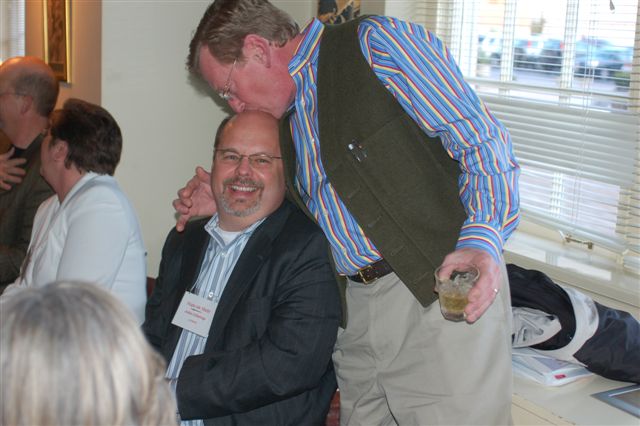
I also wanted to share a picture of John and I taken at Magna Cum Murder.


So, how many of you have received less-than-stellar reviews? What was the most distressing or comical lines, if you can remember them? And do you think reviews really affect sales? Have you ever kissed John’s head? Do you know the taste of Turtle Wax?

Where is Kathryn?

lilleyOur lovely and talented blogmate, Kathryn Lilley, will be taking a medical hiatus for a while. As she makes a speedy recovery, we are going to open up Tuesday’s as a general discussion day for any topics relating to publishing and writing (or anything else you think we can answer). Is there a term or buzzword you’ve heard but don’t quite understand? Are foreign rights a mystery? Do all contracts pay an advance against royalties? What’s the difference between a novel and a novella? How can you get a discount when ordering those free-range eggs from Miller?

Post your question in the comments and we’ll try to answer any and all for the next few weeks while Kathryn is away. So let us know what’s on your mind but were always afraid to ask.

BTW, I’ll be discussing the term Sellthrough in my post tomorrow so be sure and come back for that.

Putting things in context

In last week’s post, “Don’t confuse your reader,” we discussed some writing “do’s and don’ts” that can help us avoid losing readers. I’ll revisit a couple of those points in today’s critique. My comments follow in the bullets.
 

     Dani struggled to haul another load of class materials across the campus to where she’d had to park her pickup truck. Just a few minutes late, and she’d not been able to find a spot closer to the building where her temporary classroom was located. The renovations should have been finished weeks ago, but all the rain had shut down construction, and the ground was so saturated that every step felt like the entryway to a bottomless pit.
     A new session, actually a completely new program, would be starting soon and she was eager to get her room organized and ready to go. She stopped to set the box down for a minute and wiped her dripping face. She loved living in the southeastern part of the country, but the muggy summers were sometimes hard to take. Dani felt something hit her lightly on the back and turned to see her friend and colleague, Suzanne Feltenburg, trying to get her attention. The balled-up piece of paper that Suzi had thrown started soaking up water, and Dani bent down to pick it up, then glanced at her friend’s face. 

     “What’s wrong? What’s happened?”, she signed with one hand as she shoved the paper in her pocket. Suzi hesitated, then blurted out with rapid signs, “They’ve found another body.”
    “What?!” Dani muttered under her breath as she signed back in reply to her friend’s obviously uncomfortable gaze. “This is getting ridiculous. The science department said they’ve accounted for all the animal cadavers that were used in the biology classes this year, and the students involved in illegally burying them have already been identified, so what’s the deal?”
     Suzi signed, “That’s the problem. This one is human.”

  • I enjoyed the tone and voice of this first page very much. I do think it could use some tweaking to heighten its impact. For example, I think the use of the past perfect tense (“she’d had to park”) in the first sentence serves as a drag on the opening. I would keep the action in simple past tense for the first sentence, then provide the explanation of why the truck was parked in a problematic spot.
  • The introduction of the verb “sign” was a bit confusing to me at first. It was only after I kept reading that I figured out that she was using sign language. Whenever you introduce a verb or phrase that you think might be unfamiliar to your readers, you need to introduce it with enough context so that its meaning is clear from the start. Then you can use it freely. That said, some readers might find the constant use of “sign” as a substitute for “said” a bit distracting. If I were the writer, I’d consider establishing the signing at the beginning of every scene, and then switch to the less intrusive “said.”
  • Try to use fresh similes. “Bottomless pit” is a bit of a cliche. 
  • This is just a nit, but the names Suzi and Dani seem overly similar–two syllables, ending in “i”. I’d leave Suzanne’s name as is, or have her nickname be something else. The more you can do to differentiate your characters for the reader, the better.
  • Dani’s dialogue-explanation of the animal cadaver background is a bit long and stilted. It might be more effective to use a couple of short exchanges between your two characters to provide the same background.
  • I really liked the ending. I’d keep reading.

Other thoughts, TKZ gang?

by John Gilstrap
http://www.johngilstrap.com/

Let’s do another first page critique. This one is entitled, “I Just Killed My Wife…Does Anyone Have Change for a Twenty?” The italicized block below is the original text (italics added by me):

It’s quiet here, although it shouldn’t be. I can hear my heart thumping in my ears. My breath is short and shallow. The beads of sweat trickling down the side of my cheek seem so pronounced. I should be hearing and feeling more than I am, but the sounds around me are muted. The girl I’m holding won’t stop crying, however, her sobs are more like faint background noise than anything I should be concerned with. The man pointing his gun at me is screaming something. I can barely hear what he’s saying. There is nothing in my foreground to take me away from the quiet I find myself suddenly enveloped in. Perhaps this is the calm one feels before they die.

The Glock I’m holding has no weight to it. It feels like a plastic toy. I’m sitting on the ground with my arm outstretched. It’s trembling as it aims at my target who is, in turn, prepared to fire himself. Suddenly we’re the living, breathing rendition of the Reservoir Dogs movie poster. The police have surrounded the building. I can see their pulsating lights penetrating the dark hallway beyond where I lie. With only a flashlight I left on in the other room and the emergency exit sign above the door, I can see the outline of the man I’m willing to kill, but can’t make out any details of his face. Parts of his weapon – the barrel and trigger guard – shine in our otherwise black surroundings. I should be home eating a TV dinner and watching Seinfeld reruns or Vampire Diaries. How did I end up here? How did I become a murderer?

There are some good bones here, I think; but as is the case in so many of the submissions to the Kill Zone, this one is way over-written for my taste. Before getting to the guts of the story, though, I have to say that I hate the title. Having said that, I have to confess that I always hate cute writing. Cute puppies and cute kids are great, but cute writing just makes me want to move on to the next choice on the shelf. If this were a published book on the shelves of my local bookstore, the title would keep me from even picking it up. But that’s just me.

Self-consciously clever or over-stylizaed writing are close cousins to cute. The more aware I am of the writing, the less engaged I am in the story, and for me, story is the most important thing. This is why I continue to believe that it is always a mistake to write in the present tense. I don’t like most present-tense books even when they are written by seasoned professionals. In less experienced hands, the distraction is overwhelming.

Now for the good stuff: Overall, I think the short sentence construction works well, even if in many cases the sentences are not quite short enough. Below, I’ve been presumptuous enough to edit the piece to demonstrate how shortening can make a piece stronger. Pay particular attention to how phrases such as “I’m sitting” and “it’s trembling” are stronger as “I sit” and “it trembles.” That -ing sentence construction is often troubling because it reads as passive.

Finally, the only major criticism I have is the throw-away reference to the Reservoir Dogs movie poster. It just didn’t work for me–largely because I have no idea what the poster looks like.

Now, here’s my shot at an edit:

“I Just Killed My Wife…Does Anyone Have Change for a Twenty?”

It’s quiet here. My heart thumps in my ears. My breath is short and shallow. The beads of sweat on my cheek seem so pronounced. I should be hearing and feeling more than I am, but the sounds are muted. The girl I hold won’t stop crying. The man pointing his gun at me screams but I can barely hear. Perhaps this is the calm before death.

My Glock has no weight. It feels like a plastic toy. My arm is outstretched. It trembles as it aims at my target who is, in turn, prepared to shoot me. Parts of his weapon – the barrel and trigger guard – shine in our otherwise black surroundings. I should be home eating a TV dinner and watching Seinfeld reruns. How did I end up here? How did I become a murderer?

Don’t confuse your readers

Confusion is a writer’s enemy. When your reader gets confused by something in your manuscript,  she has to stop to figure things out. I’m a cranky reader–if I get repeatedly confused, I stop reading.

There are many ways to confuse readers–some are sins of omission, others of commission.
Here are some of the major manuscript issues that have confused me as a reader:

  • Switching a character’s name from his full name to a nickname without providing enough context for the switch. For example, a character might be introduced as Dr. Anthony Powell, but then is referred to as Tony in the next reference. 
  • Using character names that are too similar: Terry and Tara, Brandy and Sandy, Milton and Merle.
  • Introducing an unusual word, term, or concept without enough context for it to be understood.
  • Including two characters of the same gender in a paragraph, followed by dialogue or action that is attributed to “he” or “she,” without clarifying who is speaking or acting.
  • Switching POV without a format break.
  • Allowing a character to drop from a scene for three or four pages, then suddenly reappear without reintroduction.
  • Including too many characters in a single paragraph or scene.

What have I left out? What are some of the things that confuse you as a reader, or that you avoid as a writer?

Life is taking up all of my time.

By John Ramsey Miller

The Ramsey is back this week because I realized that although it may be pretentious, it is a vital part of my identity. Originally I put the Ramsey in because there were more than one John R. Millers scribbling. It is my actual name, even though the census bureau only wants the R, and has deemed the Ramsey irrelevant to existing in the rolls.

I’ve spent the past week learning to be a census taker, or an enumerator, and it’s been an eye opener. The idea of going up to a house and knocking on a door where I am not expected runs against my nature, and not necessarily being welcome to be on the front porch amazing. If you have never been told to “Get the F*ck off my property and don’t come back!” you are missing some real life up close. I took an oath and am fully capable of keeping your deepest secrets or I could go to prison for six years and be fined $250,000.00. So, although I love gossip, I’m not telling anybody anything that is PII (Personally Identifiable Information), or regarded as a “State Secret, or (as we say in the trade) a High Secret of the Federal Gov’ment.

I’ll say this about the Census Bureau, my class was comprised of people from all walks of life, some of which are working more than one job. Nicest bunch of people you’ll ever meet outside a writer’s conference. I’m not a best selling author doing research or looking to supplement my vast income from sales of my books, I’m another co-cog in the wheel and I like that.

I need to be knocking on doors and meeting people and running from dogs, and being rejected because I am a federal agent for a meddlesome government. I have awesome powers. “No Trespassing” signs do not apply to me and this is something the owners of the property often object to. The other day I went to an isolated location to pick up some old fencing for my chickens and the owners of the property had to walk down to a gate just like the one on the border of a small country. When they arrived I told them as a census worker I could have entered and he said, “That’s what guns are for.” And he meant it, or so you’d think is you didn’t know him, which I didn’t. After three shots of Ancient Age after loading the fence segments on my trailer, I told him, “You don’t have to cooperate with the census. This is America. Even though it is in the Constitution and serves purposes too numerous to mention, you can tell them to f*ck off, or chase them to your gate with a gun. They “can” fine you $100.00 (probably never happen) but they’ll have to come back and keep trying. But privacy is your right. And they probably won’t fine you. Do this for me,” I said. “Put a sign by the fence that says, “Census workers. There are two of us living back here in a cabin with two dogs and a cat. We don’t allow anybody on our property uninvited, which there is a mortgage on. I will tell you that there were two of us (a married couple) that were living here on April 1, 2010 and nothing else is any of your business. I’m crusty and my wife lets me be.” He agreed to do that.

The truth is most people who say, “get off my property” are good people. My fence buddy certainly is, but he is suspicious of the government and with good reason. I feel the same way about the government I have been watching for the past forty years. But I also know that the census is a good thing. I do believe that the information that links named people with a place in time is a great historical record (The PII records are sealed for 72 years), and the statistics are available to corporations looking for a factory location, an office, and so forth. The government uses the stats to bend and twist to justify this or deny that. Not my job to worry about that, but my right to worry if I like.

So for the next four weeks or so I’m not an author. I’m off today to run a rural route out in the county and knock on doors, and help gather information and not as an author, but as a strange man at the door asking impertinent questions. I’m sure I’ll have all the research for writing about door-to-dooring I’ll ever need.

So, guys and gals, when someone knocks on your door and asks to fill out a form because you didn’t mail it back in time, or fill it out, think of he or she as me, and smile and agree or refuse, but remember that person is somone’s son or daughter father or grandfather or whatever and be nice. believe me it matters.

Lend Me Your Ears

By John Gilstrap
www.johngilstrap.com

Everyone is born with different gifts. I’ll tell you right now that I was at the end of the line when athletic prowess was being bestowed. I can’t hit, throw, kick or dribble worth a lick. Honest to God, in elementary school, the kid with braces on his legs was chosen for teams before I was. I’m not making that up.

I did okay in all things nerdy, though. I’ve been a voracious reader for as long as I can remember, and an aspiring writer since first grade. I still have some of the stories I wrote back in elementary school, and when I read them now, I become ever more appreciative that my parents spared me the truth and encouraged me anyway. At that age, I guess passion counts more than ability.

By the time I got to high school, writing well was about my only talent, granting me a certain measure of nerdy notoriety. Teachers loved me and jocks hated me for screwing up the bell curve in English class. In my sophomore year, I discovered a new talent: public speaking. Trophies in forensics and debate led to coveted roles like emceeing school talent shows. Turns out that public speaking is a great confidence-builder.

Fast forward thirty-five years, and here I am writing this blog entry on a flight to San Diego, where next week I will deliver three separate speeches as part of my big-boy job. I can’t wait. Truthfully, when I read that public speaking ranks among the top five phobias in people’s lives, I just don’t get it. Being in front of an audience is like living at a higher plane.

Which brings me to my point for today’s post:

We’ve spilled significant cyber ink over the past couple of years talking about the horrors and frustrations of book tours and store signings, and Lord knows I’ve lived my share. I hate sitting at that front table while people walk past as if I’m invisible, thoroughly absorbed in their pursuit of Michelle Gagnon’s next book. “We’re both in the G section,” I yell, but they just don’t care. The problem with most in-store signings is that I just don’t sell many books.

Give me a crowd to talk to, though, and I can sell a ton. Earlier this week, I spoke to the Charlottesville Newcomers, a luncheon group of about 100 ladies gathered at the Glenmore Country Club in Keswick, Virginia. I have a number of presentations in my repertoire, but the one I delivered on Tuesday is called “Dare to Dream.” It starts out as a funny look behind the scenes of the book and film businesses, and ends with a great inspirational message for anyone who’s ever been talked out of pursuing their artistic dreams. The audience was terrific. They could not have been more gracious. At the end, the applause rolled on way past polite, and into the range of genuinely appreciative. Several of the attendees told me that I was the best speaker they’d ever had. (At the risk of sounding grotesquely immodest, I get that a lot.)

And I sold a ton of books. More to the point, Barnes & Noble sold a ton of books. I’d arranged to have them bring stock to the luncheon and to set up in the back of the room. I don’t know the exact numbers, but I signed for a good 40 minutes.

It goes this way every time I get to work an audience. The problem is finding the audiences. If book tours were built around a speaking circuit, I’d willingly tour for weeks on end. Hell, lots of people earn serious cash by delivering speeches. How do you break into that market without first surviving a plane crash or being snatched by pirates? What a terrific way to earn a living! (The question is not rhetorical, by the way. If you know how to break into the speaking circuit, please share.)

So, what about you, dear Killzoners? Is the thought of delivering a speech—say, a commencement speech—the stuff of dreams or nightmares?

I’m enjoying this critique thingie…

John Miller


I dropped the Ramsey this week because it seemed pretentious all of the sudden. I may put it back, but I don’t ever use it in my day-to-day life. My friends and neighbors call me Miller, and I prefer it to Mr. Miller, John or John Ramsey Miller. Out of a sense of boredom and thinking I should make some money for a new hen house and bullets, I applied for a job as a census worker. It’s really a funny story and I did a truly shitty job on the written test, and I left the testing center (a small county library branch with none of our books in it) laughing because the guy said I could take the test as many times as I liked. I told him I didn’t like taking his test the first time. Long and short is I’m getting trained Monday, Tuesday, Wednesday, and Thursday at $15.00 an hour. So I won’t be writing or authoring for a few weeks while I bother my sometimes touchy (and anti-whatever you’ve got) neighbors in the quiet evenings and on weekends, and no doubt will be seen as a gov’ment agent. I like honest work, especially gardening, chicken chasing, and cutting trees, etc… I have always seen writing as good hard work, but I like to get in the ditches, move dirt, rip things apart, and put things together.


Anyhow, today’s page gets very little criticism from me. Other than the first line about 1918, I can live with it and I’d keep reading.


Chapter One


Atlantic City, New Jersey


“The 1918 has gone: a year momentous as the termination of the most cruel war in the annals of the human race; a year which marked, the end at least for a time, of man’s destruction of man; unfortunately a year in which developed a most fatal infectious disease causing the death of hundreds of thousands of human beings. Medical science for four and one-half years devoted itself to putting men on the firing line and keeping them there. Now it must turn with its whole might to combating the greatest enemy of all–infectious disease,” (12/28/1918).


American Medical Association final edition of 1918


He wanted it all to be over; the war in Iraq, the terrorism, the death, the killing. But it wasnít going to stop. Not anytime soon.


Explosions rocked a large market in Iraq disrupting a diplomatic visit by two senior House of Representative leaders. The in-country reporter glanced nervously over his shoulder as he searched for something to say. The scene played out on the plasma television above the bar, caught on tape by CNN cameras. Details on the forty-something U.S. soldiers killed that day scrolled along the bottom of the screen. The image changed. Visiting Representatives Jackson and Levey, draped in body armor, were being rushed from the scene by a tight knot of amour-clad soldiers.


Pete Robinson teetered on the bar stool contemplating the grizzly scene. Those political idiots were probably second-guessing their decision to parade around Iraq in support of the President and his claims that things were improving. The more he thought about the war, the more he drank, and the more he drank, the angrier he got. Heíd been perched on the bar stool for the last two hours. He was hammered and pissed-off. Just nuke the bastards.


Starts off like my kind of book. I’m along for the ride. What do you think?