Refilling the Well

One of the authors at the recent Ninc conference said, “Don’t think of writing as draining your mental energy so you need to refill the creative well. Think of writing as recharging your batteries so that the more you write, the more you’ll want to write.”

In a way, this is true. Once you’re on a roll, it’s a glorious feeling. The story flows and you don’t want to stop or interrupt your train of thought.

But how about when you’re in between books? I’ve heard other writers say they write every day, or they take a week off and then start the next story.

Me, I’d rather take off a few weeks or more to catch up in all the things I put off when I’m on a project. I can keep going with one book after another for only so long. Eventually, I reach a saturation point where I feel as though I can’t write another word. I don’t want to sit at the computer in my writer’s cave every day while life passes me by. I’m not getting any younger.

Currently, I’m revising my WIP. It’s intense work because I don’t set a daily page quota. I start when I wake up and I quit when my brain feels fried. I need a break. A month or two looks good right about now. I’ll clean the office, sort files, catch up on emails, write blogs, go out to lunch, and go shopping. And I might even start plotting the next story. Once I do the character development and write the synopsis, I’ll be ready to roll again. In my view, this is part of the creative process.

It’s okay to keep the engine running but sometimes you need to shut it down for maintenance. It might turn on smoother from a fresh start. I know that I need a break after I’ve completed a few books. How about you?

Opinions, Please

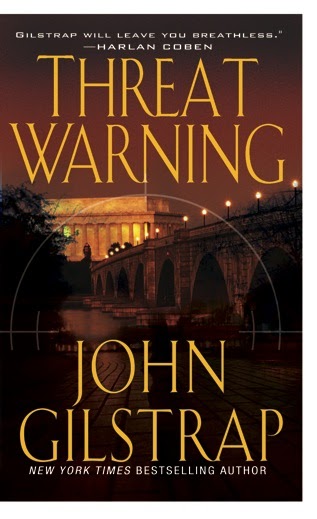
This week, I heard the words that every author lives to hear from his editor: “I love it!”  This in response to reading my new entry in the Jonathan Grave series, to be published next July.  The title is Threat Warning, and the opening scene features two young people opening fire on gridlocked traffic on the Woodrow Wilson Bridge, one of only two Beltway Bridges over the Potomac River.  When the shooting is over and the panic is building, one of the shooters carjacks a mother and her son, launching a series of events that prompt Jonathan Grave to implement his very special skills.
Previously, there’s been a considerable delay between manuscript submission and cover design, but this one came faster than most.  The picture above is the concept they sent to me.  What do you think?
My only concern at first glance is that the picture is not of the Woodrow Wilson Bridge, but rather of the Memorial Bridge.  Of course, at the time when people are responding to the cover and picking the book up off the rack, they won’t know the significance of that.
Share your thoughts, and please be honest: Would this cover jump out at you from a rack at the store?

Bookstores: An Endangered Species

John Ramsey Miller

About a year ago a couple opened a bookstore in Locust, NC, a picturesque small town a few miles from here. They were personable, energetic and did most everything the right way. They had an accessible and central location in the downtown, put out word to area readers, contacted authors and advertised signings, kept up by newsletter with their readers and customers, hosted a book club, had author events by the score, and generally gave it their all. I had asked them to sell my books at a fund-raising event for the supporters and alumni at a local University, and they readily agreed. Yesterday I received an e-mail that, since they were closing immediately and selling out their stock the next day, so they would not be able to sell my books at the event. They apologized for any inconvenience and I sent a note of understanding and condolence. The only thing they did wrong was to open a bookstore in a disastrous environment.

We write here often about the troubles and the demise of small independent bookstores. Every author has seen their favorite booksellers fail as the mega sellers rose and ate them one by one. When the ARC for my first book, THE LAST FAMILY, was sent out, John Barringer owned The Little Professor in Charlotte. He liked it enough that he sent out a personal letter to all of the Independent Booksellers on his list. At that time he was the president of the League of Independent Booksellers of the Planet Earth, or something like that, and he sent hundreds of letters of recommendation to booksellers on his list. Nobody asked him to or paid him to do it, and at that time he didn’t know I wrote that book while I was living around the corner from his store and was a customer at that time. I’d never spoken to him, but I used our common zip code in the book, which he caught. He tracked me down through the publisher and called me to praise my work and to set up a signing. He and his staff hand sold a good three hundred of my books in his store and God knows how many through his recommendation letter. A few years back John sold the store and retired due to health issues. The store is still going strong and changed its name to Park Road Books (still a Little Professor franchise). They remain in business because they have a history of excellence, a great atmosphere, the staff works hard, they hand sell, and they have a fairly loyal customer base (that in itself is a rarity). I have never done a signing in an independent book store without buying books from them to show my appreciation in a meaningful way. And I’ve never asked for a discount.

Now the e-book is an additional (and serious) threat to booksellers––even the big chains. I suppose they will have to find a way to get in on that market or more will fail. I’m not sure how that would work since the publishers can do that themselves without any second party being necessary for distribution. I love my Kindle, and although I love browsing in book stores, I am now ordering books in electronic streams. I will say that there are some books that will never work as ebooks on Kindles––most notably books for children (Golden Books) and art books. Of course I may well be proved wrong

Big box stores are sterile and I get the feeling that the younger staff members are working for the money and I doubt most of them are even readers, much less book lovers. Forget hand selling. The majority of staff at some stores are just clerks standing at registers and would be equally at home there, in supermarkets or in bait shops. A real shame. Independents would never put up with that.

Most of us authors (especially the older ones) have had great experiences signing in amazing stores. We all have our favorite bookstores. Aside from the Little Professor in Charlotte, my best signing experiences were at Square Books in Oxford, MS and Lemuria in Jackson, MS.

Bad Guy Boot Camp

By John Gilstrap
Good morning, everyone. Welcome to Bad Guy Boot Camp. Please take your seats so we can get started. Yes, it’s good to see you, too, Dr. Lecter. What’s that? Oh, no thanks. While your snack looks delicious, I’m still full from breakfast.

Um, Mr. Morgan? Dexter? Please don’t sit so close to Dr. Lecter. Okay, I’m pleased that you’d like to get to know him better, but you can do that after the session. The lounge downstairs has a very nice wine list. I recommend the Chianti.

Let’s get right to it, shall we? I think I speak for all of us when I say that I’m sick and tired of the good guys getting all the credit in fiction. Without us, all those stories would be pretty darned boring and I think that . . .

Um, Mr. Dolarhyde, please turn off the camera. We don’t allow filming of these sessions, and I believe you know why. Thank you.

As I was saying, I think it’s about time that we started taking more pride in our work. For me, it’s about craftsmanship and respect. For example—and please take no offense—several of you were taken down by a quadriplegic detective. I mean, really. That’s embarrassing. Yes, we all know that it’s the hot chick doing all the leg work (no pun intended), but the quad is the headline, and that makes us all look bad.

Let’s start at the beginning. If you’re going to be a bad guy, be a freaking bad guy. Do your crimes, get them over with, and quit making it so easy for the good guys. If we frustrate those detectives enough, they’ll quit being so glib.

Let’s start with you serial killers. I know you’re crazy and all, but try to stay focused on the goal here: sexual gratification through unspeakable mutilation. Everything else is secondary. You’ve got to quit it with the notes and clues. I know that for some of you, the creative process requires spewing DNA, and I suppose you gotta do what you gotta do, but how about leaving that as your only direct pathway to arrest? It’s about risk management. In a perfect world, you should keep all your body juices to yourself, but for heaven’s sake, do without the notes and the videos.

And here’s a suggestion for everyone: Stay out of Miami, Vegas and New York. They’ve got CSI teams there that are unlike any I’ve ever seen. As some of you know all too well, they’ve got a hundred percent catch ratio, and the average time from incident to arrest is only an hour. Really, an hour. I recommend keeping to the heartland, where all the local police are incompetent and depend exclusively on the FBI or on passing private investigators to get anything done.

Any questions? Okay, great.

Let’s move on to marksmanship and gunplay. Folks, as a group, we really need to sign up for some NRA courses to learn how to shoot. I notice a trend developing in which you’re very accurate at the beginning of your crime spree, but then something happens once the star sleuths get involved. Folks, you’ve got to settle down and shoot straight. When you whiff the shot and hit within inches of your target—and we do that a lot—we end up alerting the good guys to our presence, and we lose our advantage.

Look, the odds are already stacked against us as it is. The good guys are on the opposite talent trajectory from us. They tend to whiff their shots the first time we run into them, but then get better toward the end of our relationship. Many of them have weapons that never need reloading, cell phones that operate everywhere, all the time, and an uncanny ability to fight on even while critically wounded. We need to close the deal on these folks the first time we see them.

Here’s the key: When in doubt, shoot. If the moment comes when you’re muzzle to muzzle with the good guy, don’t negotiate, shoot. Why do you care if he drops his gun? You’re a bad guy. Act like one. Just pop him. Same goes when you have the good guy captured and immobilized. Why are you tying him up to begin with?

Sorry, Dexter, that doesn’t apply to you, but unlike most of the others in the room, though, you put the ropes and knots to good use. The rest of you use that opportunity to chat. For crying out loud, quit doing that! Let the SOB go to his grave wondering why you’re doing what you’re doing. That can all be part of the torture.

Yes, Dr. Moriarty, you have a question?

Actually, I’m not sure I agree that murders have become less civilized over the years. You should bring that up with Lizzie Borden during her lunchtime keynote this afternoon . . .

Technology and You

Overdrive software ( http://www.overdrive.com/) allows patrons to download ebooks and audio books from their local library. It’s not necessary to own an ebook reader. Anyone can download these files to a computer, smart phone, or Apple device.

I’m happy that my out of print books reissued in ebook format are now available for this market. As for me, all I can do on my cell phone is make calls, send text messages, and go on the Internet for brief intervals. Would I really want to check out a virtual book from the library for 21 days to read on my phone? Would you? And what happens after your three weeks are done— the book vanishes from your device? What if you haven’t finished the story?

An article from the Sun-Sentinel titled “Libraries go high-tech with audio, e-books” by Doreen Christensen says you can read ebook library titles on the Sony and Nook readers and soon on the iPad. Or on your phone, if you have an iPhone, Droid, or Blackberry. This is great for old folks or people who can’t get around, but do they possess these devices? If not, that leaves it up to tech savvy young’uns and middle agers to download ebooks and audio. Young people today are growing up with these devices, but what about the rest of us raised in the day when computers didn’t exist?

In addition to computer classes at our libraries and adult education schools, I think we need to add hands-on workshops on How to Work the various gizmos. Here are some topics I’d suggest:

  • How to Choose a Smart Phone.
  • Which Ebook reader is for you?
  • How to download a pdf file to your Ebook reader.
  • Playing an Audio Book on your Handheld Device.
  • How do you convert your doc format into a readable file that works on your device?
  • What else can you do on your phone besides make a call?
  • What’s an App?
  • I want to check movie listings and order a pizza. How can I do it on my device?
  • How to browse the library shelves from your home office.

We have all these wonderful options now, including borrowing books from the library by a simple download onto our smart phone or ebook reader. But the more technology advances, the more we need someone to demonstrate what we can do with these wondrous devices. What kinds of questions would you want answered?

Must the Desert Be So Dry?

by John Gilstrap

Last weekend, I had the honor of teaching a couple of workshops and delivering the lunchtime keynote address to the League of Utah Writers meeting in Salt Lake City.  It was a terrific conference, I met a lot of great people, and the Wasatch Mountains make for a delightful backdrop.  As a special bonus, I finished the manuscript for Threat Warning (the next Jonathan Grave novel) while I was there.  Can it get any better?

Actually, yes, it can.  I had been to Utah before, but I didn’t remember it being so dry.  Oh, I remember the desert; I just didn’t remember that alcohol was considered a controlled substance.  The full realization didn’t hit me until I attended the Friday night pre-dinner social hour in the lobby and saw that they were serving water.  Really, water.  Not tea, not soda.  Water.  And it smelled kind of bad.

Well, it’s a small conference, I told myself.  Surely there’d be wine with dinner, if only through a cash bar.  They were serving beef tenderloin, after all, and nothing augments the flavor of a nice cut of beef like a good red wine.  Wrong.  In fact, the drink of choice during dinner was . . . wait for it . . . pink lemonade.  I’m not big on lemonade in general, and pinkness somehow makes it worse.  I stuck with the water.  I was tempted to ask for an olive to put in my water glass just so I could pretend, but I ultimately lost my nerve.

I understand that certain religious groups eschew alcohol, and I suppose that if the reception and dinner were held in a church meeting hall, I would have anticipated that there’d be no alcohol served; but this was at a hotel.  It never occurred to me that the Volstead Act still applied in Utah.  Given that I was flying in from Washington, DC, I’m a little shocked that no one thought to mention this one peccadillo of the Utah landscape.

I don’t know why this annoys me so much, but it does.

Here’s another thing that annoys me:

My flight from Washington to Denver en route to Salt Lake City was completely full.  I wasn’t able to upgrade, so I had a window seat in coach, which was perfectly fine until the ENORMOUS middle-seat occupant arrived.  I’m not talking fat here–although he could have lost a few pounds; I’m talking linebacker big, probably six-six, three-twenty.  I’m talking seat-and-a-half big, with beefy arms that expanded way beyond the arm rests on either side.  Because of his girth–and I’m not slamming him for his size here; he is who he is–I had to spend three hours and change crammed between him and a very non-flexible bulkhead.  Our arms were continually pressed against each other, and this guy had the core temperature of a woodstove. 

How is this reasonable?  When the airlines upcharge for everything but the breathing air, how come I have to pay full price for two-thirds of a seat?  Stated differently, with all respect, shouldn’t Gigantor have to pay for two seats?  Yeah, I know it’s not his fault, but it’s not my fault, either.

By the time I finally arrived in Salt Lake City, boy did I need a drink.  (See above.)

Overcoming your greatest weakness as a writer

I’m still feeling a little depressed after reading Clare’s post yesterday about the passing of a great bookseller, David Thompson. I didn’t know David, but just hearing about the loss of someone special in this literary world is enough to let me wallow in a stew of malaise for an entire day.


I quickly journeyed from feeling sad about David to feeling sad about other things in life, including my own shortcomings. As a writer, my current liabilities seem to be a lack of discipline and a firm writing schedule.  I used to write in a heavily regimented way. Two hours every morning before work, come what may, you’d find me at the laptop. I wouldn’t quit until I had a couple of new pages.


Now, I’m not working a full time job, so I should be able to get at least three times as much writing done, right? But does that happen? So far, not so much. Sure, I could blame the fact that I’ve been struggling with some gnarly health issues this summer (and evidently long before that, although undiagnosed). But that’s no excuse.


“Apply glue to butt, sit on chair,” is what my Dad always used to advise when I was facing a school deadline. So now, even though I’m sans deadline,  I think that advice still applies.


At times like this I start browsing around for inspiration, even looking online for  nuggets that will help inspire me. (If nothing else, it lets me burn up the time when I’m Not Writing). I did find a cute video featuring Ray Bradbury discussing the value of writing persistently. He could have been speaking directly to me, Ms NonPersistence. Here’s the video, and then tell us if you will, what is your greatest weakness as a writer–really now, no fibbing! What do you do to combat it?

The People Next Door

Three years ago I decided that I wanted to live where I could breathe more private air so Susie and I bought a place out in the country where life is slower. Our neighbors were standoffish, but after three years we have gotten to know most of them, and our lives are richer for it. As Michelle said in her post, people do not get to know their neighbors like they used to. The fact is, I get to know my neighbors. I always have done. I have had neighbors I cared for less than others, but the idea of living as a stranger in a place and not knowing who I share air with is alien to me. Maybe it’s because I grew up in the south in small towns, or maybe it’s because I’ve always had this curiosity about people and things.

When I was playing census worker a while back, I often asked someone about the people next door to learn that they had no idea who their neighbors were. Even when I lived in large cities I knew who my neighbors were. If you aren’t curious about people and don’t get to know them, how can you write about people?

I got this Kindle 3 and I’ve been reading a lot since. It’s weird at first, but I’ve gotten the hand of it. This week I’m reading Ken Follet’s WORLD WITHOUT END, the follow up to PILLARS OF THE EARTH. Great book. Rich characters. Kenny flat knows people and understands psychology and conflict. You don’t get that way by shutting people out. He was one of the best thriller authors of all time. EYE OF THE NEEDLE was one of my top five all time favorites, and still holds up today.

Do yourself a favor and speak to the people around you. Some of my best friends have been people I’ve lived near. Go out of your way and be a good neighbor and your neighbors will surprise you. Who knows you might just find characters who’ll put your next book over the top.

Faceless Characters

By John Gilstrap

A friend and fan asked me last week what one of my characters looks like. After giving it some thought, I had to admit that I have no idea. In fact, I have only a shady idea of what any of my characters look like. I know how they think and how they feel, and I know how they view the world; but their faces? Not a clue.

My characters are more like well-defined silhouettes for me. They have no faces.

By contrast, I visited a writer’s board a few weeks ago where a writing “expert” went on at length about how to develop physical profiles for your characters, using known actors or your own acquaintances as prototypes. Until that step is completed, this “expert” argued, you can’t have flesh-and-blood characters.

Hmm. Yet another example of how different authors’ processes work, and of how there are no hard and fast rules in any art form.

I wish I could say that my characters are deliberately faceless—part of an intentional statement on my part—but that would be lying. It’s just the way it works for me. Now that I think about it, I don’t notice faces all that much in real life. I’m notorious for failing to recognize people I’ve only recently met. I don’t say this with pride—in fact, it’s embarrassing and arguably hurtful, which is never my intent—but I remember conversations and mannerisms far more readily than I remember faces and names.

In my writing, I’m a limited third-person point of view purist. As the author, I work hard to keep myself out of the story. Every scene I write is filtered through the eyes and personality of the character who’s living it. As such, it’s difficult to make any casual observations about physical attributes. They would seem out of context to me.

As I write this, I am sitting at my desk, wearing blue jeans and a blue and white striped shirt. I have a hairline that doesn’t exist anymore, and I have a graying goatee on my chin. Those are the facts, but none of those would factor into a scene I wrote about a guy writing a blog post at is computer. The POV reality would be the thoughts flowing through the character’s head as he wrote, and, because I’m channeling the characters feelings, I might include something about the temperature of the room or the comfort of his chair. But why would I work in the clothes and the beard? How would that be relevant to his world view? I suppose he could scratch the beard and reveal it that way, but unless it contributed to character or plot, that passage would likely not survive my final edit. My number one rule: Never stop the flow of the story.

In the Jonathan Grave books, we know that Boxers is huge and that Jonathan is wiry because those are observations made about them by other point of view characters. We know that Gail Bonneville is “hot” and that she’s got great legs, because that’s what Jonathan first notices when they meet. And we know that she’s got beautiful eyes. But a face? Nope. At least not on the page.

Yet I hear from people all the time who are ready to cast the movie version of the books. (No, no such movies are in the works. Dammit.) Readers assign their own faces to characters as they read. Given the knowledge of beautiful eyes and great legs, readers can plug images from their own passions, whether it’s their current squeeze, or a favorite movie star.

This is a good thing. If one person is seeing Matt Damon in their head when they’re reading about Jonathan Grave, and another is seeing Clark Gable in his prime, does that mean I’m not doing my job as a writer? Or does it mean that I’m enhancing the imaginative potential of the story?

I’m probably not the best judge for such things, but here’s the God’s honest truth: No matter how you describe your characters in your story, the effort is going to be wasted on me because faces aren’t important. What’s important to me is the character’s heart and soul. Sell me on those, and I’ll hang on your every word.

Big IS better

I recently began reviewing books for a network of book review sites (under a pseudonym, so don’t look for any critique-bouquets or brickbats from me online), and it’s been an interesting experience. Most of the books I’ve reviewed so far have been readable, well written, and fairly interesting. (Except the historical romances. I told the editors to spare me any more bodice rippers. Can’t stand ’em.) But overall I’d have to say the books I’ve reviewed so far are simply…ho hum. With few exceptions, I’d never spend my own money to buy another book by these authors. The experience has made me wonder: What is it exactly that makes a compelling story?  Why are the books I’ve been reviewing not living up to that standard? The answer, I’ve decided, is that they’re not big enough. The stories lack the “hugeness” that is necessary to make a story into a must-read novel.

What do I mean by “big”? Think of Jurassic Park: A brilliant man figures out how to bring dinosaurs back to life. Or Jaws: A monster shark terrorizes a vacation retreat. Or The Exorcist: A priest who is having a crisis of faith has to battle the devil itself for the soul of a little girl.


Small-scale family dramas can be big as well as super-sized stories. Think of The Bridges of Madison County (don’t groan–it sold 12 million copies). As long as the emotional stakes are huge, any type of drama, large scale or small, can be “big.”


Do you agree that being big is important to the success of a story? What are some of the “biggest” stories you’ve loved?