
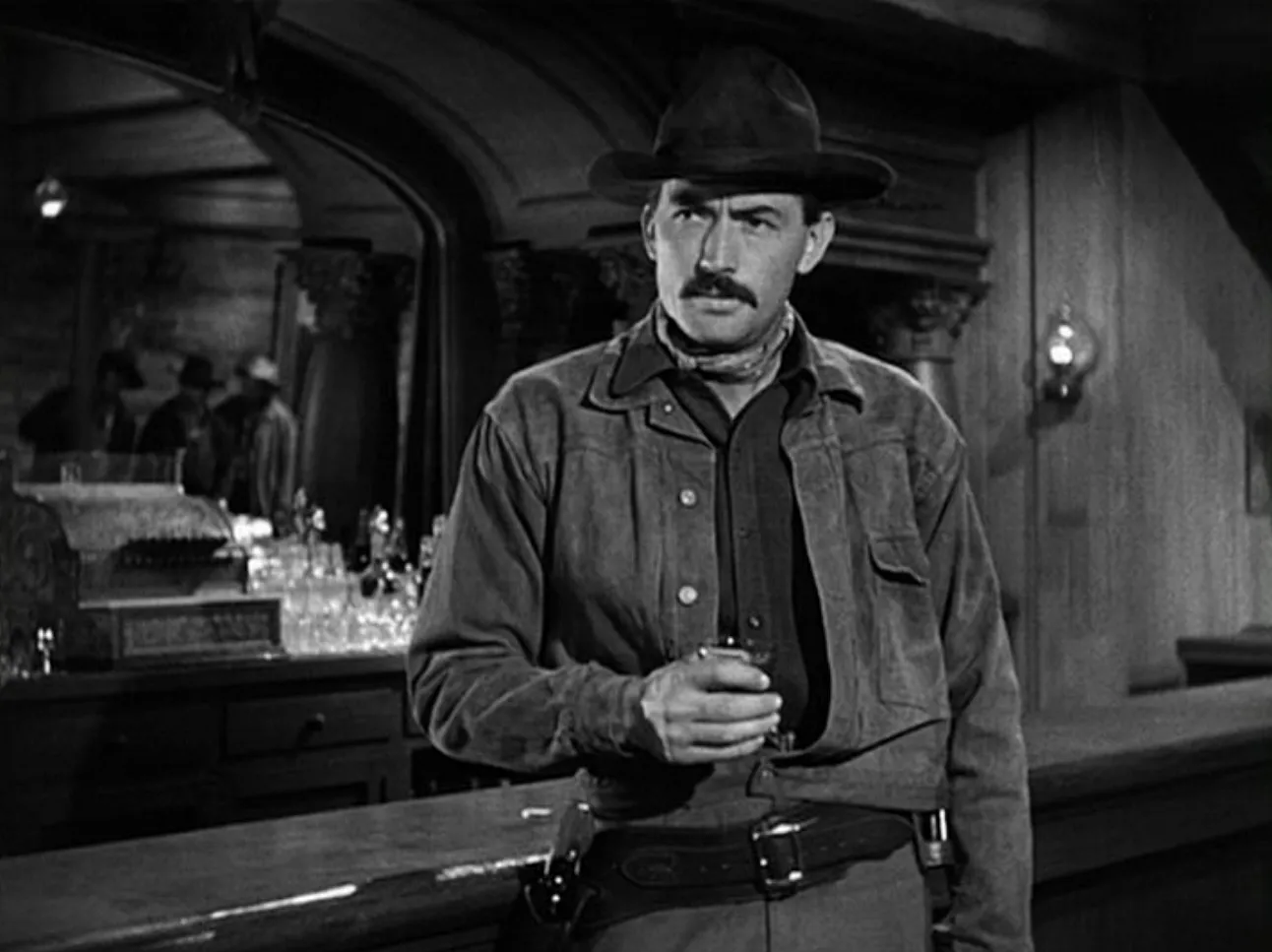
Gregory Peck in The Gunfighter (1950)
Gregory Peck is one of my favorite actors. Most know him for his immortal portrayal of Atticus Finch in To Kill a Mockingbird. But he turned in many brilliant performances over his long career, sometimes unappreciated because his acting was subtle and low key. (If you want to sample Peck’s acting chops, two of my favorite performances are in The Gunfighter and The Big Country.)
Once, Peck was standing in line with a friend, waiting for a table in a crowded Los Angeles restaurant. They’d been waiting for some time, the diners seemed to be taking their time eating, and new tables weren’t opening up. Peck’s impatient friend said, “Why don’t you tell the maitre d’ who you are?” Peck said, “No. If you have to tell them who you are, then you aren’t.”
Reminds me of the old saying: “Be who you is, ‘cause if you ain’t who you is, you is who you ain’t.”
Which brings me to you, fellow writer. There are three “selves” we spin like plates.
First is the self presented in the writing. The major aspect of this is voice, often talked about but rarely defined. (Someone wrote a book about it). Voice is at the center of the whole AI debate. If you use AI’s words, you ain’t you who is.
By the way, you may have read that Anthropic’s Claude is now adding “watermarks” to generated text (and text that has been edited with it). That invisible coding stays with the output when it’s copied and pasted into a document. This has teed off a large number of Claude users who’ve canceled their accounts. But other models will probably follow suit. The way to avoid this detection is to write your own words. Shocker!
The second self is your public profile and social media presence. Choose wisely how you go about it. I try to follow Ben Franklin’s admonition: “Speak not but what may benefit others or yourself; avoid trifling conversation” (and, I would add, ranting and raving. That never brings in new fans, but it does alienate a segment of your current and potential readership. Up to you whether you want more readers or fewer).
Also be wise about how much time you spend on social media as a marketing tool. Don’t make the mistake of thinking social media is a great way to sell books. It never has been. Recently, a trad-pubbed author dropped $10,000 on a “TikTok influencer campaign.” Result? Three (3) sales. “It just doesn’t convert,” says the author. “Views are not sales. People watch a 40-second video about your book the same way they watch a video about a raccoon eating grapes: entertained, moved even, and then they keep scrolling.”
The last self is who you are in private, with friends and family. This is the place to “let your hair down” (obviously just an analogy for some of us). You get your support here, your solace, and sometimes a needed kick in the pants. But it’s all done “behind closed doors,” which is a good place to keep it. Guard your writing time, but don’t hoard it. Be present with people, knowing that your writer mind will always have a little wander in it. Many a time Mrs. B has said something like, “Jim? Jim, are you listening to me?” And I’ve thought, That’s an odd way to start a conversation.
If I may paraphrase Polonius: “To thine own selves be true, give each due consideration, and it must follow, as the night the day, thou canst not then be a phony baloney to the reading public.”
What about you? Have you given much thought to your own three “selves”? Any other advice or warnings to offer?
<!– wp:social-links –><ul class=”wp-block-social-links”><!– wp:social-link {“url”:”https://gravatar.com/jsb54″,”service”:”gravatar”,”rel”:”me”} /–></ul><!– /wp:social-links –>
Sad to say, some writers claim AI is a tool that writers should learn to use, and if they don’t, they’re Luddites. Research is one thing, but to copy, paste, and submit is another. I cannot understand how anyone could present the work of others as one’s own.
The lure of easy money. That’s not good for the soul. See 1 Tim. 6:10.
Copy, paste, and submit’ is not creativity. It is simply plagiarism of an AI that cannot complain.
Using AI as a patient and unbiased idea partner is different. A back‑and‑forth with something that never gets tired can push your thinking into variations and angles you might not reach on your own.
In Terminator 2, Sarah Connor realizes something about the machine: ‘It would never leave him. It would always be there.’
That line resonates with me. When circumstances begin to shrink your world, and the people who once shared it are no longer present, having an alternative, even an AI that never gets tired and never loses patience, can help keep your mind engaged and your ideas moving.
Yes, there’s a clear line between text generation and brainstorming.
I have no words of wisdom, but when I look at these 3 selves, as difficult as writing may be at times, establishing your voice is much easier than the 2nd self world of social media platforms. Finding time for that and making those decisions about which social media to invest your time etc. is daunting.
Basically you have to be a professional Juggler to balance them all. (I better not practice with eggs. It wouldn’t end well.)
Today I’m celebrating the fact that I wrote over 3000 words last week – a recent record for me! And I finally had a bit of a breakthrough regarding some aspects of the story I was stuck on. And I don’t think it’s any coincidence that the breakthrough occurred while scribbling longhand. Very beneficial, as we’ve discussed here before.
Have a wonderful, restful day all.
Thanks for mentioning longhand, BK. That’s a time-honored way of getting at the “good stuff.” Congrats on the 3k! That’s something to celebrate.
Jim, Voice is one of my favorite books. I often recommend it to other writers.
“If you use AI’s words, you ain’t you who is.” I couldn’t agree more!
I’ll add to the writer’s self that we often inhabit our characters and at times even become them.
When we’re inside a character, that leads to three additional faces they have: public, private (with close friends and family), and the secret face when they’re completely alone and no one can see/hear them.
Excellent point, Debbie. Living “inside” our characters is one of the great skills of a writer. Even a clunky one! That’s why Theodore Dreiser was a writer of innate genius, even though his style is often ham fisted. AI can produce competence, but not depth.
Great post, Jim. Voice is unique to each of us, and there’s only one way to express yours in all its idiosyncratic, individual glory as a writer, by actually writing. Prompting an LLM to generate a book shaped object will not get your voice on the page, and will not help you connect with readers via your voice. Our unique writer voice is one of the gifts we were given. Please use it by actually writing.
Know thyself while you be true to that self. Being kind and having grace and giving grace to others will help you be the best version of that self, both in public and in private.
Right on, Dale. May kindness make a comeback!
It’s taken me a while to see that I do have a voice as a writer. A certain “thing” that shows me as me. Social media is a whole other issue. I’ve cut way back as far as my “image,” and stay mostly on my personal page on FB. Even there, not so much of anything. It doesn’t bring me joy. Which takes me to the 3rd self you’ve written about. I want my family, and my friends, to be the most important thing in my life outside of God. It is a hard balance at times.
Good on you, Jen. That’s well stated. Not an easy balance, as you say, but well worth the pursuit.
I’d say it’s important to remember that social media should be SOCIAL media. Engage, don’t blatantly sell.
Yep.
The other day, I was trying to remember when it was exactly that I realized I was going to retire from the fulltime writing fiction gig. I couldn’t pinpoint it but I do recall the year when my editors starting bugging me to create a bigger online profile. That I had to blog. That I had to post book trailers (remember those! Ha!) That I had to start cultivating important connections with Twitter-ers. I sensed then that the end was coming. I just couldn’t do it. And you know, as you point out from the poor TikTok soul who lost 10 grand, none of it was going to sell books. Only continually producing good stories was the path. I am not so sure even this is true anymore, because the publishing system that was in place in my halcyon days is gone. No regrets. I had a great run. And self pubbing has since been a way to keep my dog in kibbles and my backlist kicking.
Publishers are primarily, almost exclusively, about making money. It costs them nothing to push their authors to get more involved on social media, in the hopes that this will bring in more revenue. It doesn’t.
I read the article you linked to and ten thousand was a drop in the bucket of what that author spent and mostly regretted.
I’m not on social media much, mostly FB to see what my friends and family are up to but now I only get ads for some product my phone heard me mention. I blog twice a week on my blog and twice a month on this blog and the Suspense Sisters and enjoy engaging with my readers. If I stop enjoying it, I’ll quit.
Ha! You’re right about those ads, Pat. The machine is listening.
My advice on social media has always been find one or two that you enjoy, and forget the rest.
I’m the little side voice of chronic illness that reminds people not everyone is currently or permanently able-bodied – and it’s something many of us have to struggle with, and it always affects our character and our goals and our methods.
That’s not a bad thing to be reminded of!
I think it adds depth to everything in a story when we don’t ignore the 20% of ill or disabled readers when creating our own characters, and choosing themes.
Yes, it makes stories more complicated – the daily life of people with challenges means many things are harder to do – but it also makes them more real, more human, more relatable than the sometimes unrealistic characters in stories with few or mostly decorative challenges.
It makes the stories harder to write, more apt to take an odd turn – and unique for the right reader. It can educate and create empathy in readers, or it can show that even characters who are ill or disabled are definitely worth reading about.