
by Debbie Burke
Paul Simon’s song “50 Ways to Leave Your Lover” includes the line: “I hope my meaning won’t be lost or misconstrued.”
Recently I learned an important lesson about the ways that meaning can be lost or misconstrued.
On Substack I’ve been posting notes, warning about various AI-driven scams used to victimize writers. Impersonation scams are immensely popular.
My latest note read:
James Patterson wants me to cowrite with him.
Oprah, Drew Barrymore, and Jenna Bush Hagar are vying to interview me for their book clubs.
James Cameron thinks my series would be perfect for Netflix.
Tip #6: Beware of impersonation scams. AI scammers pretend to be famous authors, celebrity influencers, and movie moguls.
If these emails really came from wealthy, successful people, why should they ask poverty-stricken writers for $$$???
Later that evening, I received a message from a longtime fan. She congratulated me and said how excited she was for me, cowriting with James Patterson and being interviewed by important celebrities.
Aaargh!
That was certainly not the message I meant to convey. I felt terrible, as if I’d misled her.
She’s in a Zumba group where many members read my books and are wonderfully supportive. Knowing what a sweet, generous lady she is, I was worried she would share my “good news” on social media. Then she’d be embarrassed when she learned she was unintentionally spreading misinformation.
Right away, I wrote her back, apologized, and explained these were scams that specifically target writers. Since she’s not a writer, she wouldn’t necessarily be aware of them.
Fortunately, the next day we saw each other at Zumba. That’s when I learned the actual reason behind her misunderstanding.
Her watch had dinged with a notification, and she read my note on the small screen of her watch.
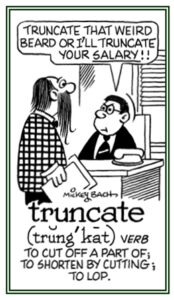
But…the note had been truncated.
Definition from dictionary.cambridge.org
truncated
adjective
made briefer or shorter, usually by removing a part:
The truncated article fit into the space allowed but made little sense.
Only the first part of my note showed on the limited space of her watch screen. The explanation about scams had been cut off.
Whoops! No wonder she came to the wrong conclusion.
We shared a good laugh, but it made me realize that people don’t always read on a full-sized screen.
Since my vision isn’t good, I read almost exclusively on my laptop where I can increase font size.
However, more and more people now read on phones and watches where messages are often truncated.
You can write a note, email, or tweet that’s perfectly explanatory and clear, but you can’t control how the message appears on the recipient’s end. They may only see a small part of it. Important information later in the message won’t necessarily show up.
This lesson taught me that current technology offers even more ways for meanings to be lost or misconstrued.
Throughout history, lost or misconstrued messages have had serious consequences, causing crises and wars. Here are a few examples.
On the positive side, misinterpretations like these can be transformed into inciting incidents for fictional plots.
But in real life, what’s a writer to do if their message is cut short?
I don’t know.
My only solution for now is to be more mindful of truncation when I write headlines and lead sentences.
Maybe smart TKZers can offer better ideas to avoid the problem. Please post in the comments.
Have you received truncated messages that led to wrong interpretations?
Have you sent messages that were misunderstood by recipients?
Consequence (good or bad)?
***

No misunderstanding about this: Instrument of the Devil is FREE for a limited time. In addition, the rest of the Tawny Lindholm Thriller series is discounted. Fill your e-reader with binge-worthy bargains while they last.