
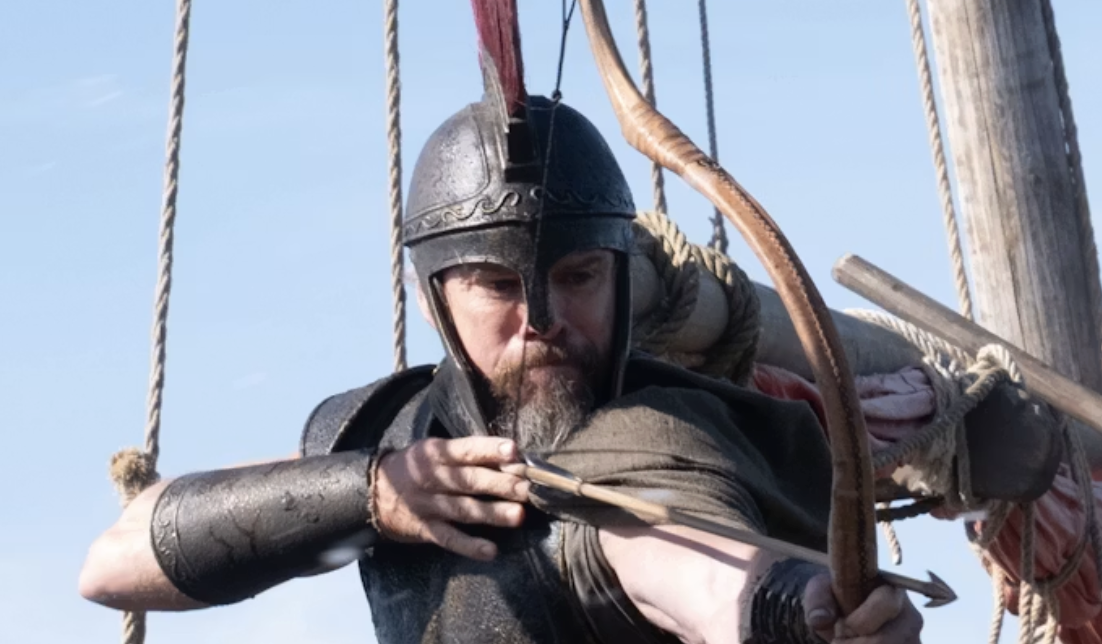
 Entertainment news this week has been dominated by the blockbuster success of Christopher Nolan’s The Odyssey. “Boffo BO,” as industry wags put it (also Matt Damon’s costumer).
Of course, it has generated some online heat, because what doesn’t these days? But there is also substantive discussion among Classics scholars, some of whom say that whatever the movie’s merits, it’s not Homer. (Reminds me of the line from a college essay years ago: “The Odyssey was not actually written by Homer, but by another man of the same name.”) Others have no problem with a “re-imagining” of an ancient epic.
I have no opinion either way, for I have not seen it. But I do extend a laurel and hearty handshake to Nolan for a couple of reasons. This is the first feature film shot entirely with IMAX cameras. IMAX is almost always used for loud set pieces, because the cameras themselves make a lot of noise. They are not good for quiet, intimate scenes.
But Nolan, working with his cinematographer Hoyte van Hoytema, designed a soundproof housing, called a “blimp,” to cover the camera. It suppressed the noise and allowed them to film soft exchanges.
But that created another problem. The blimp casing was so large that two actors couldn’t look at each other eye to eye, which is essential for emotional connection. So Nolan came up with the idea of using mirrors to let the actors see each other’s faces. Love it.
What I appreciate most is that Nolan eschewed all AI (and most CGI) in order to capture the traditional look of classic “cast of thousands” movies. That’s worth championing. Nolan believes, and the anecdotal evidence suggests, that young audiences are quick to reject AI slop. He says:
“They [Gen Z] see it for what it is very quickly – and it’s much easier for them to identify it, because it grew out of an online world they know really well,” he explained. “And while that doesn’t mean that every aspect of the technology is useless or meaningless, in filmmaking it’s hitting at exactly the wrong time. After years of driving towards heavily virtual environments, we’re seeing a renewed interest in more tactile, more real forms of storytelling.”
I think what Nolan says applies to AI-slop books. Yes, they can be churned out, but readers are rejecting them. There are a millions of slop books on Amazon with zero reviews. Because they suck. Oh, they’re made out of competent sentences, because that’s what LLMs do. But they’re missing a human soul. It’s just so obvious. For want of a better phrase, they “ring hollow.”
Here’s the opening of a slop novel on sale now:
The city doesn’t sleep. It just changes tempo.
You learn that if you stay up late enough.
There’s a moment—somewhere between two and three in the morning—when the traffic thins, when the noise drops from a constant roar to something more honest. Tires on wet asphalt. A distant shout that might be laughter or might not. The hum of streetlights that have been buzzing longer than anyone remembers.
That’s when I work.
 That third paragraph is a hoot. What’s dishonest about a constant roar? Is it hiding something? How are tires on wet asphalt more honest than tires on dry asphalt? In what language is a shout the same as laughter? When was the last time you heard a streetlight buzz? How about never?
What’s happened here is an AI word salad, only it’s made out of the poop lettuce that’s been in the news of late. This is why people churning out 300 “novels” a year are just wasting their time on earth. Maybe some of them make a little Starbucks money, but what kind of existence is that?
My conclusion is that we who actually write (not prompt) fiction don’t have to fear the tsunami of manure being shoveled up to Amazon on a daily basis. That stuff goes nowhere. Write with your soul and that alone will set you apart from the stink pile.
Your comments are most welcome.
Thank you! So refreshing to hear that AI slop will never take the place of in your face, made me cry, fiction.
👍
Good on you, Mr. Bell. Amen.
Thanks, Steven.
Double amen…although I have head a street light buzz…usually right before it goes out. 😊
I believe the bot was actually “thinking” about neon signs.
I enjoy your books very much,
The stories make sense and are written with heart, not an AI forrmula.
Keep the pen moving.
Thank you for the good word!
Thank you, James, for calling it like you see it. We writers have nothing to fear from the manure that so-called writers try to pass off as great fiction. Shame on them.
Let’s keep the faith!
I’ve been using Claude for some research, and it always asks if I want it to draft a scene based on what it’s told me.
Hard No on that one.
Interesting side note. AI bots can’t generate a picture of a full-to-the-brim glass of wine because they’ve never seen one.
But a person filled to the brim with wine, that it can do.
Thanks so much for today’s inspiring post, Jim. You’re right, we actual writers have nothing to fear from so-called A.I.
Fiction is about the human experience: what we feel, think, desire, loath, fear, need, and much much more. So-called AI knows none of that. Fiction is also about the human connection between writer and reader through story, which AI can’t forge, only mimic.
I have to believe it will always be limited to mimicry. Therein lies our strength.
Ahhh…a breath of human air, Jim! Thanks…
And just sayin’, “The city doesn’t sleep” is such an overused phrase, it’s got mold on it. I wouldn’t read any further than that.
Apps, bots, drones, yada yada yada. Give me a view of the pine trees out in my yard…and silence.
🤗🤗🤗
Good catch on the cliche, Deb. Sinatra sang that already.
I haven’t been to a movie in an actual theater in years but I want to see Christopher Nolan’s film just to support him. Real actors, real action.
There were lousy human-written books before AI that I didn’t read. There are lousy AI-written books now that I won’t read either.
All the books I’ve written were created in my flawed, idiosyncratic, imaginative, and real human brain. I plan to keep doing that.
It’s best for our brain, too, Debbie. Keep it supple, fresh, crazily human!
Ugh. Slop is right. And how/why did the asphalt suddenly turn “wet.”
Bots have their own internal “logic.” Aristotle wouldn’t recognize it.
Could I ask for clarification–I’ve been wondering about the movie business and technology impact on the industry but I’m clueless about how the movie business works.
In your post, you mention: “What I appreciate most is that Nolan eschewed all AI (and most CGI) in order to capture the traditional look of classic “cast of thousands” movies.
Does that mean that while they aren’t necessarily hiring a huge number of extras, they are using real live people but supplementing with the CGI?
He did use hundreds of extras in the large scenes. Old school, just like David Lean, one of my favorite directors. CGI was used minimally for some filling in, from what I understand.
I began reading your book, “The Last 50 Pages,” last night. Wow! (That’s my one allowed exclamation point.) It, plus this post, will help keep me on the right track with what I write. AI has its uses, but its not in writing a book.
Thanks so much, Jen!
I get a newsletter from Andrew Price, a Blender (3D software) guru who offers highly rated tutorials on YouTube. In his latest newsletter, he pointed to someone (I don’t have the mail now) well known in the 3D art world who had AI create a 30 minute fiction movie. Price described the storyline as holding his interest, the dialogue as good, but the AI generated characters had no body language that matched the emotions in the plot or dialogue. Price thought the movie was dreadful and a good example of what’s wrong with AI. It’s the same problem AI books have–no ability to get emotion across in a believable way.
Great data point!
A laurel and hearty handshake…
How much longer before Rockridge slips into the ether…
😔
Glad somebody got it!
Okay…I didn’t get it. Please explain.
🤓
“What’s happened here is an AI word salad” – made up of iceberg lettuce words – crunchy, but low in nutritional value for the brain. 🙂
I haven’t seen The Odyssey, but I admire Nolan’s decision to skip the AI convenience.
Agree, Kay.
That AI dreck is dangerous because it prevents discoverability of the good stuff. Unless someone is searching specifically for you, they will never find you. Established writers will be found. Newer writers will not.
On the good side of AI, there’s a new group of memes about how Samuel L Jackson makes everything better. He’s currently killing it as Helen of Troy pointing out the Trojan Horse is full of Greeks and giving Achilles heck from Troy’s walls. Do a search for “Samuel L Jackson as Helen of Troy” on YouTube.
Discoverability has always been a challenge for new writers. The essential starting point is a good (human) book.