
by James Scott Bell
@jamesscottbell
Memorial Day Weekend. Across this land of ours, barbecues will be firing, grill masters will be grilling, hot dogs and hamburgers will be sizzling, beers will be pouring, flags will be waving, and kids will be playing. I do hope that some of that time will be used to educate our young charges about the meaning of Memorial Day.
Its roots go back to the Civil War, when people honored the dead by decorating their graves with flowers and wreaths. After the war, by proclamation, May 30 was selected as “Decoration Day.” By the end of the 19th century it was also being referred to as Memorial Day. Congress adopted that latter designation and made the last Monday in May the official holiday.
I get choked up about heroic deeds in time of war. The earliest Bell ancestor on these shores was William Bell, born in County Armagh, Ireland. He came to America in the 1760s and settled in Philadelphia, opening a tailor shop. During the Revolutionary War, when Washington’s army was holed up in Valley Forge, William made an officer’s uniform for his brother, John, who was serving with Washington.
But there was a problem. Philadelphia was under British control, with sentinels carefully guarding ingress and egress. This made it almost impossible to get food or clothing to Valley Forge, some thirty miles away.
John Bell’s wife took care of the problem.
As William worked on the clothing, John’s wife established herself as a woman going about her daily business. Dressed in sunbonnet and shawl, she would walk by the British sentinel, carrying basket of sundries, and return with groceries and other good. When the uniform was finished, she sewed it between her skirts and petticoats. She passed by with her basket once again, without incident, just like it was another day. Only this time she kept on going, walking the thirty miles to Valley Forge, to deliver food and the uniform to her husband.
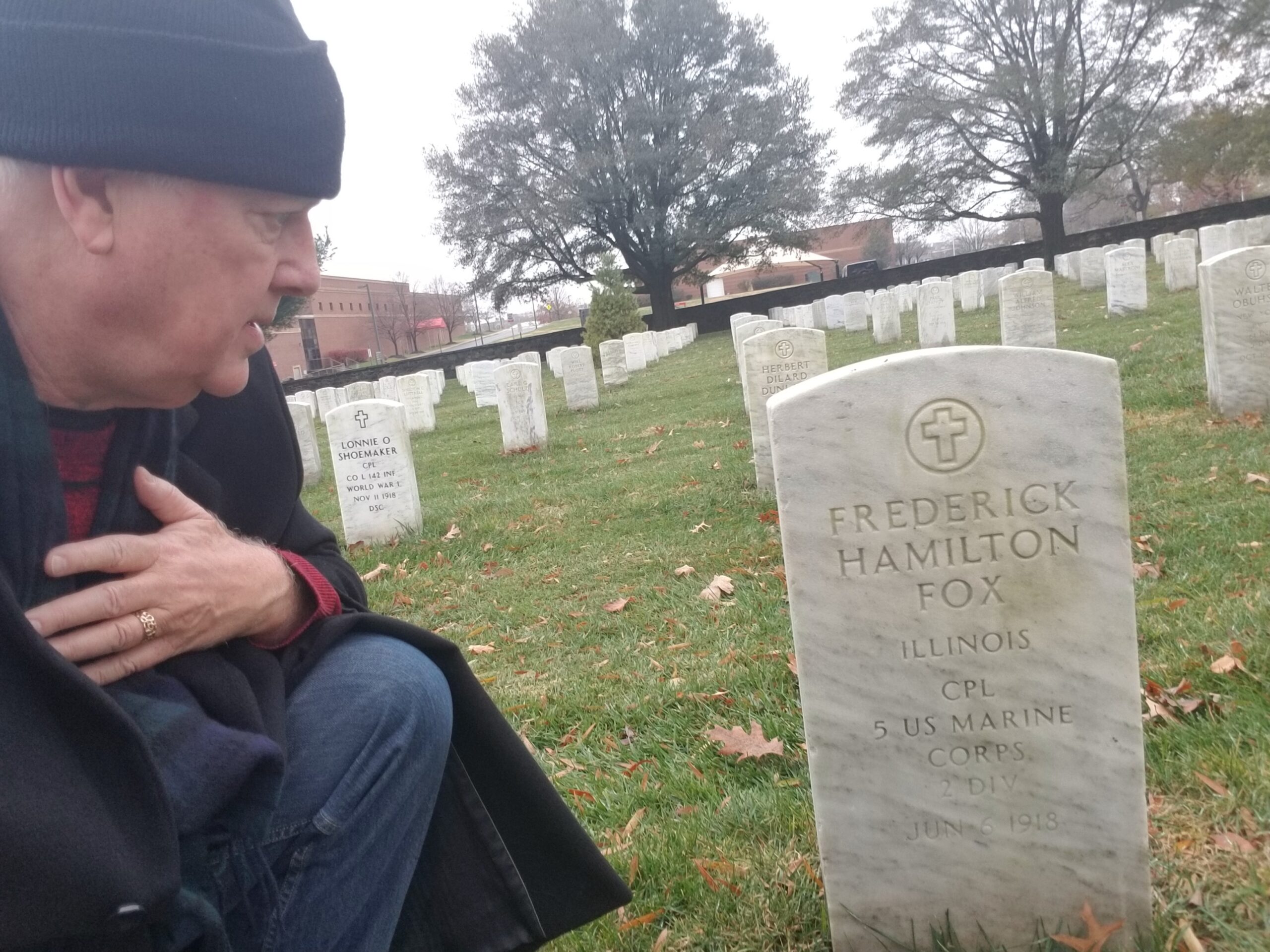
My great-great grandfather, James Winfield Scott, fought under Sherman during the Civil War. My grandfather, Arthur Scott Bell, was in the Army in World War I. His brother-in-law, my great uncle Frederick Hamilton Fox, was a Marine. He died in the Battle of Belleau Wood, and is buried at Arlington National Cemetery.
The book I’m proudest of (because it is the longest book I ever wrote and required the most work) is Glimpses of Paradise. It begins in 1916 Nebraska and ends in 1920s Hollywood. In between is a World War I sequence.
But I’ve never been in battle. Which raises a natural question: how do you write about experiences you’ve never had? Here’s what I did:
- Extensive reading. I found some books deep inside the downtown branch of the Los Angeles Public Library that were priceless, first-hand accounts of World War I battles. I also spent hours in the microfiche room, going through newspaper accounts of same.
- I connected my emotions. I believe that if we’ve made it past forty or so in this life, we’ve experienced every emotion there is to a greater or lesser degree. While I have never felt the fear that a soldier feels on the eve of battle, I have felt the fear of dying. The same physiological response is there, and by extrapolation I brought it to the characters in the book.
- I looked at a lot of pictures of battlefields, soldiers, weapons and so on. I wanted to be soaked in them, so I could write with a “lived” feeling.
- I had an expert review it. I showed the battle pages to someone who knows warfare, and got some notes for changes.
I believe a writer should be free to write about any kind of character or experience, so long as they make the effort to get things right. What about you?
Absolutely. If I confined my writing to my own direct experience my books would all be classified as sleep therapy because they would put people to sleep in a heartbeat (but at least I’d be able to cure insomnia for most people). I HAVE to write about experiences outside my own life. LOL!
And that’s what draws me to write. For decades I wish I’d grown up in the mid-1800’s in the American West when we were a developing nation. And I love history so that’s the fun part of it–doing all that research.
And then today, while brainstorming one story set in 1917, out of nowhere, an idea popped into my head about a modern day story (which I typically shy away from). I’d been thinking of a particular health care profession and wondering “What would it be like for someone in that healthcare profession to solve a mystery?” Again, it will require considerable digging and research, but I’m going to at least explore it and see if its a worthy possibilty.
Getting outside my own limited box and exploring other things is exciting. On the other hand, I can freeze up because I’m always afraid that despite my diligence, I’ll screw up a detail that someone will roast me for. But live and learn.
As to Memorial Day, I’m extremely thankful for those who have served, and humbled by all the sacrifices that have been made over time. Whether those who paid the ultimate sacrifice or those who served and thankfully came home. Though on Memorial Day I always have mixed emotions—we all typically offer well wishes to fellow employees or people when a long weekend is coming up, since most people get a 3-day weekend out of it. But then it feels odd to wish a great weekend when it’s really all about those sacrifices our people in uniform made.
I echo your sentiment–while we have this time at barbecues or whatever we do over the weekend, that we don’t forget what it’s all about. Freedom comes at a price.
Getting outside my own limited box and exploring other things is exciting. On the other hand, I can freeze up because I’m always afraid that despite my diligence, I’ll screw up a detail that someone will roast me for.
Not an uncommon fear, BK! Especially when it comes to weapons. But if I’ve put in the effort, I just go for it.
It took me a while to realize that “Write what you know” means to write:
• what I’ve experienced,
• what I’ve witnessed in and about others,
• and what I’ve learned through research and general observation.
I, too, have never experienced battle, (nor have I been to New York or New Mexico or Europe, or Vietnam Nam, outer space, the bottom of the ocean, Middle Earth, alive before 1958, or one of the opposite gender – or lost an immediate loved one in battle), and with some notable exceptions, this is true for the vast majority of writers and artists in general… and yet… Asimov, Bradbury, Clarke, Michener, Tolkien, Wouk, our esteemed Mr. Bell, and novelists (and performers/actors and songwriters), without number who deliver works that give pause, bring forth tears of both joy and grief, elicit the “thrill of victory and the agony of defeat,” allow us to feel love and loss vicariously…
Which brings me back to Memorial Day – ancestors and indirect relations, from seaman to admiral, from non-coms around Chancellorsville and at Pearl Harbor… at least one POW, one severely wounded at Gettysburg, one buried in Grenada, another in Atlanta… all have made me grateful for their service and sacrifices – physical and emotional – that allow me to do what I do, and be both who I am and who I am still becoming.
Well said, George.
Many of my family, past & present, have worn a uniform. But I don’t know of any who died wearing it. Those folks are in a class by themselves and have my profound gratitude.
I’m glad you cleared something up for me in this post, Jim. “Write what you know”…for some reason I’ve never of the research angle.
I’m with BK…what I know without a serious effort at research wouldn’t fill a shot glass! 🤓
Happy Sunday!
Write what you need to know, and what you’d like to know….ya know?
🤗🤗🤗
Great post, Jim. Research and a willingness to absorb that research to understand the experience of another. First person accounts can be hugely helpful.
My father and his three brothers all served, each in a different branch of the service. My father service in the USAF during the Korean War while his oldest brother served in the USN in the Pacific during WW2, as a signalman on a large landing craft during the Island hopping campaign.
I like that word, Dale. Absorb. That’s what I try for. When I did the historical series The Trials of Kit Shannon, I was so immersed in the research I actually had waking dreams about walking the streets of 1903 Los Angeles, smelling the smells, hearing the sounds. It was a little freaky, but also wonderful.
Also probably smelly.
My suggestion about research vs. experience is that research can help you write about stuff, but, if your main character is an expert like being a scuba diver and spends most of the novel in the water, but you have no experience, you are more likely to make an idiot of yourself. I did one diving scene in a novel, and no one saw it until I had my brother, a certified diver, vet it.
Yes to the expert vet. I wrote a novel about the Supreme Court, and did a lot of research about the inner workings. I gave the MS to a former clerk for one of the justices, and he said I nailed it. That was a proud moment.
If writers could only write about experiences they’ve actually had and places they’ve actually been there would be whole lot fewer books out there, not to mention movies and tv shows.
Dull books, too.
Last Monday morning, my writer/engineer friend, David A. Kenney, passed on at age 101. He was a WWII vet who served as a radioman with the OSS at Station Victor in the UK and later at Chihkiang, China. The air base at Chihkiang was the objective of the last major Japanese offensive in China, which fell short by less than 60 miles. The outcome was “one of the most important Chinese victories of the war.” (NYT, May 17, 1945)
I met Dave at a workshop in Torrance, CA, in the early 70s. His stories were brightened by his mischievous sense of humor, and his poems often appeared in the Wall Street Journal. I consulted him when writing my WWII thriller. He was one of those who helped make “the Greatest Generation” great.
Almost all gone now. We owe them so much.
I wonder if Mr. Kenney was a member of China Post 1, American Legion, formed in 1948 in Shanghai China.
My dad was a merchant seaman in WWII and I can remember some of the stories he told. And I lost two good friends in Vietnam. I think of them on Memorial Day. Visited the Vietnam Memorial Wall when I was in Washington DC and found their names.
I like to write about things I want to do but probably never will, like rock climbing and being a park ranger.