
OpenStax, CC BY 4.0 <https://creativecommons.org/licenses/by/4.0>, via Wikimedia Commons
by Debbie Burke
We often talk here at TKZ about the importance of reading throughout life.
Reading to young children is well recognized to benefit their early brain development.
Reading instructs us through school. It guides us in our daily lives and careers.
Reading keeps the mind sharp as we age.
I just learned a new reason why reading is important: for hearing.
My good friend Dr. Betty Kuffel is my favorite source for medical knowledge. Her husband has profound hearing loss and hearing aids aren’t helping. He will soon have a surgery for a cochlear implant. Betty described the procedure:
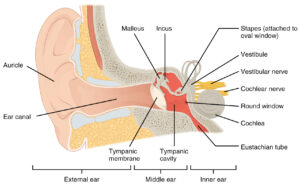
An array of electrodes within a thin wire is threaded through a hole drilled through the outer skull and into the cochlea behind and above the ear. The tiny wire follows inner contours of the cochlea with anatomy resembling a snail shell. It bypasses the damaged area reaching the hearing nerve that carries impulses to the brain. Then the surgeon buzzes out a shallow crater of bone for placement of the magnetized device with a microchip in it. Once secured, the scalp is sutured and after a couple of weeks of healing the device is activated. An external rechargeable sound processor with two microphones is worn behind the ear like a typical hearing aid that connects magnetically to the implant. Amazing technology.
BruceBlaus, CC BY-SA 4.0 <https://creativecommons.org/licenses/by-sa/4.0>, via Wikimedia Commons
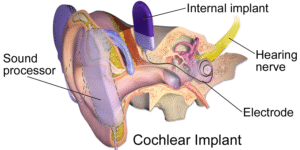
However, the implant isn’t plug and play. The brain has to be retrained to use the device. Instead of the normal neural pathways between the ear (which hears sounds) and the brain (which interprets the meaning and appropriate reaction to those sounds), this rewiring makes new connections.
Here’s the interesting part Betty added:
The training consists of reading aloud as the primary trainer. You see the print, read and the brain processes the visual + verbal input.
In this article, audiologist Grace Sturdivant of the University of Mississippi Medical Center explains two crucial connections between hearing and the brain:
One is called Cross-modal Plasticity. Don’t let that term bog you down – it means that when the area of your brain which is purposed for processing sound (the auditory cortex) is not being stimulated adequately (i.e., when hearing loss is present), a well-functioning system like vision will begin to recruit that area to process its own input.
…the second brain change I’ll discuss is Cortical Resource Reallocation. Even in these mild, sloping hearing loss cases, auditory cortex activity is decreased and frontal lobe activity is increased on listening tasks…The frontal and pre-frontal areas are critical for working memory and executive function. When hearing loss is present and you are straining to hearing and understand someone in a challenging environment, your frontal lobe is loaded down with trying to understand what someone is saying in that moment. We call this “effortful listening.” This leaves less ability for that frontal lobe to help you remember what someone was saying after you walk away from the conversation.
In other words, over time as the ear no longer functions as it’s supposed to, the brain also loses those neural transmission pathways.
Sturdivant expands on the health effects:
…People with severe, untreated hearing loss are five times more likely to develop dementia…adults with untreated hearing loss develop cognitive decline 3.2 years sooner than people with normal hearing; or than people with dementia and severe untreated hearing loss have rates of cognitive decline 30-40% faster than dementia patients with normal hearing.
According to this article from Johns Hopkins Medicine:
Getting used to the cochlear implant takes a while. Eventually, the sound quality will change as the brain learns the stimulation patterns that the device provides. Most patients notice improving sound quality during the first three to 12 months.
This article from Alber Hearing Services outlines some steps in auditory rehabilitation:
Listening to these everyday noises and naming them out loud helps your brain connect the new signals from your implant to what they actually are. Watching TV with captions turned on or following along with lyrics while listening to music can also build stronger connections between sound and meaning.
More rehab techniques from Cochlear Implant Help:
Reading and listening to a fully abridged audio book helps the brain to make the connection between the words heard and words seen. By listening and looking at the words the connection can be made. To make this exercise more challenging, remove the visual and focus on the auditory input. This helps build one’s ability to understand what is being stated.
With sound and visual print correlation, the brain adjusts and soon words are clear and
meaningful. Each person is different but over 80% hearing restoration can be accomplished.
However, the National Institutes of Health reports 29-42% of people with implants express some level of regret.
Of course I’m wishing Betty’s husband an excellent outcome with improved function and no regrets.
I have some hearing loss, but the body adapts in amazing ways. Without being conscious of it, I’ve developed a little skill in lip reading.
Also, for about a year, I’ve been turning on closed captioning for TV and online videos. Will this combination of simultaneously reading and listening help keep my brain working? I don’t know.
But I figure it’s worth a try. Can’t hurt, might help.
~~~
TKZers: Do you think reading helps your hearing? Do you read visually (print books or ebooks)? Do you listen to audiobooks? Or both?
My sister is considering a cochlear implant, so I’ll share this with her.
I do both–read visually and listen to audiobooks, and I also listen while Word reads my manuscripts aloud while I follow along on the text. It really helps with finding missing words and clunky sentences.
I have discovered, though, that I don’t retain information when I listen to an audiobook as well as when I read it visually, but I’m also a visual and kinesthetic learner.
Pat, hope your sister finds the right solution for her hearing problem.
I also don’t retain information as well when listening. Additionally, I don’t retain as much from reading onscreen as from a print book. That’s why I prefer hard copies for reference guides.
No matter the format, reading is essential to a good quality of life.
Fascinating, Debbie! I can’t listen to audiobooks, even while reading along. I need to “hear” the characters in my head, and the narrator’s voice destroys my interpretation.
Even more amazing than our ability to hear with our brain, elephants can hear through the footpads of their feet. They’re the only species who can transfer physical touch into soundwaves.
And we have the audacity to call them inferior. Shame on us.
Dumb animals? Hah! Far smarter than most humans.
Sue, we both enjoy getting lost down the rabbit hole of brain science. Thanks for that great tidbit about elephant footpads!
Amazing info, Debbie. Best wishes to your friend and her husband. I hope his results are good.
I started watching movies with subtitles years ago when I was running on the treadmill. I got so used to it that I prefer to have subtitles on everything I watch now.
I usually read books on my iPad, but like you, I prefer paper for reference works. I do occasionally listen to audio when I’m working out or doing chores, but I find my mind will sometimes wander away from the story. I also use Text-to-speech to edit my own stories before they’re published.
Btw, one of the fascinating things I learned from the Magellan book was that they encountered multiple tribes where people had no knowledge of the written word. The people in those cultures were amazed when Pigafetta showed them how he could write something down and read it back to them.
Kay, people survived for thousands of years before written language, passing on survival knowledge via stories told around the fire.
Once upon a time, I transcribed recordings of oral histories. That required a whole different technique to process info. I remember some of those stories more vividly than the most recent book I read.
I’m not an auditory person. I have to read along when I let Word read my manuscript in the editing process. Same goes for when I listen to the audiobook narration. The narrator is very good, but it’s still a proof-listen pass, and I’m not listening to the story as much as the words, making sure they match the manuscript.
In college, I had to take copious notes to remember what the professors were saying.
Terry, I also took copious notes in college as well as throughout my business career. I still take notes esp. during doctor’s appointments. Hearing alone doesn’t work for me to retain information. Gotta read it.
I also have to take notes in order to remember information. In college I used to re-copy my notes to help me memorize the material for tests. Now I’ve become a habitual note-taker. (Being a newspaper reporter for 10 years reinforced the habit.) I even take notes for sermons in church. Writing down people’s names helps me remember them. I rarely listen to audiobooks because I like to hear the character’s voices rather than the narrator’s.
Kelly, thanks for chiming in as another note-taker.
Even when my hearing was better, the written word worked best for me.
Enlightening post, Debbie! Lots of great info in here.
I was diagnosed with hearing loss (in one frequency range) in 2018 and have worn hearing aids ever since. I can under 95% of what is spoken without them, but the world sounds muffled to me. With them, I can hear hummingbirds, the noises the fridge makes while it cycles, a pin drop etc. I still miss the occasional word in casual conversation and always ask the speaker.
We watch most programs with captioning turned on. I do listen to audio books, but mainly non-fiction, the except being cozy mysteries while doing jigsaw puzzles with my wife. That said, I retain more when reading nonfiction, though if I really want to process something I need to take notes.
BTW, I had a terrific writers retreat last week–three insightful presentations, lots of great conversations and many words were written.
Hope you have a wonderful week!
*I can “understand”* 95%…a half missing word is a new typo for me.
Dale, thanks for adding the voice of experience. Glad your hearing aids work so well.
Your retreat sounds inspiring and energizing. Will we hear more in a future TKZ post?
Fascinating how our brains adapt to new challenges and even injuries. Your description of how training the brain to adapt to the implant by reading out loud reminds me of accounts of MRI studies. When we think about kicking something, it stimulates those areas of the brain that control the muscles involved in kicking. We think with our entire body, not just our brain.
Mike, thanks for adding that tidbit about what MRIs show. Amazing brains.
Who knew? For years, I’ve been using the Read Aloud function of my word processor to listen to my manuscripts before presenting them to critique groups or the editor at my publisher. Consistently doing this has allowed me not only to catch weird sentences and missing/repeated words, but also to discover (to my embarrassment) logical holes in my plot.
On the other hand, I become very frustrated listening to audiobooks. I much prefer to develop my own perception of a character’s voice, not to mention the narrator of the story’s voice. The person reading in the audiobook never sounds like what I picture the characters to sound like, nor do their voices change enough from character to character for me. Perhaps I’m weird myself.
Henry, read aloud catches many goofs. After reading a manuscript many times, our eyes see what they expect to see, not necessarily what’s on the page/screen.
Judging from other comments, you’re not alone in preferring the voices in our imaginations. As for weird, well, you should feel right at home with many of us at TKZ 😉
Am curious: Does being read aloud TO help those with implants? Or is it strictly a visual (words on page) and hearing construct?
Good question, Kris. I got the impression both will help. The recipient needs to get used to the sound of their own voice again as well as the voices of others. Some report the sound at first is tinny and mechanical (like a computer voice) but improves with time as the neural connections rebuild.
Interesting information, Debbie. I like audio books, but prefer reading physical books.
Elaine, my mind wanders too much with audiobooks. They’re great on a long road trip but otherwise I’d rather read than listen. Just glad we have many choices how we read.
I am not a fan of audiobooks. I do not retain anything from listening to books on audio. Have to have print or ebook. And, as someone mentioned above in the comments, I definitely have to take notes when listening to lectures. If I don’t write it down, I don’t recall anything from the session.
Brenda, chalk up another vote for visual reading and note-taking.