
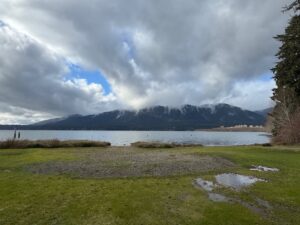
Lake Quinault
On the first Wednesday of this month I went to my annual writers retreat, held annually at Lake Quinault in Washington State’s magnificent Quinault Rainforest on the Olympic Peninsula. As usual, when I returned, I was bubbling with enthusiasm for writing (okay, even more enthusiasm than usual).
When I mentioned having gone in a comment here at TKZ, our own Debbie Burke asked if I would be sharing my experience in a post here. I’d written briefly about it three years ago in the intro to a Words of Wisdom post, but that didn’t do the experience justice.
Why attend a writing retreat? What might you get out of attending?
Writers retreats can give you the opportunity to truly put your writing first for a short period of time. I’m not talking about making your writing a priority, but rather going someplace—even if it’s with your writers group to a local coffee shop for an afternoon or a beach house for a long weekend—and immersing yourself in your writing and writing craft and letting go of day-to-day concerns.
Retreats can also be a powerful way to kickstart your writing, both for beginners starting out, or for an experienced writer looking to change up their writing, or return to it after an absence, long or short.
They can provide opportunities to learn writing craft, build community, and of course, time to focus on writing and provide a place to write, either alone or in a group setting, sometimes called parallel play and also known as body doubling where you leverage the presence of other writers engaged in the same activity. Rainforest writers has been called an “accelerant” because the retreat’s isolation, community and writing focus can accelerate your development as a writer.
***

Retreat organizer Patrick Swenson with Resort manager Ian Strait looking over his shoulder.
Rainforest Writers is run by my friend Patrick Swenson, himself an author as well as the publisher of Fairwood Press, who taught high school English classes for 39 years before retiring in 2024. Patrick has been putting on Rainforest since 2007, when it was a single five day session. Now there are four sessions, one after the other, beginning in late February and into mid-March. Each begins on a Wednesday afternoon and ends at noon on the following Sunday.
The retreat takes place at the Rainforest Resort Village, located on the south shore of Lake Quinault. Rooms are available at the Village inn, the Parkside suites, or the Fireplace cabins. There are no phones in any of the rooms, and cell service can be spotty. There is internet, which is a bit iffy in the Village inn, but quite accessible in the Salmon House restaurant and lounge, as well as the General Store.
The retreat fee is $200, which includes breakfast at the Salmon House Thursday through Sunday. Patrick provides sandwich fixings for lunch Thursday and Friday, while long-time attendees Deborah and Chuck put on a soup lunch on Saturday which nearly everyone attends. You’re “on your own” for dinner, which for me means the Salmon House, except for Thursday night when a group dinner is held in the restaurant, which is a wonderful opportunity to mingle with other writers over food.
Thirty plus writers attend each session, with many returning each year, often to the same session they attended in the past. I began going in 2019, Session 2, and did Session 2 every following year through 2025, except for the Pandemic year of 2021 when there was an online retreat instead. This year I decided to switch things up and attend Session 3, which was held from Wednesday March 4 through Sunday March 8.
Most of the attendees write science fiction, fantasy or horror, but there are a few crime dogs like myself, as well as paranormal romance writers, memoir writers and historical novelists. Writers range from novices to professional authors. Authors are a mix of traditionally published and self-published.
I’ve known writers to rent a cabin for their Rainforest session, and hole up and simply write as much as possible, which is a perfectly fine way to spend the retreat if you so choose.
However, for most of us, the writing retreat is also about community. Informal conversations about writing, the writing life and publishing, as well as writing alongside each other, at times in the Salmon House lounge, which has a lovely view of Lake Quinault and the forested hills beyond. The lake teems with water fowl—Canadian geese, loons, mergansers, ducks and more. Bald eagles also visit the lake. It’s an amazing backdrop which can provide a place to gaze between writing sprints.
***
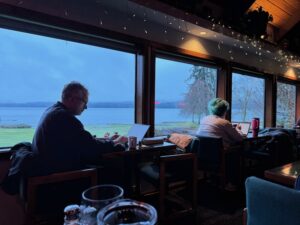
Early bird writing in the lounge.
There are two organized group writing sessions in the lounge each day—the early bird writers from 6-9AM and the night owls from 9PM to after midnight, and then there’s informal sessions at the other times.
In previous years, like a crazy person, I burned the candle at both ends and was an early bird and a night owl. in both groups.
This year sanity prevailed and I went with being an early bird, arriving just after the start at 6AM and writing until breakfast at 9AM each morning. The past three retreats I brought mystery novels to revise but this year I came with a new mystery novel I wanted to begin drafting, which is an entirely different energy. I also wrote some micro-fiction as a break from my frenzied novel drafting.
I also wrote in the afternoons following lunch, sometimes continuing in the lounge, other times back in my lakeview room at the Village inn, and often did a session in the early evening. Over the course of five days I wrote 19,339 words, which included 2100 words on the opening of a longer short story. The vast majority was on Last Seen Shelving, the fourth Meg Booker library cozy.
In the spirit of both fun competition and group effort, Patrick puts up a white-board each session where writers can track their session word counts, and also any editing they do. The person with the largest word count at the end of each session wins a prize, as well as first pick in the raffle, while the second and third place finishers get to pick a prize ahead of the drawing. Patrick also tallies the total words written by all writers in a session, which gives a bit of a team effort feel to the word count.
This session I ended up in third place. My normal writing pace is 1000-1500 words a day, going over 2000 words later in the novel as the story careens toward climax. At Rainforest I averaged nearly 5000 words a day, keeping in mind that I only had two plus hours on Sunday. On Thursday and Friday I wrote around 6000 words each day. However, by Saturday afternoon I ran out of gas and had to take a long break.
I’m not a binge writer by nature, I’m only one when forced by a deadline. Instead, I normally work at a steady pace. I tend to binge write at Rainforest.
The last time I drafted fiction at Rainforest was in 2022, when I wrote over 15,000 words worth of short stories. This session reminded me I can extend myself but just like working out extra hard, I end up needing to recover. Since I’ve returned from Rainforest, my writing pace has been much slower, well under a thousand words each day as I recharge, but I haven’t missed a day. I went into Rainforest not having drafted regularly for a while, and came out of it with a building streak, and yes, I am still tracking my word count.
***
Another important aspect of Rainforest is in providing opportunities to learn about various aspects of writing and the writing life.
Each session has hour-long presentations at 11AM Thursday, Friday and Saturday. When I started there were also presentations at 3PM on Thursday and Friday, but Patrick felt that broke up the day too much and wanted to give writers a more unbroken stretch of time for writing, editing etc. between lunch and dinner.
In the past I’ve attended presentations on characters, sensory detail, pacing, POV, action scenes, writing in more than one genre among others. I usually make time to attend at least a couple of the presentations.
Last year I was a presenter, for the first time, giving a mini-workshop on self-publishing. My audience was engaged and asked some terrific questions.
This year I attended all three presentations.
Thursday, author Kate Ristau gave a talk on the classic idea of “throwing rocks at your characters,” which looked at what your character is trying to achieve, and what obstacles and complications arise as she struggles to reach her goal. Kate gave us an exercise that asked about how the objects in our story and how we might externalize our characters’ wants and needs in the form of the objects.
For instance, in my fourth mystery, the library itself represents a place of fulfillment for my hero and a place where she can make a difference, which is a need she has.
Friday’s presentation was “Project Management Tools for Sustainable Writing Habits” by J.B. Kish and Remy Nakamura and proved to be insightful and informative.
J.B. and Remy provided us with worksheets, first looking at our expectations about “our ideal writer selves,” such as how many words per day does my ideal writer self produce, how often, when, how easily do I enter a state of focus, how confident is my ideal self, how long does it take them to finish a novel draft.
They discussed “compassionate productivity, looking at sustainably being able to reach “real outcomes” vs the ideal ones, the importance of mindfulness when it comes to your own process, challenges and life situation, and the idea of incremental, forward progress.
Accountability can be very helpful, especially when there are consequences for doing the work—rewards if you achieved it, or withholding a reward if you do not, such as not opening a bottle of fine Scotch you’d purchased until you finish the project.
“Touch the work everyday,” even if it’s only to jot down a few words on the draft, write a note or spend a few moments considering what comes next.
Saturday Dean Wells presented “The Ending Was There All Along,” how to breakdown the decision tree of your ending. Dean began by stating that writer’s block is noise: your creative side is stymied by your critical side. His solution is “structured problem solving.” Drill down through the noise. It’s a back-to-basics approach. He counseled using your analytical side to engage in dialogue with your creative side. Ask your creative side questions about what you want as a writer in this story.
At essence, story is character + setting + problem. The character either succeeds or fails.
Which do you want as a storyteller?
He uses a logic tree. Identify the problem. Does it result in success or failure? If success it can be simply happily ever after or come at a cost. If the latter, that can range from the personal to collateral damage. What does this look like? Personal can be self, loved one, friend etc.
This leads us to before the ending and our hero’s fear—what is your character afraid of losing?
In order to overcome this the hero must be willing to sacrifice, which Dean feels is the single most important aspect of your hero. They take a little leap of faith in order to solve the problem.
He broke down Act III into Climax, Resolution and Denouement and noted its importance, the untying of the story not. For me as a cozy mystery writer, it’s the granting of the boon of justice which restores the integrity of the community where the story takes place.
He gave examples from films such as Star Wars: A New Hope and the 1972 western The Cowboys, starring John Wayne and Bruce Dern.
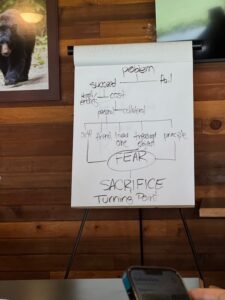
Part of Dean Well’s decision tree on endings.
***
The Cabin party is held Saturday night, in Cabin 6, Patrick’s cabin, where you can drop by anytime during the day during your session for a snack or a beverage, and often an informal conversation about writing. Cabin parties are another opportunity to meet and talk with your fellow attendees.
Every session wraps up Sunday morning, at 11 in the lounge, where the Rainforest inspiration award. Every attendee votes for the attendee who proved most inspirational during their session.
In Session 3 this year, that was J.B. Kish, the co-presenter of project management for writers (his fellow presenter Remy Nakamura won the inspiration award a previous year). The inspiration award winner will have their name engraved and put on a retreat plaque commemorating all the winners.
After this, the session word count winners were announced, with me coming in at third behind Cyrus at second, with 23,000 plus words, and Rebekah at first with a staggering 32,000 words written. It was her first Rainforest and she was stunned to have won.
A raffle for donated prizes—everything from books and music to coffee and tea mugs to fine wine followed, and then we said our goodbyes and we began our drives back to our respective homes.
Another session had flown by, giving us a chance to put writing first for a few days, concentrate on a project, learn a few things, and perhaps make new friends as well as reconnect with old ones. I always return home with increased creativity and enthusiasm.
Crow at Lake Quinault playing the part of mystery’s iconic raven.
Resources:
Rainforest Writers: https://rainforestwriters.com/index.html
Making retreats part of your writing life: https://writershelpingwriters.net/2026/01/writing-retreats/
***
Have you attended a writing retreat, or would you like to? What do you get out of retreat, or what would you like to, if you’ve never been on one before?
Great recap, and sounds like a worthwhile experience.
I went on one writing retreat, not as ‘rigorous’ as yours. It was held at the Franciscan Retreat Center, https://www.franciscanretreatcenter.org/about-us which has an interesting history as a TB Sanatorium before becoming a convent and now a retreat center.
Rooms were spartan, as would be expected. All meals included in the dining room. Some workshop sessions, but mostly it was a time and place to get writing done.
My latest book, Deadly Ambitions, took some inspiration from what I saw walking the grounds.
I will say, for me it was a little disconcerting to have Jesus watching me from above the small “desk” in the room, but I did get a satisfying amount of writing done. Unlike yours, the writing productivity wasn’t stressed. It was a place to do whatever you needed, whether it was producing words or recharging in the pastoral setting.
I did a blog post after the retreat with more details.
Thanks, Terry! I learned that perhaps I was too rigorous with the word count push at Rainforest and aiming for, as you well put it, a “satisfying amount of writing” is a better goal.
A pastoral setting would certainly be a place to recharge, something not to be undervalued.
I’ve been to conferences, but never a retreat. Since I live in central WA, it would be a manageable drive to Rainforest. Hmmm…
It sounds enticing for sure!
😀
Not only is it a wonderful experience, it’s a bargain. The area is so beautiful, I took my wife there in late September 2024 to stay in a cabin for a few days.
Great post, Dale! It sounded like a great retreat. I attended one last summer in Pigeon Forge, TN. We didn’t have any classes, just worked on our books. Picture seven or eight writers sitting in a great room, each with a computer typing away. Of course, me being ADHD, I didn’t get a lot of writing done, but it was a refreshing time.
Thanks, Patricia! Your retreat last summer sounds like another slice of writer heaven.
Terrific review, Dale! Glad you had such a satisfying experience. The beautiful natural location sounds wonderfully tranquil.
Years ago, the U of MT sponsored the Yellow Bay Writers Workshop on Flathead Lake. Water lapping outside the cabins, ospreys flying around, incredible faculty like James Crumley, Carolyn See, Rick DeMarinis. Idyllic dream come true for a new writer.
Thanks, Debbie! The Yellow Bay WW sounds wonderful, too.
Sounds like an excellent retreat with a strong focus on writing rather than socialization. Love that. I so enjoyed the breakdown, Dale. Congratulations on your third place achievement!!!
The last retreat I attended was New England Crime Bake, where I was a panelist. There’s something special about being surrounded by other writers — an unexplained feeling you don’t get anywhere else — one that fires you up to write. I could feel your passion throughout this post.
Hope you’re enjoying your weekend, my friend. Cloudy here, so no stargazing of late.
Thank you, my friend! You are so right about the feeling you get being surrounded by other writers—that’s a big part of what makes Rainforest so special.
We actually have a clear evening for a couple of hours and I’ve set up telescopes and binoculars for a little star party for myself 🙂
Sorry it’s cloudy where you are.
Sounds like a wonderful experience, Dale. 6000 words/day is fantastic!
I’ve been to writers’ conference, but never to a retreat. I know I would enjoy the focus on writing with no outside interruptions.
Have a great rest-of-the-weekend!
Much appreciated, Kay!
Hope you have a wonderful weekend as well!