
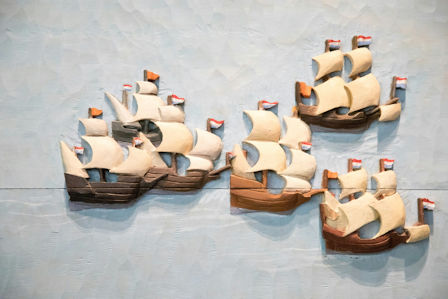
“You can never cross the ocean unless you have the courage to lose sight of the shore.” ― Christopher Columbus
* * *
I recently read Over the Edge of the World by Laurence Bergreen. It’s a detailed account of Ferdinand Magellan’s extraordinary expedition that resulted in the first circumnavigation of the Earth. For such an accomplishment, you might expect Magellan’s story to be the quintessential tale of the hero. Let’s see how he did:
* * *
In the typical hero’s journey, the main character is reluctant to accept the call to adventure, but Magellan didn’t fit that model. He wanted to lead an expedition. The goal wasn’t necessarily to sail all the way around the world, but to secure fame and fortune by finding a route to the Spice Islands in Indonesia by sailing west—something earlier explorers had failed to do.
Back then, spices were to Europeans what oil is to the world today, i.e., very valuable. So Magellan, being a reliable seaman with strong credentials, felt his plan was something the nautical powers-that-be should be willing to finance.
Those maritime powers were Spain and Portugal, and they ruled the exploration of the world. Being Portuguese, Magellan pitched his plan to King Manuel of Portugal, who repeatedly refused to fund the journey. A lesser man may have given up, but Magellan instead turned to King Charles of Spain who agreed to bankroll the expedition. After all, if a quick route could be found to the Spice Islands in Indonesia, that would mean valuable cloves would line the king’s pantry and silver coins would jingle in his pocketbook.
Magellan at last had his chance to secure his place in history, following in the watery footsteps of his personal hero, Christopher Columbus.
So far, so good.
* * *
In September 1519, Magellan set sail with five ships, 260 seamen, a chronicler named Pigafetta, and a woefully incorrect map of the world.
Previously, no one had found a waterway from the Atlantic Ocean around or through the large land mass we call the Americas, but Magellan had a plan. The map he used showed a strait, a small body of water that sliced through the southern part of the Americas. Magellan went to sea to seek that strait and find a thruway to the Pacific, and he proved himself a true hero in this part of the journey. He led the expedition through a stormy crossing of the Atlantic, suppressed (albeit brutally) a mutiny, identified the mouth of the strait, and managed to continue with three ships after one was lost to a storm and another was taken over by mutineers and turned back to Spain.
By the time the weather was good enough to enter the strait, Magellan, ever the disciplined seaman, carried on and led his group through the treacherous waterway. This was no small feat. The strait was so circuitous, with winding inlets that went nowhere and weather that worked against the expedition, that some historians call Magellan’s crossing of the strait the greatest navigational feat in history.
To put it in perspective, the waterway that came to be known the Strait of Magellan is 350 miles long, a shorter distance than that from Los Angeles to San Francisco. It took the expedition over a month to maneuver through it. We can only imagine their delight when one morning they sailed out into a vast ocean—the first time a European vessel had crossed from the Atlantic Ocean to the new body of water Magellan named the “Pacific Ocean.”
So how was Magellan doing on the hero scale? He gets high marks for Leadership, Discipline, Endurance, and Courage. But the journey wasn’t over yet.
* * *
Using his inaccurate charts, Magellan expected it would take just a few days to cross this new ocean to the Spice Islands. It took over three months until they sighted land.
Up until then, Magellan had shown himself to be up to the task of the hero, but once the expedition arrived in the Philippines, his ability to deal with the nuances of other cultures proved to be far weaker than his skill as a seaman. When a tribal king complained about a possible fight with another tribe, Magellan offered to punish the second king by warring with them. In the skirmish that followed, Magellan and several of his crew were killed.
Without Magellan, leadership was lacking, and progress to the Spice Islands was slow. In the end, only one ship managed to acquire a load of spices and complete the circumnavigation. The Victoria sailed into Seville harbor in September 1522, almost a full three years since it had left. Of the 260 sailors in the original expedition, only 18 were aboard.
Following the magnificent accomplishment of the first circumnavigation of the Earth, other expeditions were sent out to retrace Magellan’s route, but they all failed. It would be fifty-eight years before another explorer, Sir Francis Drake, would complete a circumnavigation of the world.
* * *
Authors will appreciate that one major accomplishment of the expedition was the work of the chronicler, Pigafetta, who survived the journey to publish his personal narrative, one version of which resides in the Library of Yale University. Of Pigafetta’s work, Bergreen notes
“…it is a compilation of events, illustrations, translations of foreign tongues, prayers, descriptions, epiphanies, and bawdy asides… The reader of Pigafetta’s chronicle hears his voice, alternately bold, astonished, devastated, fascinated, and in the end, amazed to be alive in the cruelly beautiful world of his time.”
Although his original goal was to find a route to the Spice Islands, perhaps Magellan’s most heroic accomplishment was to have single-handedly changed the map of the entire world. Bergreen writes
“Although no continent or country was named after him, Magellan’s expedition stands as the greatest sea voyage in the Age of Discovery.”
Maybe no countries were named for him, but Magellan did have a couple of impressive remembrances. The Strait of Magellan was named in his honor a few years after the expedition, and two galaxies orbiting the Milky Way that are visible from the Southern Hemisphere were named the Magellanic Clouds. Not bad to have your name enshrined in the heavens.
* * *
So TKZers: What do you think about Magellan? Hero? Flawed meddler in someone else’s quarrel? Cruel task master? Or maybe a combination of these qualities. How do you construct the heroes of your stories? Do you have a Magellan-like hero?
* * *

Heroes come in many sizes and shapes, and the lure of treasure is bound to propel them into adventure.
Join Reen & Joanie as they tackle a treasure hunt with determination and a little help from their friends. Can they fend off the evil Alicia, solve the strange puzzles, and bask in the glory of success? Click on the image to go to the Amazon detail page.
I like the way one college essay put it: Magellan circumcised the globe with a 100 foot clipper.
Those early explorers had to be courageous, tough, sometimes brutal , especially when long at sea. And were, like all men, flawed. But those are the most interesting heroes, right?
I am in awe of the early explorers. They mapped the world for us with nothing more than the sun and stars to go by. It was always hard and sometimes horrific.
Pigafetta’s journal is a treasure in itself.
I nearly choked on my coffee, but it seems there was more to the man than we learned when I was in school. Who knew that Magellan was also an accomplished(?) surgeon. But I think I’m most impressed that someone in his day invented a 100-foot clipper.
Hmm, I hope that clipper was only used for that one task.
🙂
Fascinating, Kay. I hadn’t read about Magellan since school.
Great accomplishments require great hubris and determination. He clearly had those but also a fatal flaw.
If he’d been a writer, I think he’d be considered a pantser, like those of us who have a destination in mind but don’t know the specific route.
Great analogy, Debbie! Magellan was using the Discovery Method. 🙂
Flawed, yes, but I love a hero who perseveres. Fascinating, Kay.
Good morning, Sue.
Yes, those early explorers needed a large dose of perseverance to stay alive. Heroes stay the course.
Have a good week.
I have done a little reading on the early spice trade. It was not for the timid. It sits at an intersection of religious persecution and bravado. In the late 1400s navigators were almost all Muslims or Jews. Most spice ships never left site of the shore. So, to get a ship of black pepper or clove, it was to sail from Spain, past the entrance to the Mediterranean to Africa. around the western edge of Africa, up the east side, across Arabia, and then to India. About a year on a voyage where about a third of the crew would die enroute. But, it paid extraordinarily well. Two or three successful trips and you could retire, assuming you lived that long. It took a good mix of stupid and brave and the ability to convince others to follow you.
Another down side to the spice trade. In the year each way spice ships picked up other high value cargo for sale both in India and Europe – slaves.
Morning, Alan.
Good info. I will never look at a little jar of cloves the same way again. 🙂
Panster for sure, with a strong trait of perseverance. I can’t even imagine being on the ocean that long!
“I can’t even imagine being on the ocean that long!” I’m with you, Pat. To set out on the ocean and not even know where you’re going to end up—that’s beyond my courage index.
Have a great week.
Fascinating, Kay!
And now we have satellites and GPS.
😂
Hi Deb!
We have many gifts that were paid for by heroes.
Have a great week.
A flawed man who accomplished a great deal, and lost his life in the process. Putting down a mutiny was a matter of life or death, and measures had to be harsh. Thank you for an interesting blog.
Thanks, Elaine. I agree with you—it’s hard to judge people who lived 500 years ago by our standards.
Have a good week.