
Story Genius
Terry Odell
There have been great societies that did not use the wheel, but there have been no societies that did not tell stories … Ursula K. Leguin
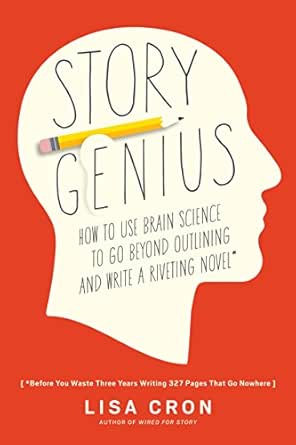
I recently discovered an overlooked book in my Nook Library. Given I was in that what next after finishing Deadly Ambitions, and waiting for the release date I’d set several months in advance, I opened it.
It’s been a while since I’ve read a craft book, and our own JSB has a passel of them out there, but I’ve heard Lisa Cron speak, and I thought I’d give this one a try.
The book? How to Use Brain Science to Go Beyond Outlining and Write a Riveting Novel (Before You Waste Three Years Writing 327 Pages That Go Nowhere) by Lisa Cron. With a title like that, who could resist?
Cron quotes Jonathan Gottschall, author of The Storytelling Animal, who says, “Functional MRI (fMRI) studies reveal that when we’re reading a story, our brain activity isn’t that of an observer, but of a participant. … Their brains are instructing their bodies to do all the things they’d do if they were actually under mortal attack.”
Cron then goes on to say that story is the original virtual reality, and it dates back to the days of the cave people. If it had no adaptive significance, it would have disappeared long, long ago.
“It turns out that great feeling you get when you’re lost in a good story, the feeling that can keep you up all night reading, is not ephemeral, it’s not arbitrary, it’s not pleasure for pleasure’s sake, it’s not even. It’s actually the biological lure, the hook that paralyzes you, making the real world vanish so you can experience the world of the story. That feeling is what compels us to drop everything and pay attention.
What actually causes that great feeling is a surge of the neurotransmitter dopamine. It’s a chemical reaction triggered by the intense curiosity that an effective story always instantly generates. It’s your brain’s way of rewarding you for following your curiosity to find out how the story ends, because you just might learn something that you need to know.”
Cron makes the distinction between plot and story.
Plot:
- Plot is the sequence of external events — the things that happen on the surface. It’s the visible action: what the characters do, what obstacles they face, what events unfold.
- Plot is the vehicle that delivers the story — but not the story itself.
- As Cron puts it, plot is “what happens,” but it’s not “what it means.”
Story:
- The story is the internal journey — the change happening inside the protagonist as a result of those external events.
- It’s driven by the protagonist’s misbelief — a deeply held but false belief formed in the past that shapes how they see the world.
- Every event in the plot should force the protagonist to confront and eventually reevaluate that misbelief.
Story is about how the external events (plot) affect the character and how they transform because of them. Readers care because of what those events mean to the character. Readers don’t care about events in isolation.
Cron also goes into great length about the third rail, which she says is the protagonist’s internal struggles. It’s the emotional energy source that gives power and meaning to everything that happens. Without this third rail, the plot just sits there, going nowhere emotionally.
She also stresses the protagonist’s misbelief, which is deeply ingrained, but is a false belief about themselves or the world, formed from a painful past experience. For example, the character has been hurt by someone close to them, so they don’t let anyone else close. They believe that if they stay independent, they’ll never get hurt. For character growth, they need to learn that real safety comes from trust, not isolation.
Cron goes on to offer her process for writing a novel. She had a willing volunteer who had a glimmer of a story idea, and they agreed to work together to turn that idea into a novel, and it was interesting to watch the process unfold.
Am I a follower? Not really. The closest I come is being a planster rather than a panster. Cron shows us her story cards (although you don’t need to have them all written before you start). Do I think I’ll use them? Probably not. I’m too lazy. And, they’re much more complex than scene notes on 3×5 cards (or their digital equivalent.)
What do her cards look like?
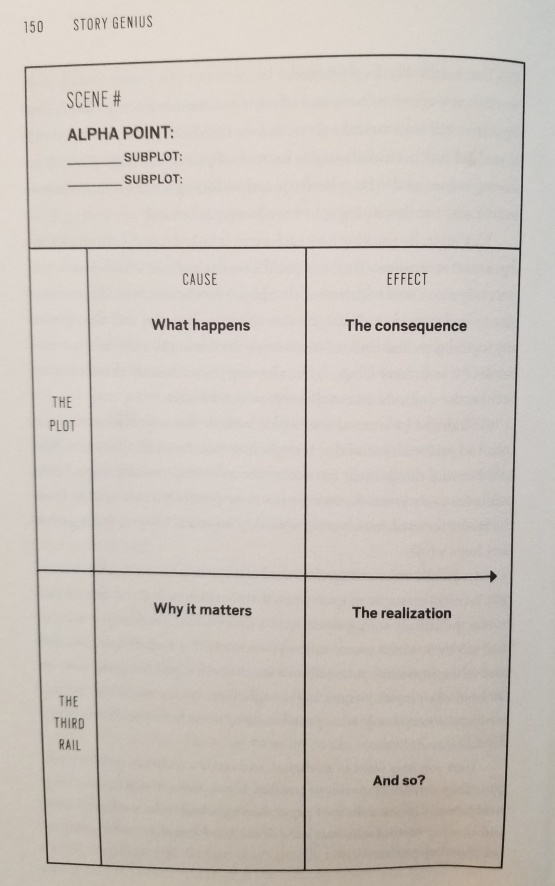
The Alpha Point – what is the scene supposed to accomplish?
Subplots – what’s going on with secondary characters?
The top row in the grid is the Plot. What happens, and the consequences.
Below that is the Third Rail – Why it matters, and what does the character realize?
Last is the And So? What happens next, which will lead into the next scene.
Cron points out that these cards don’t have to be written in order, which to my mind is a good thing. To be honest, I’m much more likely to write something like these cards after I’ve written the scene. I prefer playing with the words on the page/screen once I can see what’s happening.
And for this, Cron’s biggest takeaway for me is to keep asking Why? This is something I’ve been doing almost from the beginning of my writing gig, but it’s nice to get a reminder once in a while.
For my current wip, I knew my protagonist preferred to hide behind the lens of her camera, but I needed to know why. For Cron, getting to know characters isn’t filling out a sheet with height, weight, eye and hair color. It’s digging into their pasts, discovered what shaped their lives up to the point of Chapter 1. This becomes the back story that’s trickled in as needed.
My noodling with an opening paragraph doesn’t show any of my delving into Evvie’s why.
Door chimes tinkled a cheerful greeting as Evvie Gale pushed open the door to the Barrington gallery. “You wanted to see me?” Smiling, she approached the counter, where Roger Barrington glanced up for a nanosecond before ducking his head, averting his gaze. Not the face of someone happy to see her. Not the expression of someone who wanted to extend an invitation to display more of Evie’s photographs.
I’m hoping readers will be interested enough in the ‘whys’ of this opening paragraph to keep reading. And, this is all subject to change as more of the plot and story unfold.
In closing, a lot of what Cron writes has been written before, with different terminology. But a rose by any other name can still help our writing.
Your turn. The floor is open.
Find me at Substack with Writings and Wanderings
Deadly Ambitions
 Peace in Mapleton doesn’t last. Police Chief Gordon Hepler is already juggling a bitter ex-mayoral candidate who refuses to accept election results and a new council member determined to cut police department’s funding.
Meanwhile, Angie’s long-delayed diner remodel uncovers an old journal, sparking her curiosity about the girl who wrote it. But as she digs for answers, is she uncovering more than she bargained for?
Now, Gordon must untangle political maneuvering, personal grudges, and hidden agendas before danger closes in on the people he loves most.
Deadly Ambitions delivers small-town intrigue, political tension, and page-turning suspense rooted in both history and today’s ambitions.
 Terry Odell is an award-winning author of Mystery and Romantic Suspense, although she prefers to think of them all as “Mysteries with Relationships.”
Terry, I haven’t read Story Genius but I did read Cron’s Wired for Story and highly recommend it. It covers similar brain science. Fascinating how the brain responds to different aspects in a story, what exactly triggers those responses, and why.
Jim Bell’s and Jack Bickham’s books are the backbone of my craft library but in other authors’ craft guides, I usually find a few fresh twists I hadn’t been aware of before. Good for our brains to keep learning.
When I heard Cron speak, she used Wired for Story, and I read that as well. The brain is an amazing thing. We need to keep using it.
I need some time to digest all of this. It seems like its a formula that needs followed. If I were a plotter, that would work. If I were a pantster, I’m not sure it would work. Fortunately, I’m a combination of both, so there might be a learning opportunity here. Might be. I need to let it digest, roll it around in my mind, compare it to my work. It might work.
Thanks, Henry. That’s why I call myself a “planster” which combines plotting and driving into the dark. Take what works and go with it. If you think it might help you, I suggest you read the book in its entirety. I only scraped the surface for this post.
I’ve gone through Story Genius and need to pull it out again. While I don’t fill out the sheets I do want the answers to the questions in my head before I start writing. But sometimes I can’t get the answers until I start writing and see how the character reacts to challenges.
Refreshers are good, Pat. I’m with you on writing first and summarizing afterward (something I’ve fallen behind in doing with this wip), and see how things fit, and where I need to dive deeper.
I have this book, along with 37 other books on the craft of writing. I made sheets like the one you inserted above and thought it would work. It didn’t. I have sheets for at least a dozen other methods, none of which work for me. If I just follow my own instincts and write (yes, I’m a pantser) I have no problems getting the words on the page. If I try someone else’s method, it’s like my mind goes blank. I bought these books and I read blogs because I’m looking for that elusive something I feel I’m missing. Now, years after the first novel I ever wrote was published by Berkley, I’m pretty sure I have a handle on plot structure, but when I write with the signposts in mind, it stifles my creativity. As I’ve written here before, in my case, maybe just writing the story is my method.
And I also have a few books on editing. I’ve read many books and articles written by people who love editing. I’m not one of those people. Hmm… This makes me sound stubborn. And, as I believe JSB has mentioned, that is probably why my novels haven’t taken off.
I’m a firm believer that your process is what works for you. I don’t like to know too much about what’s happening, because then it’s all about choosing words. But my books are probably not the compelling reads Cron is talking about. I write for me first, and my brain can’t deal with the pre-planning details on Cron’s story cards.
I am not a fan of mysteries, but I have stayed up all night reading some of your books, Terry, so I would call them compelling. Your process is certainly working.
Thanks, so much, Becky.
I have ebook copies of Story Genius and Wired for Story by Lisa Cron, but it’s been a few years since I read (at least part of) them. I need to go through them again.
One thing I’ve learned on this writing journey is that I often get ideas as I’m writing that are better than the plot I had originally planned. That’s why I can’t lock into a plot at the beginning. Like you, Terry, I’m more likely to write one of the scene cards after the scene is written to make sure I’ve touched all the bases.
Thanks for another thought-producing post.
I agree, Kay. My ‘plot’ is very nebulous at the beginning, but I’ve always been about the characters, which is what Cron stresses with her ‘third rail’ examples.
As Debbie notes in her comment above, I find value in reading a bunch of different craft books — while I may not adopt all the recommendations from a particular craft book, I usually pick up a good idea or two that helps me continue to grow in my writing and my process. I’m pretty sure I’ve read Story Genius but it’s been a while.
I agree, BK – different pieces work in different ways, and it’s finding what resonates.