
Almost Full Circle?
Terry Odell

Image by Richard Duijnstee from Pixabay
Lately, I’ve seen a growing number of authors choosing to take selling books into their own hands. I get it. Selling through the “usual channels” means sacrificing a chunk of the profits. Plus, people are stopping making purchases from certain outlets for personal reasons. With sales from the Big Store dropping, or a desire to stop sharing revenue, I can understand indie authors wanting to find other ways to make up for lost sales.
My thoughts? Note: This post is focused on e-books.
This takes me back to the pre-Kindle days, when ebooks were starting out, and e-publishers were popping up like mushrooms after a rain. These were actual “publishers.” You had to submit your book, it had to be accepted, and most likely went through an editorial process. How rigorous that process was varied.
They had an art department that designed a cover. How much input an author had varied there, too. Some accepted suggestions. Other said if your name and the title were spelled correctly, that was it.
For these publishers, your book lived on their site, and people had to go there to buy it. If you published different books with several of these, then a fan might have to go to each site separately to buy the books.
Here are some of the early ebook pioneers.
Ellora’s Cave, and its offshoot, Cerridwen Press
Loose ID
Samhain Publishing
Fictionwise
eHarlequin/Harlequin Digital
The Wild Rose Press, which is still around. (I was their first outside contracted author back in the day, when their main offering was short romances.)
Liquid Silver Books
There were no e-readers then, either. You read on your computer, a PDA, Palm Pilot, or printed the book. PDF was a common format. Anyone remember Rocketbook/.rb?
A while later, other sites (still pre-Kindle) would let you put your books up for sale in their “stores.” This meant you didn’t have to get approval, and you could put your book on more than one site. A step toward one-stop-shopping, although most had a specific genre focus.
Some examples:
Fictionwise
eReader.com
All Romance eBooks
Diesel eBook Store
Most met their demise once Amazon and the Kindle joined the party.
At the time, my genre was romantic suspense, so I was publishing at venues that targeted romance readers. If someone bought their books from All Romance ebooks, then by golly, I was going to make sure mine were there, even if it was a single reader who requested it.
Now, with authors creating their own storefronts, it’s come almost full circle. I’m not a big fan. If I want to shop, I want to look at books from lots of authors. I don’t want to have to bounce from one site to another, buying from author A here, author B there, and author C somewhere else.
Does this mean I might miss books by excellent authors? Probably. Heck, I already deal with that because I buy my books from Barnes & Noble.
There are plenty of excellent authors who prefer to go wide and make their books available to as many outlets as possible. If I really want a book by an author who’s not at B&N, I go to my library. I’m not going to get into a “which is better, wide or exclusive”? argument here. Those are personal decisions.
I also have no plans to open my own storefront. Too much bookkeeping, more hoops to jump through, and there are still costs of doing business. I’m lazy.
Your thoughts? Shopping from multiple author storefronts or the one-stop-shopping at the major ebook stores, such as Kobo, Barnes & Noble, Apple, or Amazon?
Authors, do you have a storefront? How’s it working for you?
New! Find me at Substack with Writings and Wanderings
Deadly Ambitions
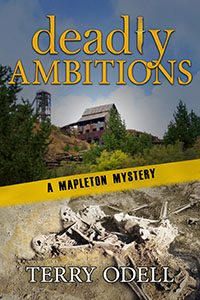 Peace in Mapleton doesn’t last. Police Chief Gordon Hepler is already juggling a bitter ex-mayoral candidate who refuses to accept election results and a new council member determined to cut police department’s funding.
Meanwhile, Angie’s long-delayed diner remodel uncovers an old journal, sparking her curiosity about the girl who wrote it. But as she digs for answers, is she uncovering more than she bargained for?
Now, Gordon must untangle political maneuvering, personal grudges, and hidden agendas before danger closes in on the people he loves most.
Deadly Ambitions delivers small-town intrigue, political tension, and page-turning suspense rooted in both history and today’s ambitions.
 Terry Odell is an award-winning author of Mystery and Romantic Suspense, although she prefers to think of them all as “Mysteries with Relationships.”
I must’ve had my head buried in the sand in the pre-Kindle ebook days because other than Wild Rose Press, I don’t recognize any of those names.
The bottom line for me is its hard enough to find time to write, let alone market so I’m not going to make it harder for myself. For my own reading I’m not going to hop around to 50 different sites — I’m a one stop shopper. And that’s the approach I’d take with selling books too.
I’m with you (as you probably guessed from my post). I’m looking for ways to simplify, not create more work. Thanks for chiming in.
Terry, thanks for sharing this history. Like Brenda, I didn’t know about these earlier sites.
I don’t browse online in general but rather go looking for a specific author or book that was recommended or that I read about in newsletters. I don’t pay attention to “also bought” recommendations by Big Z.
Browsing in a physical bookstore is different. I once knew someone who’d been accidentally locked in a bookstore overnight. What a fun adventure.
It’s fine with me to pay a percentage to distributors and let them handle sales and bookkeeping.
At book events, I accept cash or check only, no credit cards.
I don’t foresee setting up my own storefront b/c safeguarding customers’ credit card numbers from hackers is nearly impossible. Nor do I want the bookkeeping headaches. But never say never.
I”m aware of most of the sites because that’s the time I was starting to think about taking my writing into the ‘serious’ realm. I wasn’t having a lot of success with the traditional route, so I took a chance with these e-publishers. It was a good introduction.
I always tell potential indies that they are, essentially, setting up a business. You have to have an awareness of and modicum of skill in good business practices (I wrote a book about that called How to Make a Living as a Writer).
However, you have to balance business with your ability to keep writing good books. When the biz side begins to encroach too much, there’s a diminution on the creative-production side. While selling direct is an option these days, for me that’s too much encroachment. I want to keep the main thing the main thing—writing.
With you all the way JSB. Time is valuable, and for me, on both sides of the coin, selling myself and having to buy from multiple sites eats up too much of it.
I’d heard of all of the pre-kindle places except Loose ID and Liquid Silver. I have a few novellas on Amazon but other than that I’m traditionally published so I’m not about to compete with my publisher with a storefront on my website.
Makes perfect sense, Patricia. If it ain’t broke, don’t fix it.
It’s an interesting concept, but I can’t imagine adding the extra burden of a personal storefront to my already time-challenged schedule. I like what JSB said about keeping the main thing the main thing—writing.
Agreed. I wonder if anyone here has first-hand experience with a personal storefront. I can’t imagine another time suck.
I do remember those earlier sites before the Kindle and how they vanished after it.
I know other Indies who run a personal storefront, but like you, it would be a huge investment in time. I have considered Kickstarter for a future project, but that also has a huge learning curve and time investment.
For now, my ebooks are available everywhere, and I have print versions available at the major book sellers. Like Jim and Kay, I’m striving to keep writing the first and most important thing.
Thanks, Dale. Suzanne Brockmann just did a huge Kickstarter for her next release, but it’s only good for preorders, so I’m not sure I’d be willing to invest the time and energy in doing that.
If I’m looking to buy books from several different authors, I can’t imagine having to go to each of their sites, and then pay for each book separately.
Back in ancient times, we hoped that the ebook publishers and their sites would free us from the evils and control of the big publishers and the book distributors, but, alas, people are intrinsically lazy and preferred one-site shopping so we eventually became Amazon peons. That in turn meant that royalties went way down because Amazon took such a large chunk. My first books were 50% royalties.
Rocketbook and its site was a much bigger player than you mention. They were at the point where they could have been Amazon/Kindle, but they were bought by a big electronics corporation who took one look at the small profits in comparison to their TVs and ended the program. Then Amazon appeared.
I’m one of those lazy people who doesn’t want to bounce from site to site, but yes, the arrival of the Kindle and Amazon (where you can buy a refrigerator along with your books) put most of them out of business.
Thanks, Terry…good post with good info. I hadn’t heard of some of those pre-Kindle entities, either.
And I agree totally with “keep the main thing the main thing”. If the main thing isn’t the main thing anymore, I’ll soon not have to deal with a marketing strategy.
🙂
So true, Deb. Without a product to sell, there’s no marketing.
Perhaps I’m not understanding this correctly, but bookshop.org is available as an online retailer (not a publisher) for independent bookstores to sell at one site. I’ve enjoyed purchasing books through them as a reader, but I’m an unpublished fiction writer, so have not looked at pros and cons of indie authors selling books there.
I’ve heard of bookshop.org. It’s relatively recently that indie authors could put their books there, but if I understand it, it’s just another place to buy/sell books. I’ll have to look further to see how the financial side works. Thanks for bringing it up.
Bookshop . org has been a huge relief to me for hardcopy book shopping in my efforts to avoid the monopolizing elephant.
But I freely admit that I use it more to find past titles vs the current hot topic purely because my TBR pile is so enormous that I’m consistently years behind the trend. Lol!
Thanks, Cyn.
But it’s still a bookstore, not an individual author’s shop, right? So you don’t have to go to multiple sites to buy books by different authors.