Writing Exercise: Six Word Memoir

by Michelle Gagnon

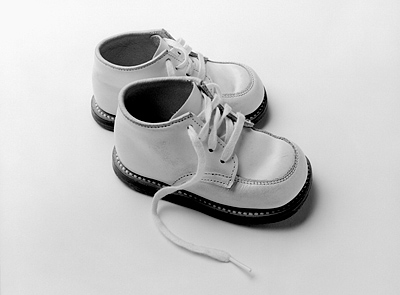
Hemingway was once famously challenged to write a short story in six words or less, and he came up with, “For sale: baby shoes, never worn.”

Kind of the perfect story- so much there, yet so much left unsaid. It leaves you wondering and wanting more.

Smith Magazine launched a six word memoir contest awhile back, inviting people to submit the story of their life with extreme brevity. It was so successful that they produced a book with submissions from a wide variety of authors both famous and obscure, including Amy Sedaris (Mushrooms. Clowns. Wands. Five. Wig. Thatched), Sebastian Junger (I asked. They answered. I wrote), and Po Bronson (Stole wife. Lost friends. Now happy).

Today, I challenge you to do the same. Here are some of my favorites, culled from their ongoing blog:

  • “More fun since moral compass broke.”
  • “Write about sex, learn about love.”
  • “I thought that I’d be taller.”
  • “Committed voluntarily, until tried to leave.”
  • “Asked to quiet down. Spoke louder.”

And here’s mine, always a work in progress:

“Loved and lost and loved again.”

So what’s your life been like, in a sextuplet?

Writing Exercise: Six Word Memoir

by Michelle Gagnon

Hemingway was once famously challenged to write a short story in six words or less, and he came up with, “For sale: baby shoes, never worn.”

Kind of the perfect story- so much there, yet so much left unsaid. It leaves you wondering and wanting more.

Smith Magazine launched a six word memoir contest awhile back, inviting people to submit the story of their life with extreme brevity. It was so successful that they produced a book with submissions from a wide variety of authors both famous and obscure, including Amy Sedaris (Mushrooms. Clowns. Wands. Five. Wig. Thatched), Sebastian Junger (I asked. They answered. I wrote), and Po Bronson (Stole wife. Lost friends. Now happy).

Today, I challenge you to do the same. Here are some of my favorites, culled from their ongoing blog:

  • “More fun since moral compass broke.”
  • “Write about sex, learn about love.”
  • “I thought that I’d be taller.”
  • “Committed voluntarily, until tried to leave.”
  • “Asked to quiet down. Spoke louder.”

And here’s mine, always a work in progress:

“Loved and lost and loved again.”

So what’s your life been like, in a sextuplet?

Opening Chapters

Throughout my years as a published author, I’ve participated in various mentoring programs. This past weekend at the Space Coast Writers Guild Conference. I was assigned to mentor three writers for a total of six hours. This being my first such experience at a conference, I wasn’t sure what to do. Guidelines would have been helpful, but I was out there on my own. So I started by asking my subjects how far along they were in the writing process and what they wanted to learn.

The eager writers were nearly done with their manuscripts and wanted to hear writing tips and how to submit their work, where to find agents, what to do in terms of author branding. So we talked about all of those topics. Then they gave me about 30 pages each of their work to read. It would have been helpful to have had those pages emailed to me before the conference, because after going all day from around 9 to 7 or so, I wanted to relax. But I diligently read through and critiqued their manuscripts that evening.

Sunrise (800x600)
SUNRISE ON THE BEACH
Lois Winston (800x600)
LOIS WINSTON AND NANCY COHEN

Each person wrote fantasy or science fiction so we had those elements in common. That was up my alley since I write sci fi and fantasy romance in addition to cozy mysteries. As for the basics of fiction writing, it doesn’t matter what genre you favor. The principles are the same.

When I read their work, I found the world building blocks to be solid. The problems they shared involved pacing in the first chapter.

Either I found too much backstory repetitively entwined through the current action, with snippets of dialogue from prior conversations running through the protagonist’s head in the middle of a fight scene, or prolonged chit chat between characters that could be shortened. In a couple of cases, I suggested moving up the beginning to the point where my interest really kicked in.

These are not uncommon problems. I’ve revised my own openings endless times, haven’t you? And nowadays, when on Amazon potential readers can sample your first chapter and determine on that basis if they’ll buy your book, these first few pages are critically important. This experience also shows why it’s good to work with critique partners who can view your opening from an objective perspective and tell you if it works or not. So here are the basic points I’d like to reiterate about first chapters:

  • Start with action or dialogue. If you absolutely must begin with a description, make sure it is emotionally evocative from the main character’s viewpoint.
  • Leave backstory for later or weave it in with dialogue. Or drop it in a line or two at a time in the character’s head if it relates to the action.
  • Make sure all conversations serve a purpose.
  • Remember to include emotional reactions during dialogue between characters.
  • Make sure your characters are not talking about something they already know just so the reader can learn about it.
  • Keep the story moving forward.

Are there any other points that you would add?

Opening Chapters

Throughout my years as a published author, I’ve participated in various mentoring programs. This past weekend at the Space Coast Writers Guild Conference. I was assigned to mentor three writers for a total of six hours. This being my first such experience at a conference, I wasn’t sure what to do. Guidelines would have been helpful, but I was out there on my own. So I started by asking my subjects how far along they were in the writing process and what they wanted to learn.

The eager writers were nearly done with their manuscripts and wanted to hear writing tips and how to submit their work, where to find agents, what to do in terms of author branding. So we talked about all of those topics. Then they gave me about 30 pages each of their work to read. It would have been helpful to have had those pages emailed to me before the conference, because after going all day from around 9 to 7 or so, I wanted to relax. But I diligently read through and critiqued their manuscripts that evening.

Sunrise (800x600)
SUNRISE ON THE BEACH
Lois Winston (800x600)
LOIS WINSTON AND NANCY COHEN

Each person wrote fantasy or science fiction so we had those elements in common. That was up my alley since I write sci fi and fantasy romance in addition to cozy mysteries. As for the basics of fiction writing, it doesn’t matter what genre you favor. The principles are the same.

When I read their work, I found the world building blocks to be solid. The problems they shared involved pacing in the first chapter.

Either I found too much backstory repetitively entwined through the current action, with snippets of dialogue from prior conversations running through the protagonist’s head in the middle of a fight scene, or prolonged chit chat between characters that could be shortened. In a couple of cases, I suggested moving up the beginning to the point where my interest really kicked in.

These are not uncommon problems. I’ve revised my own openings endless times, haven’t you? And nowadays, when on Amazon potential readers can sample your first chapter and determine on that basis if they’ll buy your book, these first few pages are critically important. This experience also shows why it’s good to work with critique partners who can view your opening from an objective perspective and tell you if it works or not. So here are the basic points I’d like to reiterate about first chapters:

  • Start with action or dialogue. If you absolutely must begin with a description, make sure it is emotionally evocative from the main character’s viewpoint.
  • Leave backstory for later or weave it in with dialogue. Or drop it in a line or two at a time in the character’s head if it relates to the action.
  • Make sure all conversations serve a purpose.
  • Remember to include emotional reactions during dialogue between characters.
  • Make sure your characters are not talking about something they already know just so the reader can learn about it.
  • Keep the story moving forward.

Are there any other points that you would add?

Creativity: Invoking the Gods or Madness


Looks like the source of Creativity has been an ongoing discussion for ages. Poets in ancient Greek and Roman times invoked gods to assist in their writing. (Can’t say much has changed there.) What I found fascinating is that many believe psychotic-ism causes creativity. Even Aristotle claimed that there was never a genius without a tincture of madness. And, that’s a direct quote.


Makes me feel rather distinguished as a creative being–though I am not crazy enough to consider myself genius.

There has been active debate on whether creative genius is dependent on mental illness or insanity. This debate continues further by stating that madness alone cannot suffice as Source for creativity. Nay, nay. An openness to experience, intelligence and wisdom complete the mysterious formula. They are actually writing papers on the subject. The bottom line: Creative people make creativity a way of life.

We can all name artists, musicians, writers, scientists, etc. who inspire us with their fascinating and divergent thinking. (Look at our own Basil Sands, for goodness sake.) The argument for creative personalities presented by Hal Lancaster during the late 90’s in The Wall Street Journal stated six basic qualities exist:

1. Keen powers of observation.
2. Restless curiosity.
3. An ability to recognize issues that others miss.
4. An ability to generate numerous ideas.
5. Persistently questioning the norm.
6. A talent for seeing established structures in new ways.

Do you see yourself in any or all of the above? I do, which is fun. But, what really appeals to me is the recurring theme of madness in creative beings. After all, if you’re considered a little crazy you need no excuses for your behavior. I like that.

So, I am trying out my creative juices in a new location for awhile. I am writing to you from Santiago, Chile today. My Muse is having a field day. We’re eating foreign foods, seeing exotic places and conversing in my pitiful Spanish as much as possible. I’m getting funny looks and lots of laughs. So, I’m pretty sure I am doing something right!

Once again, which of the 6 traits above is your strongest? You’re favorite? Inquiring minds want to know!

Cao for now!


Creativity: Invoking the Gods or Madness


Looks like the source of Creativity has been an ongoing discussion for ages. Poets in ancient Greek and Roman times invoked gods to assist in their writing. (Can’t say much has changed there.) What I found fascinating is that many believe psychotic-ism causes creativity. Even Aristotle claimed that there was never a genius without a tincture of madness. And, that’s a direct quote.


Makes me feel rather distinguished as a creative being–though I am not crazy enough to consider myself genius.

There has been active debate on whether creative genius is dependent on mental illness or insanity. This debate continues further by stating that madness alone cannot suffice as Source for creativity. Nay, nay. An openness to experience, intelligence and wisdom complete the mysterious formula. They are actually writing papers on the subject. The bottom line: Creative people make creativity a way of life.

We can all name artists, musicians, writers, scientists, etc. who inspire us with their fascinating and divergent thinking. (Look at our own Basil Sands, for goodness sake.) The argument for creative personalities presented by Hal Lancaster during the late 90’s in The Wall Street Journal stated six basic qualities exist:

1. Keen powers of observation.
2. Restless curiosity.
3. An ability to recognize issues that others miss.
4. An ability to generate numerous ideas.
5. Persistently questioning the norm.
6. A talent for seeing established structures in new ways.

Do you see yourself in any or all of the above? I do, which is fun. But, what really appeals to me is the recurring theme of madness in creative beings. After all, if you’re considered a little crazy you need no excuses for your behavior. I like that.

So, I am trying out my creative juices in a new location for awhile. I am writing to you from Santiago, Chile today. My Muse is having a field day. We’re eating foreign foods, seeing exotic places and conversing in my pitiful Spanish as much as possible. I’m getting funny looks and lots of laughs. So, I’m pretty sure I am doing something right!

Once again, which of the 6 traits above is your strongest? You’re favorite? Inquiring minds want to know!

Cao for now!


Ebook Prices

By Clare Langley-Hawthorne


I just saw a recent analysis by Booklr of the top 100 Amazon Kindle books versus the top 100 Barnes & Noble Nook titles in respect of their relative price points. The results are, I think pretty interesting for anyone considering ‘indie’ publishing, and in demonstrating the role price may play in different e-book ‘markets’. 


According to the Booklr survey 35% of the top 100 books on Kindle were free or priced under $2 compared to 0% for the Nook. 61% of the top 100 books on Kindle were priced under $6 versus 39% on the Nook. In the higher price bracket, the results are also pretty different with 27% of books on Kindle priced above $10 versus 40% on the Nook. 


These results suggest that customers have quite different book buying habits in these two ‘e-reader’ markets. It also points to a potential new culture for the Kindle in which customers tend to buy what is free or less than $2. As an author, this signals to me that if I was to go the ‘indie’ route, I would need to consider price very, very carefully indeed. 


The Booklr analysis indicates that the average price for a Kindle top 100 e-book is $6.48 compared with $8.94 for the Nook – which gives us a rough gauge of the price differential between customers for both platforms and opens up the debate over the impact of free and cheap (99c) e-books on overall pricing trends. 


So for all your authors considering the indie route, how are you approaching the issue of price? If you are traditionally published, what kind of price point has your publisher set for your e-book? And how much influence do you think Amazon is going to have on driving e-book prices down?

Ebook Prices

By Clare Langley-Hawthorne


I just saw a recent analysis by Booklr of the top 100 Amazon Kindle books versus the top 100 Barnes & Noble Nook titles in respect of their relative price points. The results are, I think pretty interesting for anyone considering ‘indie’ publishing, and in demonstrating the role price may play in different e-book ‘markets’. 


According to the Booklr survey 35% of the top 100 books on Kindle were free or priced under $2 compared to 0% for the Nook. 61% of the top 100 books on Kindle were priced under $6 versus 39% on the Nook. In the higher price bracket, the results are also pretty different with 27% of books on Kindle priced above $10 versus 40% on the Nook. 


These results suggest that customers have quite different book buying habits in these two ‘e-reader’ markets. It also points to a potential new culture for the Kindle in which customers tend to buy what is free or less than $2. As an author, this signals to me that if I was to go the ‘indie’ route, I would need to consider price very, very carefully indeed. 


The Booklr analysis indicates that the average price for a Kindle top 100 e-book is $6.48 compared with $8.94 for the Nook – which gives us a rough gauge of the price differential between customers for both platforms and opens up the debate over the impact of free and cheap (99c) e-books on overall pricing trends. 


So for all your authors considering the indie route, how are you approaching the issue of price? If you are traditionally published, what kind of price point has your publisher set for your e-book? And how much influence do you think Amazon is going to have on driving e-book prices down?

A New Definition of Writing Success

“Rich are the records  . . . with stories of penniless authors, who, sick with hope so long deferred, and at last despairing, have resorted to wild and tragic devices . . .”
So begins a story in the Los Angeles Examiner,New Year’s Eve edition, December 31, 1905. The feature tells the tale of one such desperate author, a school teacher named Edith Allonby. For four years she’d labored on a novel, The Fulfilment [spelled with one “l”] into which she poured heart and soul. She had been published before, but her books had not been hits. The Fulfilment was going to change all that. In fact, Miss Allonby was certain its spiritual themes would change the world. (Indeed, she thought the book had been given to her by God, so the pressure was on).
But the book was rejected. First, by her own publisher. Then by all the other publishing houses she sent it to. “I have submitted my book to all these men,” she wrote in a note. “I have tried in vain. They will not accept it, yet shall ‘The Fulfilment’ reach the people to whom I appeal, for I have found another way.”
After finishing the note, Miss Allonby changed into a silk evening gown, put fresh flowers in her hair, and sat in a comfortable chair. She was found dead the next day, her manuscript on her lap and an empty bottle of carbolic acid at her side.

And so it has been for countless authors for hundreds of years. Not normally ending in suicide (though such cases exist) but often in frustration, depression and despair. (The Fulfilment, BTW, was published in a limited edition after Miss Allonby’s death).


There was one primary reason for all this distress: Their fate as writers was not in their own hands. To get anywhere close to “success” they had to be accepted by an established publishing house (which alone had the means to produce and distribute a book), and then hope that they earned some money for their efforts.
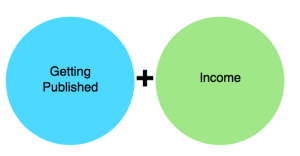
Those two things—acceptance and income—defined writing success. 
Included under “Getting Published,” we can list some ancillary things writers hope for. Like getting on a bestseller list. Perhaps being nominated (even winning) a prestigious award. Maybe just the feeling of being part of an exclusive club. 
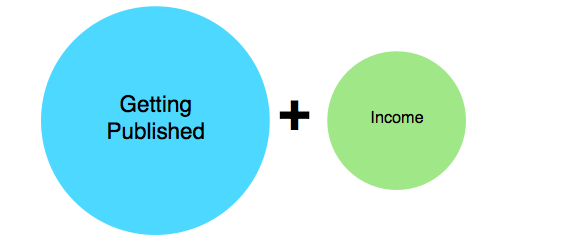
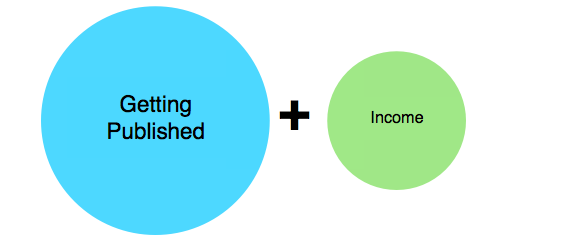
But now we are experiencing a sea change on the other side of the diagram:

We all know the traditional model is shrinking. Advances on new contracts are at historic lows. With physical shelf-space disappearing, print revenues are down. While digital income is up for the publishers, the slice of that pie given to authors remains stagnated at 25% of net (or roughly 17.5% of retail). And new writers are finding publishers increasingly risk averse regarding debut authors.
Still, many writers remain focused on that left circle. It represents some sort of “validation” even though it could very well mean less income (the right circle) and fewer readers.
But now a new model of writing success has appeared. Writers, for the first time since the troubadour era (when you could go out on your own and make up stories in song and take in some coin), have it within their power to get their writing out there without a middleman (the fancy term is “disintermediation”).
And further, unlike self-published authors of yore, they actually have a chance to make real dough. Every day we are hearing more accounts of self-published writers who are earning significant income as independents.


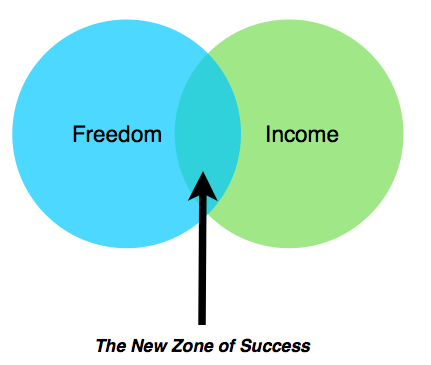
Yet income alone is not the main draw of this new model, which looks like this:

Freedom is the invaluable commodity here. To be able to write what you truly want to write, and know that you can get it into the marketplace, is tremendously liberating. It is, in fact, the engine of happiness for a writer. It’s exhilarating to write for yourself, see what you’ve written, fix it, and keep on writing—and be assured that it will have a place in the stream of commerce, for as long as you live.


This does not mean that going the traditional route is a spurious view of “success.” If one seeks that validation, it’s there to be pursued. The point is, however, that it is no longer the only game in town. Which is why I am more jazzed about being a writer than ever. Not just because of increased production and income, but because of the freedom to take responsibility for my own work. 
Let me be quick to point out, however, that this responsibility carries challenges. Being in charge means you are CEO of your own company. You alone are in charge of quality control and production. You can expect to experience the stresses and strains of running a small business. You will need new skills to handle them. These can be acquired, but only through effort and self-discipline.
But it’s more than worth it to be holding the reins of your own writing and life. 
I think Miss Allonby would have felt that way, too. Had she been able to self-publish, she might have lived a long, full life. Maybe she’d have written many more books, grown a readership, and made some money, too.  


I can say this because, in one of life’s ironic and poignant turns, The Fulfilment by Edith Allonby is now available for the Kindle.
So how would you define success as a writer? 

A New Definition of Writing Success

“Rich are the records  . . . with stories of penniless authors, who, sick with hope so long deferred, and at last despairing, have resorted to wild and tragic devices . . .”
So begins a story in the Los Angeles Examiner,New Year’s Eve edition, December 31, 1905. The feature tells the tale of one such desperate author, a school teacher named Edith Allonby. For four years she’d labored on a novel, The Fulfilment [spelled with one “l”] into which she poured heart and soul. She had been published before, but her books had not been hits. The Fulfilment was going to change all that. In fact, Miss Allonby was certain its spiritual themes would change the world. (Indeed, she thought the book had been given to her by God, so the pressure was on).
But the book was rejected. First, by her own publisher. Then by all the other publishing houses she sent it to. “I have submitted my book to all these men,” she wrote in a note. “I have tried in vain. They will not accept it, yet shall ‘The Fulfilment’ reach the people to whom I appeal, for I have found another way.”
After finishing the note, Miss Allonby changed into a silk evening gown, put fresh flowers in her hair, and sat in a comfortable chair. She was found dead the next day, her manuscript on her lap and an empty bottle of carbolic acid at her side.

And so it has been for countless authors for hundreds of years. Not normally ending in suicide (though such cases exist) but often in frustration, depression and despair. (The Fulfilment, BTW, was published in a limited edition after Miss Allonby’s death).


There was one primary reason for all this distress: Their fate as writers was not in their own hands. To get anywhere close to “success” they had to be accepted by an established publishing house (which alone had the means to produce and distribute a book), and then hope that they earned some money for their efforts.
Those two things—acceptance and income—defined writing success. 
Included under “Getting Published,” we can list some ancillary things writers hope for. Like getting on a bestseller list. Perhaps being nominated (even winning) a prestigious award. Maybe just the feeling of being part of an exclusive club. 
But now we are experiencing a sea change on the other side of the diagram:

We all know the traditional model is shrinking. Advances on new contracts are at historic lows. With physical shelf-space disappearing, print revenues are down. While digital income is up for the publishers, the slice of that pie given to authors remains stagnated at 25% of net (or roughly 17.5% of retail). And new writers are finding publishers increasingly risk averse regarding debut authors.
Still, many writers remain focused on that left circle. It represents some sort of “validation” even though it could very well mean less income (the right circle) and fewer readers.
But now a new model of writing success has appeared. Writers, for the first time since the troubadour era (when you could go out on your own and make up stories in song and take in some coin), have it within their power to get their writing out there without a middleman (the fancy term is “disintermediation”).
And further, unlike self-published authors of yore, they actually have a chance to make real dough. Every day we are hearing more accounts of self-published writers who are earning significant income as independents.


Yet income alone is not the main draw of this new model, which looks like this:


Freedom is the invaluable commodity here. To be able to write what you truly want to write, and know that you can get it into the marketplace, is tremendously liberating. It is, in fact, the engine of happiness for a writer. It’s exhilarating to write for yourself, see what you’ve written, fix it, and keep on writing—and be assured that it will have a place in the stream of commerce, for as long as you live.


This does not mean that going the traditional route is a spurious view of “success.” If one seeks that validation, it’s there to be pursued. The point is, however, that it is no longer the only game in town. Which is why I am more jazzed about being a writer than ever. Not just because of increased production and income, but because of the freedom to take responsibility for my own work. 
Let me be quick to point out, however, that this responsibility carries challenges. Being in charge means you are CEO of your own company. You alone are in charge of quality control and production. You can expect to experience the stresses and strains of running a small business. You will need new skills to handle them. These can be acquired, but only through effort and self-discipline.
But it’s more than worth it to be holding the reins of your own writing and life. 
I think Miss Allonby would have felt that way, too. Had she been able to self-publish, she might have lived a long, full life. Maybe she’d have written many more books, grown a readership, and made some money, too.  


I can say this because, in one of life’s ironic and poignant turns, The Fulfilment by Edith Allonby is now available for the Kindle.
So how would you define success as a writer?