Forensic Genetic Genealogy: A Crime Writer’s Field Guide

Marcia King’s mother kept the same telephone number for thirty-seven years.

She kept the same house in Arkansas. She didn’t move. She didn’t disconnect. Marcia had hitchhiked out of town in 1980 and stopped calling, and her mother — like every mother in this position has done since the invention of the telephone — left the line open in case her daughter ever picked up on the other end.

In April of 2018, the call finally came.

It wasn’t Marcia.

It was the Miami County Sheriff’s Office in Troy, Ohio, telling a woman who had waited almost four decades that the unidentified body found beside Greenlee Road on April 28, 1981 — the young woman the press had nicknamed Buckskin Girl for the fringed leather poncho she had been wearing — was her daughter. Twenty-one years old. Strangled and beaten. Buried under a headstone that simply said Jane Doe.

The case had not been solved. Her killer was, and remains, unknown. But her name had come back.

Marcia King’s identification was the first cold case ever solved by forensic genetic genealogy. A blood sample preserved in an unrefrigerated tube since 1981 was processed, uploaded to the public genealogy database GEDmatch, and matched within four hours of computer searching to a first cousin once removed. A team of volunteer genealogists at the newly founded DNA Doe Project built the tree out from there. Two weeks later, a mother in Arkansas got the call.

Three weeks after that, on April 24, 2018, a 72-year-old former police officer named Joseph James DeAngelo was arrested in his front yard in Citrus Heights, California. The Golden State Killer. Caught the same way: GEDmatch, family tree, candidate identified, confirmation DNA pulled from his trash. I remember standing with my cohorts from the Los Angeles Forensic Science Academy and talking about this case and the validity of using discarded DNA and familial DNA databases to find criminals. It was walking a fine legal line at the time.

This case began a change in the way cold case investigations worked in the U.S.

Eventually, it seeped its way into crime fiction. I tackled the topic a few years ago when writing What Darkness Does.

If you write the genre, you can no longer write around forensic genetic genealogy. And if you’re going to write it, you have to write it right.

Why This Matters for Crime Writers

Cold case fiction used to live in a forgiving place. The case had gone cold because the science of the era couldn’t read the evidence. Your investigator’s job was to be present-day-clever about a past-tense problem.

Forensic Investigative Genetic Genealogy (FIGG) moves the goalposts. Evidence that was useless for forty years is suddenly usable and trackable. Crimes from the 1970s, 80s, and 90s are now solvable in ways the original detectives couldn’t have imagined. Hundreds of cases have been resolved this way since 2018. The U.S. Department of Justice issued formal policy on its use in 2019. CRC Press is releasing the first comprehensive practitioner’s guide to FIGG this month.

That’s not a problem for fiction. It’s a gift. Forensic genetic genealogy gives you a mechanism that finally works the way readers want a cold case to work — the past speaking, after years of silence — without the cheap rescue of a deathbed confession or a buried diary in the attic.

It only works on the page if you understand what FIGG actually does, what it doesn’t do, and where the writer’s instinct toward speed and tidiness is going to trip you up.

What Forensic Genetic Genealogy Actually Is

Plain English: FIGG combines DNA recovered from a crime scene with consumer genetic genealogy databases — places like GEDmatch and FamilyTreeDNA — to find relatives of an unknown suspect or an unknown victim. A forensic genealogist uses those matches to build a family tree backward and outward until the tree narrows to one viable candidate.

That candidate is a lead. Not a defendant. Not a confirmed suspect. Just a lead.

For a suspect-identification match, investigators then need to collect what is called a surreptitious sample. This is typcially an abandoned or discarded source of DNA sample — for instance a coffee cup, a water bottle, a tissue from a public trash can. This is legal if the sample is taken from public domain. That sample is then tested and compared against the original DNA profile from the case at hand.

For a victim-identification case like Marcia King’s, a relative agrees to give a confirmation DNA sample, and the unknown person becomes a known person again.

Two distinctions matter for fiction.

FIGG is not CODIS. The Combined DNA Index System is the federal database of DNA profiles from convicted offenders, arrestees, and unsolved crime scenes. CODIS hits when your suspect is already in the system. Forensic genetic genealogy works when they aren’t. That distinction is the whole point of the technique. A writer who collapses the two will lose any reader who has paid attention to the last six years of true crime.

FIGG isn’t fast. The lab work to generate a sequenceable profile from old, often degraded evidence takes weeks to months. The genealogy work that follows takes even more time. Difficult cases take months. The famously hard ones take a year or longer. The science moves quickly. The genealogy is patient, careful, and slow.

Where Crime Writers Are Getting It Wrong

After watching the field for the last several years, here are the misnomers that show up most often regarding FIGG.

The instant match. A writer’s investigator submits DNA on Tuesday and gets a name on Wednesday. In the real world, even Marcia King’s case — which made a hit in only four hours of searching — had been preceded by weeks of lab work to extract usable DNA from a 1981 blood sample most labs had already given up on. We have to compress the timeline some, but compress the timeline that much and you lose the texture that makes cold case fiction interesting in the first place.

Skipping the confirmation step. A FIGG match is a candidate. It’s not legal proof. The story doesn’t move from genealogy hit to courtroom. It moves from genealogy hit to a separate, traditional confirmation DNA sample, almost always from something the suspect discarded in public domain. A writer who skips this step is writing a case that wouldn’t survive the first defense motion.

Using the wrong databases. Since the 2019 DOJ policy, U.S. law enforcement is restricted to genealogy databases where users have explicitly opted in to law enforcement matching. That means GEDmatch (with the right setting) and FamilyTreeDNA. It does not mean Ancestry. It does not mean 23andMe. Those companies have refused law enforcement access. A writer who has investigators pulling matches from Ancestry is writing a scene that gets the case thrown out.

Treating the genealogist as scenery. Forensic genetic genealogy is not done by detectives. It’s done by trained genealogists. Not sworn officers of the law. Many of them are civilians. Some of them are former hobbyists who turned professional after the Golden State Killer breakthrough. They are the people who actually build the tree. If your manuscript is about a cold case solved by FIGG and there is no genealogist in the story, you need to go back and add them.

Ignoring the ethical layer. Real investigators, real prosecutors, and real defense attorneys are arguing about FIGG every day. About consent. About whose DNA gets used. About what happens when one family member’s spit kit puts their cousin in prison. That tension belongs in your fiction. It’s exactly the kind of moral territory crime writers were made for.

How I Used FIGG In What Darkness Does

In What Darkness Does, a fourteen-year-old named Flora finds a bone in the woods.

Flora is sharp, stubborn, and exactly the kind of kid who doesn’t let go of a question once it’s in her teeth. The bone goes to a forensic anthropologist, Dr. Samantha Eckhardt, at the University of Michigan. Dr. Eckhardt invites Flora to a two-day workshop where she’ll learn how to use forensic genetic genealogy to try to give the bone a name.

I wrote the workshop scenes carefully. I gave Dr. Eckhardt a line I want every crime writer to internalize before they write a single FIGG scene of their own:

I want you to have realistic expectations. You may not leave here today with a candidate lead.

That’s the whole field guide in one sentence. Realistic expectations. Maybe not today.

One scene I love in that storyline isn’t the moment Flora gets a DNA hit. It’s the scene where her aunt, Emily Hartford, comes back to the lab after a break and finds Flora hunched over the keyboard, fingers moving fast, eyes locked on the screen, refusing to come up for air. Emily asks if she wants a snack. Flora doesn’t hear her. Emily asks again.

Without looking up, Flora answers: What if this were your child or sibling or best friend who had gone missing, never to be heard from again? Wouldn’t you want to know as soon as possible?

That’s the heartbeat of FIGG.

The drama isn’t the technology. The drama is the moral urgency the technology gives a fourteen-year-old at a keyboard, condensed into a single sentence by a kid who has only just learned what the work costs.

Flora’s storyline didn’t come from nowhere. It came from a real program at Ramapo College in New Jersey, the same one I credit in the back of the book — Ramapo runs an investigative genetic genealogy boot camp, and the youngest person ever to help resolve a case using IGG was a high school student who took part in it. The classrooms are real. The cases are real. The kids are real.

What I needed Flora to model — and what I want every crime writer to take with them — is that FIGG is not glamorous. It’s tedious, careful, full of stretches where the only thing happening on the page is a person staring at a screen.

The drama lives in the patience. But the reward is worth the wait. And to illustrate this I stretched Flora’s FIGG storyline into book 6, Walking On White, releasing October 20, 2026. Flora will get her answers!

The Field Guide: FIGG Best Writing Practices

Practical things to do when forensic genetic genealogy enters your story.

  • Write the timeline honestly. Give the lab time. Give the family tree time. Let your investigator be frustrated by the wait. The slowness is the realism.
  • Write the genealogist as a character. Let them have a personality, a method, a doubt. Let your reader watch them work.
  • Show the confirmation DNA moment. The discarded coffee cup, the swab from a hospital, the cigarette in a parking lot. That’s the beat where the candidate becomes the suspect. Don’t skip it.
  • Use the right databases by name. FamilyTreeDNA. Mention the opt-in setting. Get this right and the readers who care will trust you on everything else.
  • Build the family tree onto the page. A scene where your detective sees a name three generations away from a killer and starts to feel the case shift — that’s a scene that didn’t exist in the genre until 2018. It’s yours to invent.
  • Let the candidate be a real person before they’re proven guilty. FIGG often surfaces ordinary people — fathers, neighbors, retired church deacons — whose DNA matched because their nephew did a Christmas-gift spit kit. Sit with that for a paragraph. The moral weight of the technique lives in that pause.
  • Don’t forget victim identification. Most crime fiction uses FIGG to catch killers. Marcia King’s case is a reminder that it also gives names back to the dead. A novel that works the missing person’s side of the technique has a clear field in front of it.

The Ethics Seam Writers Should Rip Into

When a great-aunt sends her DNA to a consumer genealogy site to find out where her ancestors came from, she is not consenting to a future case being made against her grandnephew. The chain of relationship is invisible, intimate, and one-way. She doesn’t know who she is implicating. She can’t know.

That’s the moral seam every crime writer working in this space should put pressure on. Not to take a side, necessarily — only to acknowledge that the technique that brings closure to one family creates exposure for another. A character who has thoughts about that is more interesting than one who doesn’t. A scene where a relative is told your DNA is the reason we found him is one of the rawest moments fiction can offer right now, and almost no one has written it well yet.

That could be you.

Why This Tool Earns Its Place in the Genre

The cases forensic genetic genealogy has solved are the cases that broke families for decades. Children waited their whole adult lives to learn who killed their mothers. Parents died not knowing what had happened to their daughters. The technique can’t undo any of that. It doesn’t give back the years.

What it does is end the unknowing. And the unknowing, as I have written before, is the part of grief no one survives well.

In April of 2018, a mother in Arkansas finally got an answer about a daughter she had never stopped waiting for. The headstone in Riverside Cemetery in Troy, Ohio, that had said Jane Doe for thirty-seven years got a name carved into it: Marcia Lenore Sossoman King. The murder is still open. The killer hasn’t been caught. But Marcia is no longer Buckskin Girl. She is herself again, in death, the way she was in life.

Every crime writer who writes in cold case territory is, in some sense, writing toward that exact moment — the unknowing that finally breaks. FIGG deserves a place in crime fiction. It deserves to be written without shortcuts. It deserves to be written by people who understand that the truth at the end of the family tree belongs first to the family of the victim.

Get the science and technique right. Get the genealogy right. Get the long process right.

The story takes care of itself from there.

Want more on writing forensics that actually holds up? My Crime Writer’s Toolkit and the Master Crime Writing Course at forensicspeak.com walk through the procedures, evidence types, and craft principles that separate the novels readers trust from the ones they put down on page forty.

Jennifer Dornbush is an author, screenwriter, and forensic specialist who brings crime stories to life with authenticity and heart. With a background rooted in real-world forensics and a passion for crafting unforgettable mysteries, Jennifer offers readers and viewers a front-row seat to the intersection of science, justice, and human nature. Jennifer’s crime expertise has made her a sought-after speaker, consultant, and educator. Through her webinars and master courses, Jennifer guides writers in melding suspenseful storytelling with forensic realism to the screen and page. Meet her at www.jenniferdornbush.com

Sources

Turn the Tables on AI Scams

by Debbie Burke


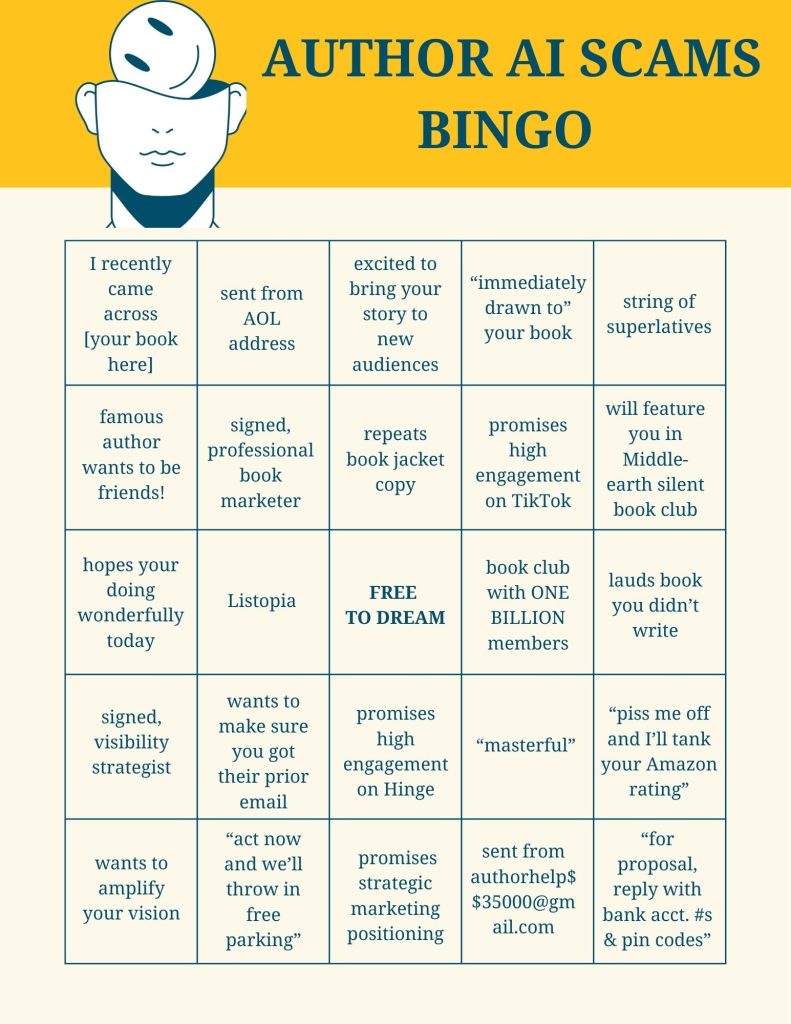
Last post, we talked about scam emails generated by AI chatbots. Just for fun, here’s a great bingo game from R.L. Maizes the Elder on Electric Lit.

My bingo card would be a total blackout except for the squares “Piss me off and I’ll tank your Amazon ratings” and “reply with bank acct #s and PIN codes.” But the day is young. Those emails could arrive in my inbox any moment now.

I have to admit grudging admiration for the evolving progress of scam emails over the past few months. They may be crooked, but they aren’t stupid. ChatGPT, Claude, Gemini, and their cousins continue to improve and refine their approach. In fact, some scammers have gotten so good, they may have inadvertently outsmarted themselves.

After plowing through the sycophantic flattery, several recent solicitations offered surprisingly good analyses of my book sales pages. They not only pointed out flaws, they offered valid critiques. Some outlined detailed promotional strategies targeted specifically for my books.

Hey, I thought, why don’t I take their plans and put them into action myself? Turn the tables on the scammer.

Test-driving their advice costs nothing except my time.


That’s probably not what they had in mind but, if they offer free advice, who am I to turn it down?

I started keeping a file called “Good AI scam ideas,” saving the best as references.

Here are several examples that gave valid critiques. I highlighted portions in red that especially struck a chord:

From: JaneBennett250@gmail.com

“Fruit of the Poisonous Tree, Book 9, currently sits inside Psychological Thriller on Amazon, a subgenre with very specific reader expectations, unreliable narrators, dark domestic tension, interior psychological weight.

The Tawny Lindholm series is something different: investigative, legally grounded, relationship-driven, anchored in Montana’s landscape and community.”  

Bot Jane is right. The category I chose is wrong. I need to act on that.

Another good point:

“Your Kill Zone presence is consistent and professional but that audience is other writers, not readers looking for their next thriller series.”

True.

From Joseph Booth, with a gmail address:

I’ll be honest I almost didn’t write this email because I wasn’t sure how to open it without sounding like every other marketing pitch you’ve probably deleted without reading.”

See how smart this bot is. It already knows I automatically trash the type of message it’s sending. Because of that hook, I kept reading.

“But then I met The Villain’s Journey.

A craft-of-writing guide that flips the Hero’s Journey on its head and takes writers straight into the darkest depths of the human soul. Who shows exactly how to create villains readers love to hate from comic troublemakers and charming sociopaths to terrifying psychopaths, fatal females, avenging angels, and every shade in between. Who arms writers with Build-a-Villain worksheets, deep psychological insights, and practical techniques to make antagonists multi-dimensional, unforgettable, and story-driving.

That’s not just another writing book. That’s a game-changer for storytellers. And writers who find it don’t let go.”

Okay, I confess I don’t mind a little flattery even though it’s vacuumed directly from my book sale page.

“Here’s what stops me cold: 23 ratings. A 4.8 average with writers calling it “much needed,” “a master class,” “essential,” and “the resource we’ve been waiting for.” One reviewer said it filled a gaping hole in the industry. Another called it a terrific guide that will push heroes to the limit and keep readers up at night.

What’s missing is reach and that’s exactly what I build.”

Now Bot Joseph is getting down to business. At this point, I almost quit reading but then noticed the plan of action he proposed:

“I help writing craft and fiction authors like you create real, sustainable momentum not through noise or gimmicks, but through targeted, story-honoring strategy that puts The Villain’s Journey: How to Create Villains Readers Love to Hate in front of the writers who will absolutely lose their minds over the practical tools. Here’s exactly what that looks like for your book:

Goodreads Review Building: With only 23 ratings, The Villain’s Journey is still below the visibility threshold that Goodreads and Amazon’s algorithms need to start recommending it organically. I work with authors to build genuine Goodreads credibility 400 to 500 real readers, no bots, no manufactured accounts, who leave honest, genre-aligned reviews.”

Despite Joseph’s assurances, I suspect the 400-500 reviews would be written by its/his bot pals. However, the recommended categories make sense.

Goodreads Listopia Domination: We get The Villain’s Journey placed and voted up on the high-traffic lists where your exact reader is already browsing: “Best Writing Craft Books,” “Best Books on Character Development,” “How to Write Villains,” “Books for Mystery & Thriller Writers,” “Creative Writing Reference,” and other targeted lists where serious writers hunt for their next must-read craft book.”

Okay, Listopia might be helpful. Then Joseph started droning about Amazon ads, Facebook, and Insta. I was getting bored and ready to hit “trash” until it/he tossed out this gem:

Sales Funnel Optimization: A complete reader journey built around The Villain’s Journey and the craft of creating unforgettable antagonists:

Top-of-funnel free magnet a downloadable “Build-a-Villain Quick-Start Worksheet” delivered via BookFunnel to grow your list with writers who want better bad guys.

Mid-funnel nurture with extra villain examples, Q&A with Debbie Burke, and teases from her Tawny Lindholm thriller series.

Bottom-funnel pushes through timed discount campaigns, writing conference outreach, and sequences that turn first-time readers into loyal buyers of your future craft books and fiction.

That sales funnel program sounded imaginative and effective. I’ll follow the specific, step-by-step instructions and give it a try. Thanks, Bot Joseph!

Another example from: authoreditorsusanwels@gmail.com:

Where Your Book Stands Today, and the Extraordinary Potential Just Ahead

Your guide sits within a highly engaged and continually growing space:

  • Fiction writers seeking craft improvement
  • Crime, thriller, and mystery authors
  • Screenwriters and storytellers across media
  • Writing students and workshops
  • Readers of craft books who actively apply what they learn

At present, however, your book is not yet being consistently surfaced across all of these communities.”

Again, valid critique plus suggestions whom to target. Bot Susan goes on with her strategy:

The Blueprint for Your Book’s Reach and Reader Engagement

The Foundation: Discoverability and Metadata Optimization
Your book will be positioned within writing craft, character development, and storytelling psychology categories to ensure visibility across platforms where writers search for guidance.

The Heartbeat: Writing Community Engagement
I will connect your work with writing groups, workshops, and online communities where craft discussions are already happening.

The Accelerant: Targeted Promotion
Campaigns will highlight the unique angle of your book—its focus on villains as central drivers of story capturing the attention of writers looking for fresh approaches.

The Amplifier: Educational and Content Integration
Your material is well-suited for excerpts, guest articles, and teaching opportunities, positioning your book as both a resource and a reference.

Thanks, Bot Susan, for these ideas.

An email from Jessicadoyle430@gmail included colorful graphics of a magnifying glass, a book, and a gift-wrapped package. It/she also suggested Listopia categories:

Right now, the discoverability infrastructure around The Villain’s Journey does not yet reflect the full scope of that waiting audience. That gap is entirely fixable and here is exactly how I would fix it:
The Villain’s Journey belongs prominently on at least fifteen to twenty of the highest-traffic Goodreads Listopia lists. Lists like Best Books on the Craft of Writing, Best Books for Writers of Mysteries and Thrillers, Best Books for Crime Writers, Best Writing Craft Books for Character Development, Best Books About Villains and Antagonists, Best Resources for Writers, Plotting and Structure, Best Books for NaNoWriMo Prep, and Best Writing Reference Books.  I would run a targeted, fully organic voting campaign to place The Villain’s Journey in top positions across every relevant list, generating compounding, perpetual discovery at zero ongoing cost.

“Zero ongoing cost”? Notice Bot Jessica’s careful wording. Misleading assurances like this snare many writers. If I responded (which of course I won’t!), in the next round of emails, Jessica would likely ask for money. 

REVIEW OUTREACH & ARC PLACEMENT
The most powerful lever for this book right now is building a strong review base among the writers’ community most likely to evangelize it. I would curate a targeted list of fifty to seventy-five reviewers specifically matched to this book craft-of-writing bloggers and influencers, crime and thriller fiction writing communities, NaNoWriMo participants and facilitators, mystery writer guild members, and serious indie authors actively building their craft libraries.

Goodreads Giveaway for The Villain’s Journey timed around NaNoWriMo or major crime writing conference seasons would simultaneously drive a significant surge of “Want to Read” shelf additions; place the book in the hands of actively writing readers highly likely to post substantive, practical reviews; and generate organic buzz across writers’ communities that would amplify every other element of this campaign. 

Author Profile Optimization: your Amazon Author Central page and Goodreads profile should be telling the full, compelling story of who you are and what makes you the definitive voice on villain craft. I would rebuild both profiles with compelling, keyword-rich copy separating and optimizing both your fiction and nonfiction presence.

Although Bot Jessica’s assurances are empty promises, it/she nevertheless outlined good sources for me to contact as well as ways to reframe my author profile.

Elenablake546@gmail.com nailed a specific weakness in my blurb. 

Your blurb opens with the Hero’s Journey comparison and moves efficiently through a bulleted list of what readers will learn. The list is comprehensive, but it reads more like a table of contents than an emotional pitch. Writers browsing craft books make purchase decisions on one question: will this solve my specific problem right now? The problem this book solves, cardboard villains who don’t challenge the hero enough to make the story matter, deserves to be named explicitly in the first two sentences before the feature list appears.

Revise the blurb opening to lead with the problem before the solution. Something like: “Your hero is only as powerful as the villain who opposes them. A flat antagonist makes for a forgettable story. The Villain’s Journey gives you the tools to create criminals, manipulators, and monsters that haunt your readers long after the final page.” Then move into the taxonomy and worksheets. This mirrors how the top-performing craft books in your also-bought carousel open their descriptions, and it signals immediately to every fiction writer regardless of genre that this book solves the problem they’re struggling with right now.

Bot Elena, I appreciate the excellent critique and rewrite suggestion.

From aliceclarkwinn@gmail.com:

Your Vogler and Bell endorsements are the most valuable assets any craft book author could have, and they’re functioning as static text on a product page.

James Scott Bell has over 30 craft books and a devoted readership of writers who trust his recommendations implicitly. When Bell says your book “filled a critical gap,” that sentence should be reaching every writer in his audience. But right now, both endorsements sit on your Amazon page, seen only by people who already found your book through other means. The endorsement from Vogler is not being used as a discovery tool. It’s being used as a closing argument for people who’ve already arrived. That’s like having a celebrity recommend your restaurant and only telling the people who are already seated inside.

Dual positioning: you don’t just teach villain writing, you demonstrate it in your own fiction. But are your thriller readers being guided to The Villain’s Journey? When a reader finishes a Tawny Lindholm book and thinks “how does she make these villains so compelling,” is there a clear path from that thought to your craft book? Conversely, when a writer reads The Villain’s Journey and wants to see your villain theory in action, are they immediately guided to your thrillers? This cross-pollination between your fiction and nonfiction should be one of your strongest competitive advantages over every other craft book author who only teaches but doesn’t demonstrate. But without deliberate cross-promotion infrastructure (back matter links, email sequences, bundled promotions, coordinated Amazon advertising), your two audiences remain separate pools that never merge. 

A targeted visibility campaign across writing craft podcasts (where a segment on “the villain’s journey as the mirror of the hero’s journey” positions you as the natural evolution of Vogler’s framework), writing conference communities, NaNoWriMo forums and social channels (where villain-craft content performs exceptionally well during planning season), AuthorTube and WritingTok creator outreach, and craft-focused newsletters like Jane Friedman’s Hot Sheet, Writer Unboxed, and DIY MFA. Vogler’s endorsement gives you a hook that no other villain-craft book can claim: “The man who defined the Hero’s Journey says this is the book that defines the Villain’s Journey.” That positioning sentence alone can anchor an entire media campaign. 

Bot Alice delivered an excellent list of places to pitch as well as the framework to connect my fiction and nonfiction.

This email from “author amplifier” Barbara Warren (gmail, of course) outlined similar strategies mentioned above but added a fresh twist which shows how quickly bots adapt and improvise. This one anticipated objections it expected writers to raise: 

Your Next Step
Reply to this email with two words:

“Send plan.”

That is it. No phone call. No discovery call. No PDF full of pricing tiers. No scheduling a “quick chat” that turns into a sales pitch.

I will reply with a simple, actionable roadmap. 

If you like the plan, you keep it. Use it. Share it. If you want my help executing it, we talk then. If not, you have a free strategic document from someone who genuinely believes The Villain’s Journey should be required reading for any writer who wants to create villains readers love to hate.

Sorry, Barbara, your offer is tempting but I don’t want to wind up on the Chatbot Sucker List that sells my email to every scammer in the universe.

Marketing has always been my weakness. These bots identified problems and offered specific actions to solve them. This is where AI shines. 

Normally I immediately trash spam but now I give it a second look. If the advice sounds plausible and doable, I save it to the “Good AI scam idea” folder.

Writers still need to be wary. “Out of the blue” solicitations are 99.99999+% scams. Best practice is to not respond to them. 

However, some of their suggestions are valid and useful. We can take advantage of good free advice, as long as we don’t allow scammers to take advantage of us.

TKZers, how about you?

Have you received spam/scam emails with advice that’s actually helpful? Have you put the ideas into practice? Were they successful?

~~~

Following Bot Alice’s advice, I’m cross-promoting fiction and nonfiction.

Meet the dastardly villains in the Tawny Lindholm Thriller three-book gift set. Then discover how I built those characters in The Villain’s Journey-How to Create Villains Readers Love to Hate.

Click on covers for sales links. 

Reader Friday: Reader-Writer Connections

The question up for grabs today is directed at you as an author. Last week, Steve asked a question of us as readers: how do we connect with writers? What’s our go-to platforms to find new favorite authors with whom we can adventure?

This week, we’ll reverse poles and come at it from the opposite direction.

How do we as writers connect with new readers/followers?

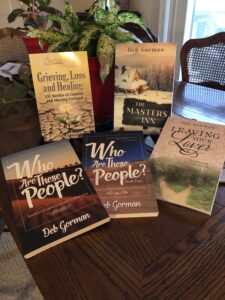
Today, we will discuss questions that are dear to my heart as a relatively new author. I have published four books of my own, plus I was published in Chicken Soup for the Soul, and I have two more books in the hopper. But those numbers are small—not insignificant by any means—but still small compared to most of you.

One of the authorish tasks I have the most difficulty with is reaching out to new/more readers and followers. I have a website where I publish a monthly blog, and I send out a monthly “newsletter.” I try to not market my books too heavily, but to include content about life in general in 2023, and sometimes what I’m curious about. I also try to include shout-out references/links to other authors, editors, and cover designers.

I do attend events, but mostly local as I am not much of a traveler. I like to say, Sure, I’d like to see XYZ location, but can’t I just be beamed over there?

So, over to you, TKZers! Steve and I are hoping to hear your tips/tricks/ideas—different methods you use to bring new readers/followers into your fold.

Wow us with your ideas, what has worked for you, and maybe what has not worked for you.

How do you attract new readers/followers?

What are some methods you’ve used to market yourself, not necessarily your latest book?

Do you ever conduct a survey of your current readers/subscribers to your blog or website to find out what content they’d like to see? What kind of response do you get?

Is there something you’ve tried in the past that has completely bombed? Do tell.

If you had to choose only one approach to connect with new readers/followers, the one that consistently produces results, what would it be?

Happy Friday, and thanks for playing the Connections Game with us today!

~~~


Deb Gorman lives in the Pacific Northwest and writes stories of redemption and reconciliation. Her next book, No Tomorrowsis due to be released this fall. You can connect with her at her website: debggorman.com