
 We all know about the “rules violation” known as “head hopping.” This is where we get the thoughts (inside the head) of one character, then suddenly “hop” into another character’s head within the same scene.
Technically, however, this isn’t a sin. It’s Omniscient POV (though it usually happens by mistake).
POV is broken down into First, Second (rare!), Third, and Omniscient (though some label Omni a type of Third, but let’s not confuse things right now). The main deal with Omni is that it can float above the action and dip into any character’s head. The Omni voice can be “objective” (straight description) or “editorial” (the author offers opinions or insights).
Omni POV is not so much in fashion these days (just don’t tell that to Delia Owens, author of Where the Crawdads Sing.) But it was the default choice of most fiction prior to the twentieth century. Here is a clip from Jane Austen’s Emma, where she hops into three different heads in the same scene:
“Emma,” said Mr. Knightley presently, “I have a piece of news for you. You like news—and I heard an article in my way hither that I think will interest you.”
“News! Oh! yes, I always like news. What is it?—why do you smile so?—where did you hear it?—at Randalls?”
He had time only to say, “No, not at Randalls; I have not been near Randalls,” when the door was thrown open, and Miss Bates and Miss Fairfax walked into the room. Full of thanks, and full of news, Miss Bates knew not which to give quickest. Mr. Knightley soon saw that he had lost his moment, and that not another syllable of communication could rest with him.
“Oh! my dear sir, how are you this morning? My dear Miss Woodhouse—I come quite over-powered. Such a beautiful hind-quarter of pork! You are too bountiful! Have you heard the news? Mr. Elton is going to be married.”
Emma had not had time even to think of Mr. Elton, and she was so completely surprised that she could not avoid a little start, and a little blush, at the sound.
The above is an example of objective omniscient. There’s no author voice “intrusion.” With editorial omniscient we are more aware of the voice. Here is one of the most famous editorial-omniscient openings:
It was the best of times, it was the worst of times, it was the age of wisdom, it was the age of foolishness, it was the epoch of belief, it was the epoch of incredulity, it was the season of Light, it was the season of Darkness, it was the spring of hope, it was the winter of despair, we had everything before us, we had nothing before us, we were all going direct to Heaven, we were all going direct the other way—in short, the period was so far like the present period, that some of its noisiest authorities insisted on its being received, for good or for evil, in the superlative degree of comparison only. (Charles Dickens, A Tale of Two Cities)
That is, of course, Dickens giving us his opinion on matters. Compare that to Margaret Mitchell’s objective-omniscient opening for Gone With the Wind, limiting herself to description:
Scarlett O’Hara was not beautiful, but men seldom realized it when caught by her charm as the Tarleton twins were. In her face were too sharply blended the delicate features of her mother, a Coast aristocrat of French descent, and the heavy ones of her florid Irish father. But it was an arresting face, pointed of chin, square of jaw. Her eyes were pale green without a touch of hazel, starred with bristly black lashes and slightly tilted at the ends. Above them, her thick black brows slanted upward, cutting a startling oblique line in her magnolia-white skin—that skin so prized by Southern women and so carefully guarded with bonnets, veils and mittens against hot Georgia suns.
The knock against Omni POV is that it removes immediacy and intimacy. When the narrator is “telling” the story, the action is slowed, and when it “hops” the reader is distanced from any one character.
I think both notions are wrong. In the hands of good writer, Omini can actually increase intimacy and connection. That’s what makes Theodore Dreiser a great novelist despite being a clunky stylist (“The world’s worst great writer” some wag wrote).
Let’s look at a bit of Dreiser’s Jennie Gerhardt. Jennie is a poor working girl employed by an older man, a U.S. Senator. He becomes infatuated with her, and one day draws her to him and gives her a kiss on the cheek.
“Oh!” she cried, straightening up, at once startled and frightened.
It was a new note in their relationship. The senatorial quality vanished in an instant. She recognized in him something that she had not felt before. He seemed younger, too. She was a woman to him, and he was playing the part of a lover. She hesitated, but not knowing just what to do, did nothing at all.
“Well,” he said, “did I frighten you?”
She looked at him, but moved by her underlying respect for this great man, she said, with a smile, “Yes, you did.”
“I did it because I like you so much.”
She meditated upon this a moment, and then said, “I think I’d better be going.”
“Now then,” he pleaded, “are you going to run away because of that?”
“No,” she said, moved by a curious feeling of ingratitude; “but I ought to be going. They’ll be wondering where I am.”
“You’re sure you’re not angry about it?”
“No,” she replied, and with more of a womanly air than she had ever shown before. It was a novel experience to be in so authoritative a position. It was so remarkable that it was somewhat confusing to both of them.
“You’re my girl, anyhow,” the Senator said, rising. “I’m going to take care of you in the future.”
Jennie heard this, and it pleased her. He was so well fitted, she thought, to do wondrous things; he was nothing less than a veritable magician. She looked about her and the thought of coming into such a life and such an atmosphere was heavenly. Not that she fully understood his meaning, however. He meant to be good and generous, and to give her fine things. Naturally she was happy. She took up the package that she had come for, not seeing or feeling the incongruity of her position…
Dreiser then “hops” into the Senator mid-sentence:
…while he felt it as a direct reproof.
“She ought not to carry that,” he thought. A great wave of sympathy swept over him. He took her cheeks between his hands, this time in a superior and more generous way. “Never mind, little girl,” he said. “You won’t have to do this always. I’ll see what I can do.”
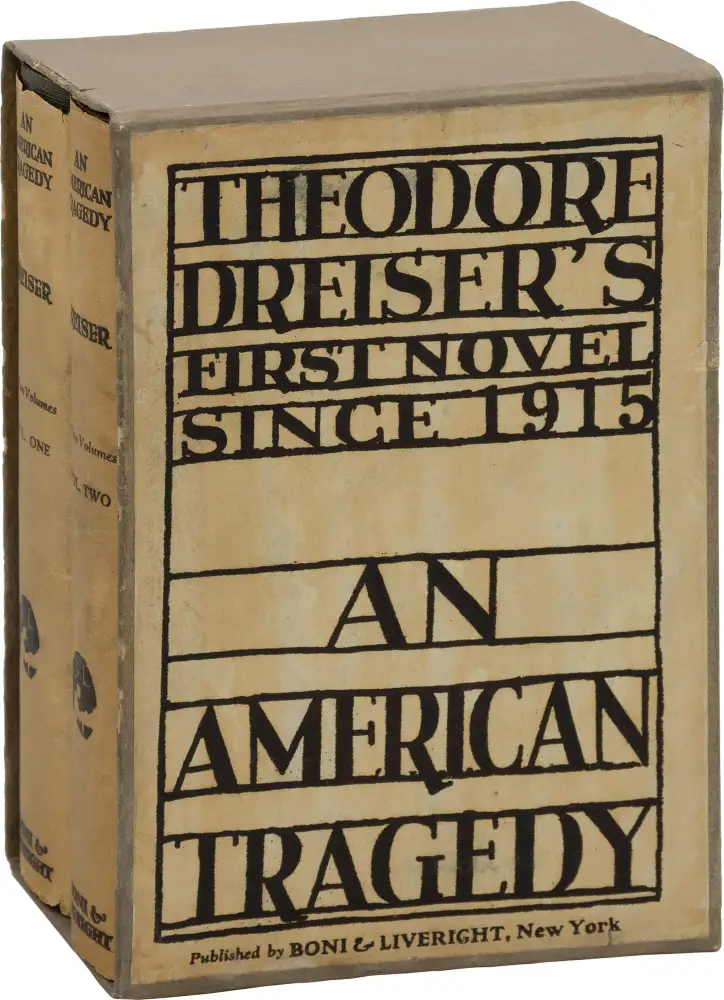
Dreiser’s An American Tragedy (a whopping 900 pages) is, for me, unforgettable (as is the movie version A Place in the Sun with Montgomery Clift and Elizabeth Taylor). He takes us deep into Clyde’s head and heart, step by step tracing the choices he makes that take him down, down, down. It’s like watching a terrible traffic accident in slow motion, starting with the first wrong turn.
One final note. An intrusive Omniscient POV is perfect for an author with a singular and humorous voice (e.g., Douglas Adams, Tom Robbins, Kurt Vonnegut). But that kind of voice is the hardest of all to pull off.
All that to say, I wonder if classic Omniscient POV could make a comeback. It requires a writer of great skill and intention…and readers with an attention span longer than seven seconds. In this age of apps that’s quite a challenge.
What say you?
While I fall into the “write omniscient by mistake” category at times, I’m not opposed to omniscient view. In some ways, I think I’d rather have omniscient than 1st person. And I probably have less resistance to it because I tend to like older books.
But if it’s well done by an author, it’s great. Your Dickens example is perfect.
Yes, and it can be entertaining in its own right, just like a good 1st Person (e.g., Chandler).
JD Robb is Nora Roberts who has perfected her kinda omniscient floating third-person voice for over fifty years of bestsellers. She does it very, very well. However, editors will toss your manuscript away if you attempt it because you are not Nora Roberts.
JD Robb uses omniscient POV. “Music Eve didn’t recognize as Mozart was playing in the ballroom.”
I don’t like it when it’s “If only she’d known …” Or, “little did she know…”
No wonder she doesn’t sell.
😂
The above was intended to be a reaction to Jim’s reply. Who says indents don’t matter? 😄
My reaction to someone else’s comment went elsewhere, too. Either our brains are rattled from too many fireworks, or WordPress is being weird.
This is a masterful rundown of the Omniscient POV, Jim. I do think it could make a comeback, in fact, I think it should. It does need. as you say, “a writer of great skill and intention.” I think it also needs an even higher degree of authorial confidence than usual to effectively pull off.
Just like, as Tom Hanks memorably said in A League of Their Own that “there’s no crying in baseball,” there’s no self-doubt in writing omniscient. Instead, own the Omniscient voice, be it authorial or editorial, but especially editorial.
It would be fun to try, I’ll admit. I’m putting it on the back burner, the far back burner, but a burner nonetheless.
I don’t know if this qualifies in this discussion, but I’m reading some Harlan Coben thrillers, and he switches scenes with nary a break on the page. Sometimes I have to re-read the end of the previous scene to figure out who’s thinking/talking in the next one; or if it’s even a different scene. I’m reading them on my Kindle, so maybe it’s something Amazon does.
It won’t stop me from reading them, though…the stories are great.
🇺🇸
Perhaps the Kindle. I think Harlan is pretty careful about white space between point of view changes.
I don’t care which POV an author uses as long as I can lose myself in the book. I don’t care for 1st person, but didn’t even realize the Hunger Games was in 1st person until someone pointed it out. 🙂
That’s really the key to the whole thing, isn’t it? Hunger Games is a great example.
That’s a good point, Patricia. I, too, am not that wild about 1st person but it’s wonderful when the book is so good you don’t even notice! 😎
Louise Penny writes where she goes from one person to the next without any indication of who the new person is in the same paragraph. I could follow it for a while, but I finally gave up about half way through the book. The story was engaging but I got tired of trying to figure out whose head I was in or who was speaking. Agatha Christie head hopped in the “Murder on the Orient Express” and it was engaging and I knew it was different people speaking, so it can be done well where you don’t lose the thread of the story.
With Jane Austin I could tell whose head I was in with a few choice words she uses that guides you to who the person is. Omniscient point of view is one that I like if done well. I could handle a comeback of it.
Austen, we can say, handled it deftly.
Comic novels, some historical big picture fiction, and high fantasy like Tolkien are the only novels where omniscient works. Those of us in popular genre who decide to use it are shooting ourselves in the foot. The only reason readers choose fiction over movies and other media is that our books hit pleasure brain buttons with our sensual details, emotions, and visuals. Essentially, we put the reader there and give them special feels no other entertainment can. Omniscient takes much of that away.
First Blood (Rambo) uses Omniscient well.
Yes, if I remember rightly (IIRR), P G Wodehouse uses omniscient POV and head-hopping in many of his books
What you say of head hopping I read more as authorial narration. To me the use of pronouns (he said, she thought, etc) signals this. Now had the authors slid from one mind to another in “deep POV” that would be different, but in my reading (I’m in the middle of Austen’s Sense and Sensibility) I don’t sense this in 18th and 19th century literature.
I READ whatever another author chooses – if it isn’t too hard to understand and they are consistent and have a great story to tell.
I WRITE deep close third pov in the mind of one character per scene, with an irregular alternation among my three main characters as best tells my story. I tell it from right behind the eyeballs of my characters, and have a step in writing every scene that says ‘CHANNEL the character’ – that’s my favorite step after I’ve gathered all the material that belongs in a scene, BECOMING the character and giving the reader that experience.