
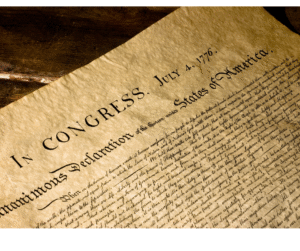
Happy 250th Birthday, America!
Today we celebrate a country that was born from one of the most brilliantly crafted pieces of writing in human history. Thomas Jefferson wrote a document that changed the world. Just like screenwriters and novelists, he did it with structure, pacing, and an unforgettable ending.
Jefferson Built a Case
The Declaration does not open with the conclusion. Jefferson does not lead with “We’re breaking up with Britain.” He builds to it.
He opens with a statement of universal principles. All men are created equal. People have rights. Governments exist to protect those rights. When they don’t, the people can change them.
Then he presents the evidence. Twenty-seven specific grievances against King George. A relentless accumulation of wrongs. Taxation without representation. Soldiers quartered in private homes. Courts rigged against colonists. Each charge adds weight to the next.
Jefferson never tells you King George is evil. By the time Jefferson is finished, George III is not just a bad king; he is a tyrant without mercy.
The 27 Grievances: How to Build a Villain Through Accumulation
The structure of the grievances section is a masterclass in escalation, tension, and pacing.
Jefferson does not open with the worst charges. He starts with the administrative, the political, the procedural. The King has refused to sign laws. The King has dissolved legislatures. The King has obstructed justice. These are serious, but they are the acts of a bad bureaucrat, not necessarily a monster.
Then the charges begin to darken.
The King has sent swarms of officers to harass the people. He has kept standing armies among them in peacetime without consent. He has made the military superior to civilian authority. We are moving from political obstruction into something that feels more like occupation.
Then it gets worse.
He has waged war against his own people. He has plundered their seas and burned their towns. By the time you reach the final grievances, the King is not a distant bureaucrat making bad decisions. He is a warlord burning down the homes of his own subjects.
The Declaration is a 1,320-word novel where the villain is King George and the twist ending is America.
Powerful, Unforgettable Ending
The Declaration builds to a clear, decisive conclusion. The colonies are free and independent states. The political bands are dissolved. And the signers pledge their lives, their fortunes, and their sacred honor.
The Declaration ends with one of the most extraordinary sentences in history.
“We mutually pledge to each other our Lives, our Fortunes and our sacred Honor.”
By signing this document, the men of the Continental Congresst were committing treason against the most powerful empire on earth. The penalty was death.
It is one of the most powerful endings in the history of the written word.
Remember
Two hundred and fifty years ago a writer sat down and crafted a document that changed history. The Founding Fathers understood that the right words, in the right order, with the right structure, could move people to action. Stories matter. Words are powerful!
Happy Independence Day. Now go write something that changes someone’s world.
Patriotic Fun
School House Rock on The Declaration of Independence
National Treasure (2004, Disney+) – a rag tag trio of history treasure hunters race an evil organization to find the treasure to follow the secret map on the back of the Declaration of Independence.
1776 (1972, Tubi or for rent on Prime Video) – a witty musical about the Founding Fathers.
Revolutionary Dramas
Movies:
A Great Awakening (2026, Prime Video) An unlikely friendship between fiery preacher George Whitefield and skeptic Benjamin Franklin sparks a spiritual revival that awakens the ideals of liberty and ignites the American Revolution.
The Patriot (2000) A family’s experience during the Revolutionary War when a father and the oldest son join the fight.
TV Series:
The American Revolution (2025, PBS) Ken Burns documentary about the American Revolution.
John Adams (2008, HBO+) Paul Giamatti as John Adams with Laura Linney as Abigail. It covers the lead up to independence, the war, and its aftermath.
Turn: Washington’s Spies (2014-2017, AMC+), a gripping spy thriller following the Culpeper ring, George Washington’s spy network.
The Crossing (2000) Prime Video – The Story of the Washington leading the troops across the Delaware River and the Battle of Trenton.
Want more content like this? Click here to subscribe to my newsletter.
I was just listening to a podcast about Thomas Jefferson and the Declaration. The host talked about the original draft versus the final draft. I found this link at the Library of Congress so I could read it.
https://www.loc.gov/exhibits/declara/ruffdrft.html
The host also described how Jefferson thought he was writing a committee report that might lead to the writing of the declaration. He poured out his heart and didn’t think anyone would remember it.
Writers, Thomas Jefferson is just like us! Next time you don’t like the feedback on your work in progress from your editor, executive or beta reader, remember Thomas Jefferson hated feedback too.
He did not like the edits that the Continental Congress did to his draft of the Declaration of Independence. He made multiple copies of his original draft and sent them to friends, asking them to compare it to the final version and agree that his was better.
I just heard that yesterday as well. I think one of them said they’d “mangled it.” And he had to sit there and listen to them.
Nicely done, Lindsey!
At White House dinner for Nobel Prize recipients, President Kennedy said, “I think this is the most extraordinary collection of talent, of human knowledge, that has ever been gathered at the White House, with the possible exception of when Thomas Jefferson dined alone.”
250 years later, I wonder what Thomas Jefferson would think if he knew his words had changed history and still survived to guide us. A pretty great legacy for a writer.
Happy Fourth of July!
Great post and perfect timing, because as I was clicking on today’s TKZ post I was also watching David Barton of Wallbuilders show a copy of a draft of the Declaration of Independence and some other items from the founding era.
As Debbie noted above — look at the powerful impact it still has 250 years later. May we always value our freedom and work to maintain it.
A wonderful article and a great reminder of how proficient our forefathers were in writing. We forget that they weighed every word of that document so it would say exactly what they wanted it to say. The same with the Constitution. And to think it has endured for 250 years.
Beautifully done, Lindsey.
Truly, I wish I could’ve been witness to our beginnings…
Have a great weekend.
The musical “Hamilton” really skewers King George with his Greek-chorus song “You’ll be back.” One of his song lines is “I’ll kill your friends and family to remind you of my love.” His last moment on stage is him cackling like the madman he is becoming.
Thomas Jefferson was reportedly 33 years of age when he pinned the Declaration of Independence. He puts to shame those of us who struggle to write a coherent sentence and call ourselves writers.
Caption on a “tee” shirt I saw today on-line.
“Crap, that’s due tomorrow?”
-THOMAS JEFFERSON
JULY 3. I776
I think we can all relate.
LOL! Love it!