
Is Your Character Brave or TSTL (Too Stupid to Live)?
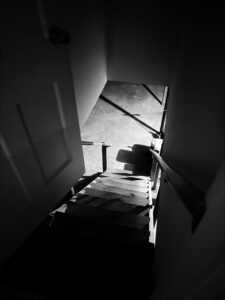
We’ve all seen it on TV or in a mystery/suspense novel. We may have even done it. You know — cue the dark music with a serial killer on the loose…the heroine hears a noise in the basement, opens the door, and the dark stairwell lures her down the steps… all the while you’re yelling, “Don’t go down the stairs!”
The thing is, authors want to show that their character is brave. I get that. I really do. But that’s not the way to do it, trust me—I know. Before I was published, I entered my first book in a prestigious writing contest that offered feedback. My heroine knew she had a stalker, had even just received a threatening note from him, but she still parked her car and walked a quarter mile in the dark to her mailbox where she was attacked before she made it back to the house. One of the judges wrote in the margin: TSTL—she knew there was a probability her stalker was out there and she stupidly put herself in danger. It was a painful lesson, but it drove home the point.
Granted, there are times when the author needs that heroine to go down those basement steps when everyone is yelling for her to slam the door and run. The thing is, you have to give your character a VERY good reason to go against all that is sane. She could be a police officer responding to a call, but even police officers wait for backup. Most of the time.
It’s all in the way you set it up.
If you want your character do something that seems insane, give him a reason the reader will understand and even urge him to hurry and do—like saving a baby or adult or even a pet. People run into burning buildings all the time to save someone, so just make sure the reason they act against their own best interest is compelling and maybe the only option open.
Here are a few scenarios I’ve seen:
- The heroine gets angry with the hero and runs out of his presences into the dark even though she’s just learned she’s being stalked.
- After being afraid of heights through the whole book, the hero can suddenly climb a fire escape and jump from building to building.
- The heroine goes to a bad part of the city to find her brother even though she knows there’s a gang war going on.
- In a historical, the heroine needs water to finish a meal and in spite of being warned not to go to the creek alone, thinks this one time won’t hurt.
So how to fix it:
In each of the cases, a slight variation could make what the character did reasonable.
- What if instead of getting angry with the hero, he’s hurt, and she has to go for help or he’ll die?
- Instead of having the hero be afraid of heights the whole book, have him slowly overcome his fear so that when he has to climb the fire escape and jump from building to building, he still has to overcome his fear, but because he’s been making headway with it, he bravely tries.
- Instead of the heroine going into the city alone, the hero can accompany her, but they get separated, and she has to face the gang members alone, but at least she didn’t go into it alone.
- Instead of needing water to finish a meal, set the story up so that a medical need requires the water—like a baby being born or someone has been wounded and the water is needed to cleanse the wound—that will make going to the creek understandable and the character a hero.
Readers will suspend disbelief or temporarily allow themselves to believe something is true even though it seems impossible as long as the author lays the foundation for the impossibility. It’s up to the author to set up the action in the story so that when your character does something brave, the reader doesn’t wonder if he’s too stupid to live.
Ok, TKZers, what would make you run into a burning building that’s only smoking so far.
Let’s start this with life as a pizza dude has put me in more than a few dangerous situations. Some voluntarily, some not. I would need to assess the risk/reward. Save, try to save someone, yes. Limited risk? Yes. One summer Saturday afternoon in 2014 my assessment changed. By then I had delivered in many questionable neighborhoods. To more than a few drug dealers. To houses where murders had happened. But that day a police officer told two young men to “get on the fucking sidewalk.” They did not. In the end, Michael Brown was dead in the middle of street I used to dive down a dozen times a day. That was when I realized I had been young and dumb a long time.
That is a chilling story, Alan.
The last time someone tried to rob me, they ended up in the custody of the Chesterfield Missouri Police Department. I was talking with the detective and I said I learned to deliver pizza in Ferguson. He stuttered when he said Ferguson because armed wearing Kevlar in a bulletproof car he doesn’t like going to Ferguson. I went every day with a pizza and a lit sign.
Oh, wow, Alan! That is chilling.
I might run into a burning building if I knew someone was inside — a baby for instance, or an injured person.
I was a reporter and many real-life examples of TSTL happened in a fashionable neighborhood on the edge of a questionable area. People didn’t want to pay $7 for guarded, lighted parking, so they’d park for free on a dark street. Or they’d walk back to their car in the free spot when they were drunk. And alone. Soon the area was known for its high crime rate. Don’t get me started on the suburban fools who’d drive into iffy neighborhoods looking for drugs.
I bet you covered some really TSTL stories, Elaine! It’s amazing to me that people will spend all kinds of money for pleasure, but then get cheap when it comes to safety!
It happens so often I think it must be a copy‑and‑paste between films. The protagonist enters the house after finding the door open, flips the light switch and nothing happens. Instead of backing out, they continue farther into the house — or better yet, into the basement — calling out, ‘Is someone there? Are you there? Hello?’
This happens almost as often as the car chase going the wrong way up a one‑way street.
Shortcuts to tension, no setup required — but they’ve become predictable jokes.
I agree, Marshall. Those scenes have become cliches…or lazy writing, take your pick.
I wrote a comic blog article about TSTL. Sadly my examples are from books I’ve read. Here’s a small chunk.
A heroine may be too-stupid-to-live if she
Doesn’t change her lock or improve security after a serial killer breaks in her home and leaves a threatening note. Nor does she consider staying elsewhere.
Sends her guards home after the so-far-inept police decide they have captured the serial killer.
The heroine gets hot for the hero and does something about it when the bad guys are near.
The trained assassin is sneaking up on her professional bodyguard so the heroine, with no fighting training, attacks him herself rather than yelling a warning.
The heroine has an entire troop of bad guys after her, but she doesn’t call in reinforcements, seek help from the police, or tell the hero she’s in trouble.
She has the only copy of some incriminating documents, and she doesn’t make copies, or put them in a safety deposit box in her bank. Instead, she leaves them in her apartment.
The bad guy asks her to meet him to exchange the documents for the hero, and she goes without back up or a weapon.
Bad guys are after the heroine so she picks high heels instead of running shoes because she’d rather die than be unfashionable.
The heroine starts a verbal battle with the hero while they are trying to sneak up on the bad guys.
Someone is trying to kill her so she wanders around outside and in the cavernous mansion she’s staying at.
What can you do to avoid a TSTL character? If you need your stalker-chased heroine to appear on national TV, don’t have her on the kiss cam at a nationally televised football game. Instead, have her save a child from a burning car, and the rescue is caught by someone with a cellphone. If she must do something stupid, have her know that it is stupid or dangerous yet make all other options worse or impossible. As Forrest Gump said, “Stupid is as stupid does.” This applies more to the writer than the character.
Marilynn, I think we’ve been reading the same books. Most of my books happen in a span of a few days with the heroine’s life at danger–that’s why there isn’t a lot of romance in my books–who has time to stop and kiss at a time like that??
I was a home health nurse in a really bad neighborhood. I wouldn’t take unnecessary risks in that area. I called my patients when I was on my way to see them. That way they looked out for me and kept me safe. It’s called being reasonably intelligent with your life. And in writing, I attempt to keep to that “what would a reasonable person do in this situation?” And that doesn’t include going down the steps into the basement or having them do something out of character like climbing a fire escape if you are afraid of heights. (I know I wouldn’t even consider it. I’d find something else to do like hide.)
What would a normal person do in this situation is a question I ask my character. And if they are not the normal, then what would be in character for that person?
Barbara, I love the question you ask your characters, especially the not-normal one. 🙂
Pat, great points esp. how important it is for the author to lay the foundation. With the right setup, I’m happy to suspend disbelief. W/o a good setup, DNF.
Remember the original Lethal Weapon? Mel Gibson’s suicidal character kept trying to get himself killed b/c he was deeply depressed. He became a hero in spite of his self-destructive actions. But an author can’t use that gimmick too much or pretty quickly readers will say, “Oh puh-leeze.”
Yes! So agree, Debbie. It doesn’t take long for a setup to become cliched. And we really have to watch out for that and if we use a cliche, we need to put a twist on it.
Terrific post, Pat. I ditto Debbie’s comments. There needs to be the right setup.
Urgency, such as a ticking clock or concern that someone is in immediate jeopardy, can also help push the protagonist into dangerous situations they’d normally avoid. Having them acknowledge the risk, in say an interior monologue or deep 3rd POV thought, would both make it clear they know this is very risky and help bond them further with the reader.
So true, Dale. Readers really want to go along with authors, but it has to be plausible, and your suggestions are spot on.