
We shook things up at Casa Wortham this week. We’ve lived here for about seven years in what we call the new house, and felt the kitchen needed a change not long after the Bride’s oven sparked, gagged, and filled the house with the heady aroma of burned chemicals.
But this isn’t about major appliances. Remember when you first moved into your place and beheld empty drawers in the kitchen?
One question always comes up. Where does the silverware go? (In Texas, daily eating utensils are silverware, even though the real silver ((plate)) is in a wooden case stuffed back in a cabinet or under a bed and only comes out on Thanksgiving or when someone dies).
Then there are wooden spoons, cup towels, oversize forks and spoons, tongs, measuring cups and spoons, vegetable peelers, graters, garlic presses, thermometers, kitchen scales, bottle openers, corn cob holders.
They need a home in the shallow drawers.
What’s the proper dispersal method?
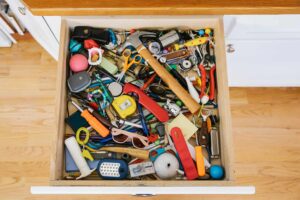
And while we’re at it, there’s the (ominous music) junk drawer. Where will that one be, because we know for certain that a drawer will devolve into one of these chaotic black holes that scientists with pocket protectors in their shirts discuss in hushed tones.
I’m sure you have one of these sacred disorganized repositories of migratory odds and ends nestled in a bed of bread ties, old rubber bands, thick blue rubber bands off celery stalks, nuts, bolts, mysterious batters that might or might not be dead (but you can’t throw them out until you know), and mysterious keys you’ve never seen before in your life. Wait. How the hell did my razor get in there? Was someone shaving carrots?
On moving day in the new house, we unloaded boxes marked KITCHEN into random drawers that were probably open and waiting, and have lived with those spur of the moment decisions since.
But there have been problems. The silverware drawer is between the oven and stove. That’s our serving area when we don’t have sit-down meals, which is 95% of the time. And there are usually a lot of people in line.

If someone is filling a plate, they’re in the way of spoons, forks, and knives, which we usually forget. Then we go back and excuse ourselves to open the drawer, or cut in line, which can be deadly with sons-in-law and hungry teens.
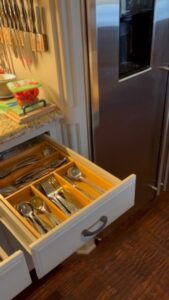
On Wednesday of this week, the Bride came home with a couple of classy bamboo dividers to help separate some of the more aggressive utensils. I was between writing projects, and the next thing I knew, we’d emptied all the drawers onto the countertops and forced significant changes in implement and gadget placement.
Now it all makes sense, to a small degree, but here’s the problem. We keep returning to the wrong places for wooden spoons, measuring cups, and the scissors which reside in the junk drawer. We’re on a learning curve, and I sent our daughters and sons-in-law a thirty-second video preparing them the new organization.
They were aghast.
The Redhead, mother of two, sent an eye-rolling emoji, and Taz, the youngest and mother of three kids, was verbally displeased. But then again, she even hates it when the Bride replaces accent pillows with new, fresh additions.
But I explained. “Change is good. Remembering where everything is in their new locations is exercise for the brain.”
With that, I needed proof to counter verbal attacks when the all come over Sunday night for out weekly get together.
An exhausting thirty second search on medical databases provided this agreement. “Positive change and new experiences are excellent for the brain, promoting neuroplasticity (the brain’s ability to form new connections), boosting cognitive function, improving mood (via dopamine, that’s why it’s called dope, according to my dad) and building mental resilience, even though the brain’s amygdala might initially perceive change as a threat. Varying routines, learning new skills, exploring new places, and engaging in diverse activities build cognitive reserve, helping you adapt and maintain long-term brain health.”
Now I have to make this relevant to my writing blog post.
With that in mind, I looked up “neuroplasticity and amygdala” before diving into another search to find that it’s beneficial for authors to change genres, or write short stories, or nonfiction articles or books. In other words, shake it up.
While reading those confusing medical evaluations and articles for another fifteen minutes, I learned that changing genres or writing styles introduces new narrative tools, breaks writer’s block (which I don’t believe in), fosters artistic growth, and offers fresh perspectives, though it requires extra time.
Switching genres challenges an individual to think differently, find new solutions, and prevents creative stagnation, leading to broader skills and more diverse ideas that can even enrich their primary genre.
But wait! Getting out of your writing lane is commonly considered a bad idea in literary circles. One article I read explored and supported Stephen Kings change from his traditional horror novels to write an alternate history with 11/22/63, or Cormac McCarthy’s shift to his post-apocalyptic The Road. I’ve been told only bestselling authors should take those chances.
Some say we should stick to our writing lanes and do what our fans come to expect.
Fine, wait a while after you write something different before submitting it, but there’s nothing wrong with taking a break from your WIP and writing a science fiction or post-apocalyptic short story if only for personal satisfaction.
This mental exercise is a great way to get out of a rut.
When you do that, find a different place to write for a day or two. Such a change just might inspire something different. Many authors write in one location, and edit in another.
You don’t have to sell those new works today, or tomorrow. You can put them in a figurative junk drawer (see the unplanned connection here? I love the subconscious author.) and dust it off sometime in the future when you need it.
I did that way back in 2012, when my first novel was published and my editors wanted the next book. I’d written a three-thousand-word short story in 1986 that sat in my file all that time, but when I needed an idea, I re-read that old experiment and found the foundation of the second novel in my Red River series, Burrows, which was truly a horror story.
Or maybe you’ve read a non-fiction article in a magazine and thought, “I know that much.” Give it a try.
For several years I wrote “hook and bullet” stories for several outdoor magazines. More than one took awards from the Outdoor Writers of America and the Texas Outdoor Writers Association. I’m proud of those stories and the framed acknowledgments from my peers.
One was an informative history of the longbow, and with liberal applications of scotch, the article was quirky and funny.
I’d exercised my creativity and different writing skills, because I like to try different things.
Like moving the silverware drawer.
In Science Explores News, an article about Dr. Nathan Spreng, a neuroscientist at Cornell University, explored how the brain changes as we learn. Much of the article concentrates on new physical tasks, such as hitting a baseball, but a deeper idea comes from pianists who can play complicated musical scores without thinking about where their fingers go. Their minds can wander, and that opens up even more neural pathways.
So if we get out of our writing lane and try something different, can authors open new creative paths to follow?
Some doctors think it does.
Try a short story, or an article, or start a new chapter in a different kind of novel just to see if that old excitement is there, or if a different way of thinking helps your writing. No one has to see it but you.
Rev, I switch around among short stories and novels, fiction and nonfiction. If i’m stuck on one project, I switch to another. As a freelancer I wrote about a guy who ocean-kayaked from Russia to Japan, the opioid crisis, how to make money with garage sales, rat rods, historic brothels, and more different subjects than I can count. I learned something new from each assignment.
Has that helped my brain? I dunno cuz I can’t remember where I left my glasses. But I’m never bored and always learning.
Change is really good, in my opinion. Writing in different genres makes us use neural pathways to create a mystery, or thriller. Mysteries require a little more planning for most, though as I’ve said, I don’t outline. However, moving to western horror for three volumes allowed me to think differently.
Truth is, I don’t know if there’s any way for me to determine how this brain of mine has improved, or devolved.
When we moved into a new house and were faced with the walls of cardboard boxes to unpack, my mom said, “Don’t put things away until you know where they should go, because you’ll never move them.”
I’m using my Substack platform to play around with new things. It’s fun and refreshing.
I have to admit, it was kinda fun. I always enjoyed moving to a new place, hooking up the stereo, turntalble, and two speakers, and unpacking. As the decades passed, that also meant adding the 8-track, then a cd player, and now, bluetooth. When we re-arranged the kitchen, I dug out old vinyl and we felt like kids again, starting over.
It was a great experience.
I think you’re the only person I ever met who enjoyed the process of moving. LOL!
I do see the value of switching it up from regular length fiction to writing short story and that’s definitely something I want to do — short stories are a whole other creature–and to me much harder to write. I have an anthology in mind that I’d like to do but haven’t yet started on the shorts to go in it.
Switching genres? Much more resistant. I love historical fiction. The only way I could see myself switching genres is if I ever came up with a story idea re: Star Trek TOS featuring Kirk, Spock, McCoy & the gang that would rival the great mass market paperback stories pubbed for Star Trek in the ’70’s and ’80’s.
Though technically I *can* say I’ve tried switching genres. I pulled myself out of the beloved mid-late 1800’s and all the way up into the early 1900’s to write historical mystery, so that counts. LOL!
And every once in a great while I’ll take a notion to write some poetry.
Reavis — I think your post brought up a great way to challenge people (and surprise them!) when teaching classes at a writer’s conference. Have them pick their least favorite genre and depending on time they have, write a few paragraphs or page in that genre & just see what happens. You never know. It could spark a whole new set of ideas. Might try that myself in the next few weeks.
Thank you, and I hope everyone remembers, this can just be a great exercise. No one has to see those works but you, and at some point, you might need to dig them out.
Switching genres and going from fantasy to mystery definitely worked my brain, Rev. I thought writing urban fantasy was challenging with all the world building, but mystery was several levels more of challenging. The hardest thing I’d ever written.
Now that I’ve returned to fantasy for the current project, I feel that I’ve broadened my fiction writing toolset and also broadened my thinking.
Short stories are also an excellent challenge–I’ve written many and they definitely work my writer brain differently than novels do. I tend to think long, so going short puts a lot of constraints on what you can do, but also leads to opportunities to be creative and look at narrative differently.
It goes again the zeitgeist of staying in our lanes, though. Most authors want to be know for their particular characters and locations. And nine books into my Red River series, I understand that. But I wanted to be more creative, and explore other genres. I had to be pigeonholed, and in my opinion, folks should accept those changes and embrace the art itself, and enjoy how the author has expanded everyone’s horizons.
My siblings and I used to be able to walk into each other’s new kitchen and find things without asking. We all followed the sacred Mom Plan from the home place. With five kids to feed, she had the whole organization plan down pat. My sister’s kids were really confused about why a top drawer was called the Middle Drawer, keeper of junk that didn’t belong elsewhere. We’ve all changed it a bit over the years. Even I, the keeper of the home place, have changed the sacred Mom Plan a little.
My publishing career trajectory involved shifts in genre and subgenres through the series of events, and I do not recommend it. Sure, it’s fun to play in genres you like to read, but every change means all those loyal readers you have may not be so loyal, and you have to keep having to rebuild your fan base.
See, we all have certain ideas that require change, allowing us to depart from that same old rut.
I see your point, as evidenced by my response to Dale, but I believe loyal readers will support the artist. Donald E. Westlake, Stephen King, Larry McMurtry. and even Robert B. Parker ,have drifted from what brung ’em, but readers embraced their new works with enthusiasm.
I hope readers show their support for the author’s Voice. And you’re right, sales might dip at the outset, but these experiments open up an entirely new audience who might like that new book, and then go look for your backlist.
Thanks for weighing in!
Blogging for TKZ helps clear out the cobwebs for me, Reavis. I started a new series set in Florida, which was a real exercise for me: creating new settings and characters, as well as crafting a mystery.
That’s great! Starting something new is always refreshing for the writer. I’ve re-ignited my Substack posts, going to back creating humorous, mostly outdoor, posts and I’m hoping it’ll bring in followers through a new platform, and new (to most) Wortham genre.