
by James Scott Bell
@jamesscottbell
 I believe it was the writer-director John Huston who once said a great movie has three unforgettable scenes, and no weak ones. Makes sense to me. Maybe that’s the difference between a good book and a great book, a fine read and an unforgettable one. Let’s think about it.
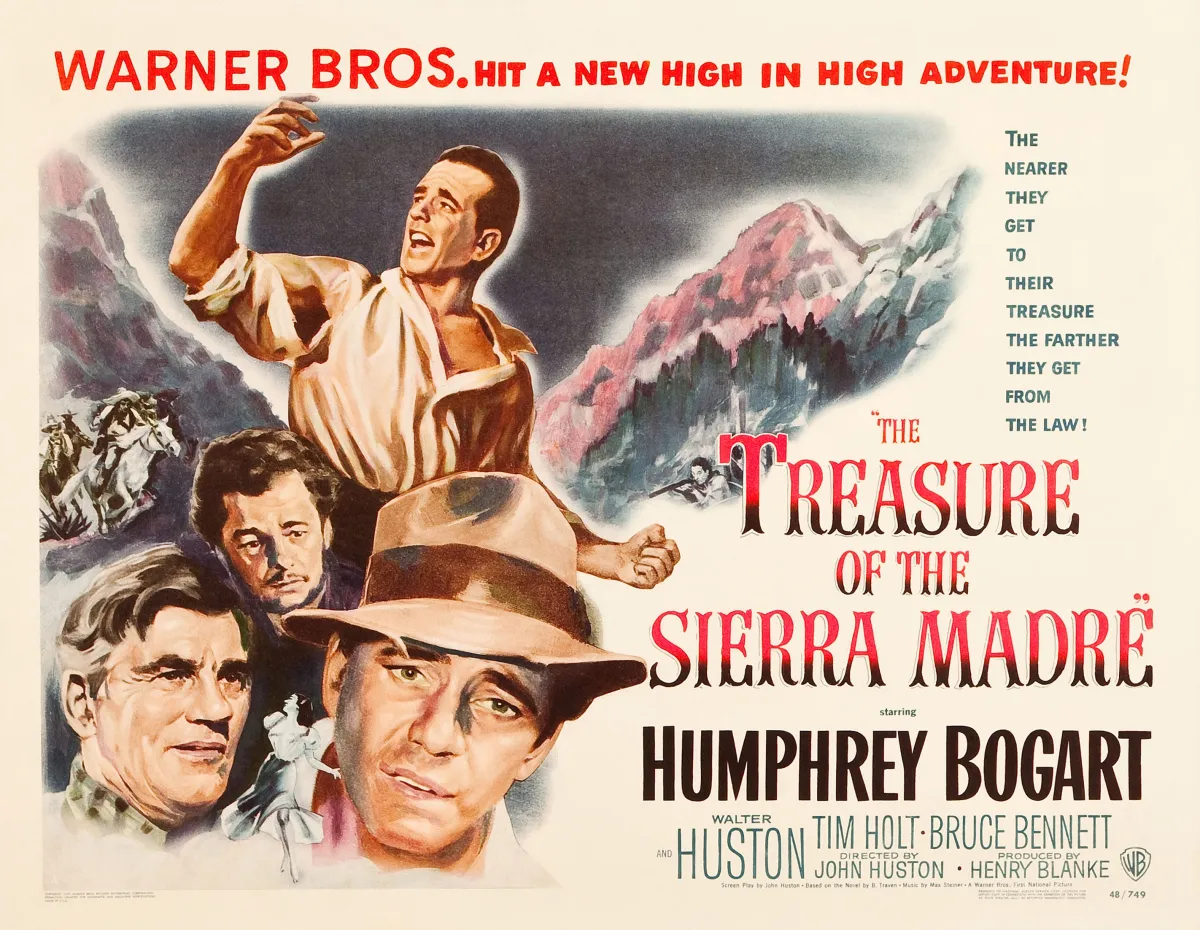
Huston wrote and directed many great films (let’s not talk about Annie. Why Ray Stark tapped Huston to direct his first and last musical, I’ll never know). One of my favorites is The Treasure of the Sierra Madre (1948) starring Humphrey Bogart, Tim Holt and John’s dad Walter Huston (who took home the Best Supporting Actor Oscar). It’s a stark, noirish drama set in Mexico. The first unforgettable scene (for me) is a brutal fight in a bar, when Bogart and Holt confront the man who owes them money. It’s brilliantly choreographed, and done without musical score.
And then there’s a scene that is with us today, whenever anybody utters the line, “Batches? We don’t need no steenking batches!”
I also love the scene where Walter Huston dances around calling out Bogart and Holt. “You’re dumber than the dumbest jackass! Look at each other, will ya? Did you ever see anything like yourself for bein’ dumb specimens? You’re so dumb, you don’t even see the riches you’re treadin’ on with your own feet. Yeah, don’t expect to find nuggets of molten gold. It’s rich but not that rich. And here ain’t the place to dig. It comes from someplace further up. Up there, up there’s where we’ve got to go. Up there!”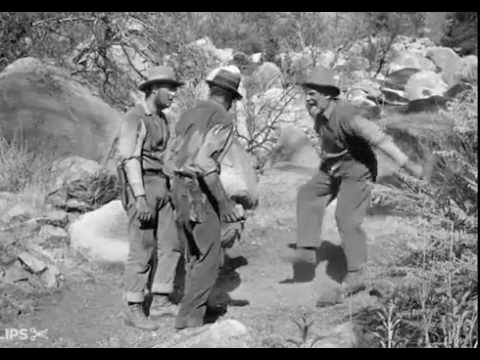
Let’s talk thrillers. Let’s talk The Silence of the Lambs.
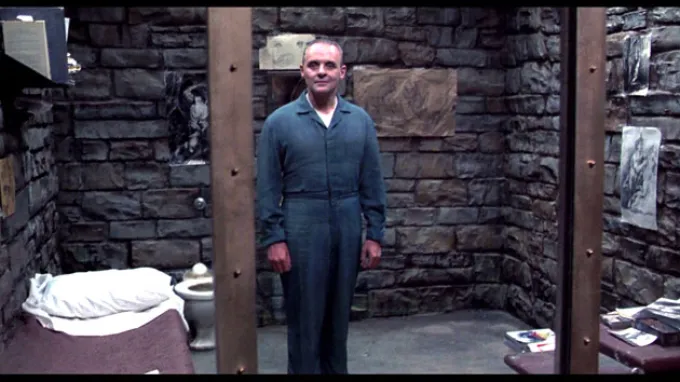
There’s the first time Clarice meets Lecter. When I saw the movie I felt a distinct chill throughout my body as Clarice first approaches Lecter’s cell in the bowels of the prison. We watch from her POV and she first lays eyes on him.
He’s just standing there, looking like Anthony Hopkins, in a position that’s hard to describe. It’s almost like he’s at attention, but with the slightest smile that is full of mystery and menace. It just radiated off the screen. And then begins the cat-and-mouse game that is almost ten minutes of pure tension, primarily through dialogue (as in the book as well).
Quieter movies or books need those unforgettable scenes, too. To Kill a Mockingbird has several to choose from. There’s the cross-examination of Mayella Ewell (the movie version is enhanced by the knockout performance by Collin Wilcox as Mayella). At the end there’s the revelation of Boo Radley (brilliantly portrayed by a young Robert Duvall).
And then there’s the scene at the jail where Atticus faces a lynch mob, and the scene takes a most unexpected turn. See for yourselves:
It’s no undiscovered writing tip to say that we ought to strive for unforgettable scenes. Some writers don’t think about it. They just go from scene to scene doing the best they can with them. I prefer to be more intentional.
One of the things I used to do (before Scrivener came on the scene) was take a pack of 3×5 cards to a local coffee establishment and start brainstorming “killer scene” ideas for my upcoming project. I didn’t pre-judge. I just wrote and looked at the cards later. I remember writing cards for my first Ty Buchanan legal thriller, Try Dying. I had this “vision” of Ty getting on a conference table and tap dancing. Wait, what? But it fit in the book as Ty, whose fiance was killed on page one, is in the conference room of a big-time lawyer trying to intimidate him:
I grabbed my notes and stuffed them in my briefcase. With a quick step on the chair I jumped onto the conference table. As Walbert’s eyes opened wider, I did a little three-step tap dance.
“What are you doing?” he howled.
“Gene Kelly,” I said.
“Get off that table!”
“This is what it’s going to be like, Barton. You looking up at me from now on.”
His face changed colors. Cheeks rosy like the dawn. I don’t know why I did it, except that I never liked bullies. On the schoolyard or in a plush conference room.
Gerry Spence, the greatest trial lawyer of his day, was once asked on 60 Minutes what he’d have done if he were a cowboy in the old West, facing a guy with a knife. “I’d leave him bloody on the floor,” Spence said, “which is the way I try cases.”
I jumped off the table and said, “See you in court, Barton. I’m going to leave you bloody on the floor.”
Let your imagination run wild, without judgment. That’s how you get the gold. That’s what Walter Huston would say. He’d point to your head. “Up there’s where you’ve go to go. Up there!”
How about you? What scenes do you remember from books or movies that were unforgettable?
“What scenes do you remember from books or movies that were unforgettable?”
Pretty much every scene from Star Trek II: The Wrath of Khan, which was the 2nd film in the franchise. And what a huge difference from the first Trek film, Star Trek The Motion Picture–I pretty much couldn’t tell you a thing about movie #1. Indeed I doubt I’ve watched it more than twice.
But boy oh boy did the Trek universe hit its stride with STII. Every scene with tension and attention grabbing skill. Outstanding characters on the good guy side, the best ever bad guy and puts you through the emotional ringer for a multitude of reasons. You don’t even want to get up to go to the bathroom if you’re near to bursting while watching Star Trek II. LOL!
If I hit my stride with a page turner book the way Star Trek did with movie #2, I’ve got it made. 😎
The Martian held my attention all the way thru.
Conan the Barbarian
Shawshank Redemption
Lord of Rings
Hitch Hikers Guide to the Galaxy
Martin Eden
Billy Summers
King Sorrows
The Dark Knight & Daredevil run by Frank Miller
The scene in The Untouchables with the baby carriage starting down the long flight of stairs. I wonder how many takes they needed to capture that incredible choreography.
The horse head scene in Godfather I. The buildup was unbearably suspenseful following the blood trail to the bed and the revelation utterly, horribly shocking.
The final scene in The Apartment where Shirley MacLaine and Jack Lemmon sit down at the table to play a game of gin rummy. Seemingly quiet and ordinary but swelling with hope for their future.
That sequence in The Untouchables was Brian DePalma’s direct homage to Sergei Eisenstein and the famous Odessa steps scene in Battleship Potemkin (1925).
https://youtube.com/shorts/VKn21KnM5cY?si=vw1P4xLkMdHEfzyv
The Death Star scene in Star Wars
The sub breaching in Hunt for Red October
Spock in the radiation chamber in Wrath of Khan. “I have been, and always shall be, your friend,”
The opening scene in Shutter Island. The music, the weather. Pure menace.
Three from “The Great Escape”:
The scene where Hedley “the Scrounger” (played to perfection by the great James Garner) “befriends” German camp guard Gunter; the scene where Steve McQueen’s Hills learns of the mass-breakout plan (“You’re crazy!”) and is persuaded to aid them; the scene were James Coburn’s Sedgewick arrives at a cafe in Paris after escaping, and encounters two nervous employees while trying to avoid the attention of three German officers lunching there, and then sees the two employees do a fast fade as a French car drives up and does a fade himself before a resistance fighter delivers justice to the Germans.
A favorite “sequel” scene, from the 1964 epic “Zulu,” when, after the battle, color sergeant Bourne is giving roll call for the surviving soldiers, marking off the dead as he does. He calls out the name of Private Hitch. No answer. “Fitch, I saw you, you’re alive.” Fitch: “Oh, thank you, sir.”
The last scene in Silence of the Lambs.
“I’m having an old friend for dinner.”
Shivers.
There are many memorable scenes from many movies.
Quigley Down Under, the climatic gun fight beginning with Marston: “By the way, you’re fired.” and ending with Quigley: “This ain’t Dodge City. And you ain’t Bill Hickok.”
However, before that are two scenes with Cora. In the first Marston’s men are driving the aborigines off a cliff and while Quigley is picking Marston’s men off with his modified Sharps, Cora races to the cliff bottom and rescues a baby. Her emotions–the grief that the people who saved her life were being slaughtered followed by the joy of saving a single life–make that scene.
Later, with Quigley off getting help in town, Cora faces the dingoes and her own demons. Having accidently smothered her own child when faced with marauding Comanches, she now must face a pack of dingoes who have discovered her in no small part because of the screaming baby.
All three are great scenes and have stuck with me.
We love that movie. Here’s my favorite quote from Cora…”Don’t worry, on a new job it’s quite common for things not to go well at first.”
I always liked the scene in To Kill a Mockingbird when Atticus kills the rabid dog. So much symbolism in that scene.
Jim Belushi in a bee costume with bandoliers and his sneering “We don’t need no stinkin’ badges” has given that movie line more life than The Treasure of the Sierra Madre. The younger generations’ loses.
The horse race scene from MY FAIR LADY, where Audrey Hepburn shouts, “Move your bloomin’ arse.”
the Yippee-Ki-Yay scene in DIE HARD. And Helen Mirren blasting away a flame thrower (?) in RED.
Excellent advice, Jim. Almost all of my story ideas stem from an unforgettable scene in my head. I may not know where or how to use it right away but it lights the fuse to get my mind buzzing.
“You can’t handle the truth!” That unforgettable tense court scene between Jack Nicholson and Tom Cruise in A Few Good Men will forever stay with me. Many in my circle still drop that line once in a while.
Mine come from Thelma and Louise–the first one come right in the middle of the movie with both women making choices that changes the direction of their lives and then, or course, the ending.
The Empire Strikes Back – “Luke, I am your father.”