
by James Scott Bell
@jamesscottbell
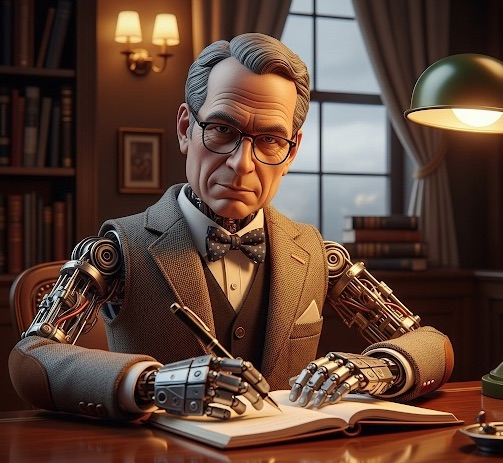 I listened to a podcast panel the other day, all about (can you guess?) Artificial Intelligence. It was a robust discussion of what AI means for writers and publishers, as has been covered several times here at TKZ and just about everywhere else in the known universe. The podcast and transcript can be found here.
One of the interviewees is a romance writer who openly admits utilizing AI generative tools to crank out her product. She released 200 romance novels last year, under 12 different pseudonyms. She sees this as a business, starting out each project by researching what tropes are selling, then interacting with LLMs to set up an outline. “I can then ask the system to generate the first draft for me.”
When asked if she reveals to readers that the books are largely AI, she said she does not. The one time she did she got 14,000 death threats. (A post about the darkness of human nature run amok may be inserted here.)
Anyway…the question came up about whether readers ultimately care how a book is produced. Well, 14,000 wackos seem to. But what about the sane? Journalist Derek Newton offered an answer:
I think the reaction that she received is probably good anecdotal evidence of what the market wants and expects. And my personal view is that a minimum, readers ought to have information about where their books come from….is this a purely human written piece, a work from the mind and spirit and soul of an author? Is it a mix up, a mash up? Did the author have an idea and use AI to put it together? Or is it something that Claude or ChatGPT banged out in 15, is it on the Amazon bookshelves fifteen minutes later? Those are very different things. And I think since we can know that, we should share that information with readers. Maybe some readers don’t care. Maybe they prefer AI. Maybe they only wanna read human stories. But I think the minimum standard ought to be we ought to tell people. And one more thing. She did mention in the interview that she discloses to Amazon. Amazon does ask that, but they don’t share that information, and they don’t have any way to verify it. So any author could simply say no or check the box. Oh, yeah. I didn’t use AI, and there’s nobody looking into that. So sharing it with Amazon may be true, but it really doesn’t add any value to the process or to readers. Readers don’t get that information, and there’s no way to know it’s true.
New York Times reporter Alexandra Alter said:
Yeah, I think it matters, when readers have the choice to decide, okay, I would love to read something written by a human, or I’m curious. Can AI write a good story? I’ll check this out. I think, you know, some might be curious and wanna read something generated by AI. But my impression from comments I’ve seen online and from my conversations with readers is that one of the things that draws people to books is the opportunity to connect with another human mind. And most people, like that human connection and would would opt for that, you know, given the choice.
On the other hand, a listener offered this comment:
We all need to accept that AI is a part of the future. Just like in the past, people had to accept the advances in technology. I believe there should be transparency about AI use, but I think the panel would be surprised to find out that most readers don’t really care if a book is written by AI or an author. Most readers are reading for enjoyment, not loyalty to a particular author.
Ah, as Hamlet might have muttered over his Kindle, that is the question. I don’t believe for a moment that most readers don’t really care if a book is written by AI. If a reader gets massive reading pleasure from a book, they’ll want to a) find more by this author; and b) get to know this author on a human level. When I read my first Bosch, I wanted to know all about Michael Connelly. I read more Bosch, and wanted to meet Michael Connelly…and did, at a book signing. That mattered to me.
And when I’ve done signings and people come up and tell me how much they love my books, there’s no greater feeling in the world. I extend my human touch via my Substack newsletter and, of course, right here at the Zone.
However (and I’m just spitballing here), maybe there is an exception in the romance world. Category romances have always been the largest market in the publishing ecosystem. Many of these are written under pseudonyms. Voracious romance readers go through them like candy. Perhaps for this market human agency is not a big deal.
What about everywhere else?
Let’s talk about it. Do you care about human authorship? Do you care if an entrepreneur uses AI to crank out hundreds of “entertaining” books, making real money on volume? If you read a book and liked it, then found out it was 90% AI generated, how would you feel?
“Do you care about human authorship?”
Yes. I want to read books labored over by real human beings. And if you are going to use AI to write your books, be honest & admit it upfront. While I concur that technology change has been something we’ve had to deal with over time, switching from manual to electric typewriters or computers did not take away human thinking capacity. And I wonder, will said authors who generate their books through AI flop as speakers at writing events? Maybe they’ll be good fakers and able to have deep discussion on writing panels discussing their books. Maybe not.
“Do you care if an entrepreneur uses AI to crank out hundreds of “entertaining” books, making real money on volume?” I care about the negative impact on genuine authors of books and the mudslide it creates in the market.
“If you read a book and liked it, then found out it was 90% AI generated, how would you feel?”
Bottom line, if I read a book then found out the author generated it via AI, I would discontinue seeking out any further works by them. I find that prospect as disheartening as the trend I’m seeing on social media of videos that are supposed to be short, compelling animal videos but you realize they are AI generated.
For me I can’t divorce this topic from what I’m seeing in general — a declining ability of people to interact with one another as human beings, and how willing people are to give up thinking for themselves.
You speak for a lot of folks, BK.
AI doesn’t have a soul. It’s a word cranker outer. Adding to that, it was “trained” by plagiarized works. Non-Amazon publishers are feeling the hit of authors like the one you mention, who crank out AI slop in great volume. Draft2Digital has tried to cut back on some of their losses by implementing charges–nominal, but they’ve gotten some hostile blowback. Barnes & Noble has made changes for those using B&N Press. I wouldn’t be surprised to find Amazon finally pushing back against indie authors using AI beyond that ineffective checkbox.
The major problem is detection. A “clever” cranker-outer can massage the output (I’ve even heard that now there are bots that will purposely include “mistakes” to seem more “human.”) The other danger is that a legit author could be erroneously tagged (there’s em dashes in there!) Etc.
Agree all the way. As an em dash lover and user, I’m surprised I haven’t had more accusations of using AI.
I’m not sure if it’s about readers caring as much as readers being able to tell.
I recently saw an author whose work had been removed because it was ‘plagiarized’ when the offending book was her own, but a translation.
This answers a question for me. I read around five books every week. Many of them are the Amazon Free Reads and many others are digital library books. Lately, I’ve noticed that books by different authors have the same descriptions, same character actions, same style, and I thought it was just the current trend. Today’s post gave me a ’duh’ moment when I realized I must be seeing the results of AI generation. If the podcast book generator (can’t call her a writer or author, can we) put out 200 books in one year, I would imagine readers would be getting bored with reading the same story over and over with only the location and names changed. I know I am. This is why the only books I am willing to pay more than $.99 for are by real authors. I’ve enjoyed every book I’ve read by authors on TKZ, and appreciate the referrals. No one knows what will happen with AI and books in the future, but I believe it pays to fight against it any way we can.
An interesting side: my ten-year-old grandson looked at a picture I found online of a Hummingbird with its baby. His comment? “Cool, but you know that’s AI, right?” Maybe there’s hope for the future.
I do think there’s still a human stamp (if it’s from the heart) that readers can discern. Yes, even ten year olds, God bless ’em!
For me, the impact on a human-created industry/art form is the deal breaker. I feel the same about AI-generated books as I do when I see drones/machines picking fruit. In the name of “progress”, a human who needs to feed his/her family now stands in the unemployment line. Sorry if that sounds anti-progress, but that’s my take on it. It’s not progress in my book.
And at the very least, full disclosure from novel generators, please.
Sounds Bradbury-esque, actually.
I prefer books written by real people, not AI machines. I’ve never liked pulp fiction, I like skilled writing and stories worth telling. The old acronym GIGO comes to mind. Machines have a place in our lives, but should not be designed to replace it and us.
Give the great pulp writers their due. They had their signature styles which came through and madet fans.
I want to enjoy a great story. Some of my favorite authors over many books in a series, seem to get darker with each book and I unfollow the author at that point. Real authors can and do produce slop. I’m reading Theo of Golden at the moment. It’s Lit Fic which is normally a genre that I don’t enjoy, but there’s a character depth in this story that can’t come from AI, yet. I gave up on romance a few decades ago, as the stories all felt the same – I can’t begin to imagine how similar they are now. AI is whack -a-mole in that we’re always trying to block it from our lives. Still this reminds me of 1984 commercial about music – “Is it live or is it Memorex.” . . .
I remember that commercial. Didn’t a glass shatter?
And who ever thought Whack-a-Mole would break out of Chuck E. Cheese and take over our lives?
“Is it live or is it memorex?” That’s what I say when a typically remote employee shows up in person at the office.
Of course the only problem is everyone else is much younger than me so most don’t recognize the reference. LOL!!!!!!!
Garbage in, garbage out. Humanity out, garbage out. I was listening to an AI generated story yesterday on YouTube, and the emotional descriptors were all wrong. Gender switches all over the place. The AI couldn’t tell the difference, and the editor didn’t care to fix it. AI also can’t count. One character would have been ten when he had his son. AI has a “curated” list of names, descriptions, and phrases that it uses in most stories, too, and listeners have their bingo cards comments.
And romance is about emotions, not about tropes. In my own experience, romance readers can spot fakes from writers who are writing romance because it’s a lucrative market, and they do not like the patronization or the misunderstanding of what they want. It’s the difference between a few plain potato chips and a full meal.
That’s the demarcation point for AI, the rendering of human emotion. Can it ever bridge that gap? It’ll probably get close, but not close enough. I hope!
I just finished my first crime thriller novel. It took me three years between research, writing, rewriting, editing, sending it to an editor and with notes, having to do some rewrites. Finally it’s done. My brother said to me – “Why didn’t you just use AI and save yourself those years.” I was highly offended and said – Never. I want to do the research, the writing, all that goes into being an author. I like the journey even though it’s hard work. And I told him, I don’t want to cheat the readers. I want them to know I put the blood, sweat and tears into delivering a novel I hope they love. When I meet them in person at book signings, I want them to know in my heart they are reading every word I wrote.
Yes, “blood, sweat and tears.” Even though the fakers don’t care about that, my writing soul does. I wouldn’t be doing this if part of it wasn’t a nurture of my inner self.
Okay, I will out her — Coral Hart is the main name she goes by. (I found it in the podcast). Also found this quote by her in a different article:
“If I can generate a book in a day, and you need six months to write a book, who’s going to win the race?”
Wow. Cynical much?
As James suggests, this might be something that is endemic more to romance, where quantity often prevails over quality. I say this as someone who got their start in romance. Readers gobble these books up like jellybeans. One reason I decided to leave the romance genre was the pressure from my editors to churn out more books more quickly. This was way back in the 90s folks, so you can imagaine the pressure — from self or outside or the marketplace — today.
I have a friend who uses AI constantly now for his mysteries. He has always been extremely prolific, cranking out at least 10 books a year over four series. But now he’s a virtual machine. No pun intended. But you know what? It’s not very good. And it bothers me that he doesn’t seem to care.
{{{shaking head}}}
I am glad I am retired. 🙂
Yeah, the not caring part is bothersome. Taking pride in one’s work seems so quaint now. So be it.
One of my favorite authors was Clive Cussler, and I read most—maybe all—of his books. At some point I found myself reading novels co‑authored by his son, and now books written solely by Dirk Cussler. Other authors have followed a similar path: first writing their own books, then co‑authoring, and eventually passing the series on to others who continue the characters they created.
JSB has a ten‑book series featuring Mike Romeo. I really enjoyed it and hated to see it come to an end. If an AI were to analyze those ten books and create more stories in his voice, I’d probably read and enjoy them. I’d want to know he authorized the extension, and I’d want to know the books were created by AI. And of course, a portion of the profits should go to the ‘Windows and Children of AI Fund,’ as would only be fair.”
Let me put my two cents in.
Do I care if the author is human or a machine? I care a great deal. The stories I read and love must be written by a human. I want to experience the writer’s hard work. Their blood, sweat, and tears that went into creating the work.
Two, if an entrepreneur uses AI to create stories, whether for entertainment purposes or not, it is, in my opinion, cheating and being lazy. The writer has no business calling themselves a writer since they did not put the work in creating something from nothing. Yes, writing is hard. Yet there is personal satisfaction in the creative process that can not be satisfied by relying on AI.
Third, if I read a story and found out it was mostly fabricated by AI, I would be disappointed and angry. I would not read anything by the writer because they proved they are lazy when it comes to the creative process, and they want an easy way out.
End of my two cents.
I’m glad to get a name finally for the woman who threw out those 200 books. Not because I want to read them, but I’ve wanted to check out the free sample to see how bad they are. Or they could be like the AI-generated music so prevalent on Facebook. The first time I heard one of the songs, I knew it was AI-generated. The voice was too perfect, the words flowed like honey, but they didn’t always make sense…the thing lacking was soul.
Cream always rises to the top. And I don’t think AI can ever be cream.