
Last night I was working on my presentation for the Pikes Peak writers conference scheduled for May. My oldest daughter, the Redhead, was on the couch with her laptop, miraculously inserting the slides as they popped up on my screen at the same time. In addition, she was adding bits of period music here and there in real time.
Kids can do this, even the ones who are now 38 and the mother of two. Technology ain’t my friend, and I’m counting all the ways My Road to Publication and Other Great Disasters presentation can screw up with an electronic hiccup.
At some point in this program, and I never know when because I kinda wander around without notes (which is going to be a problem with slides in and music in a specific order), I reach a point where I discuss the thousands, nay, the millions of rejection notices I received through the years from editors and agents alike.
I wish I’d kept them all, but in a fit of self-pity just before my first novel was accepted, I threw two paper boxes full of them into the dumpster. Okay, it wasn’t millions, but it was a lot.
Some were so faded you couldn’t read the faint blue letters because they were cheap mimeographed notices that said, “Thanks for your submission, but they do not meet our needs at this time.”
Of course the first thing I did after opening the envelope, each and every time, was sniff the mimeograph paper as all kids did back when we were in school. I still try it today. Back then, the whole class did it as one, and it became so iconic, Fast Times at Ridgemont High created that same scene. Lordy, we were probably high ten seconds after all that methanol and isopropyl alcohol hit our lungs.
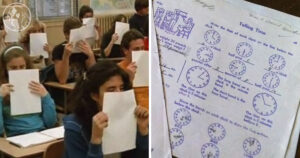
The teachers were probably buzzed pretty good themselves after returning from the workroom with their own lungs full of those same vapors, and nerves jangling with enough nicotine and caffeine to jolt a dead elephant back to life.
On top of all that, if you were a good kid (me), you got to sometimes make those copies for them back there, inhaling the heady aroma of chemicals and second-hand smoke.
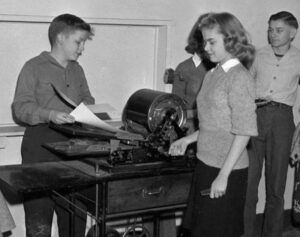
What a time to be alive.
However, back to the rejection notices. Many of them were mimeographed boilerplate blowoffs, and I soon learned it by heart.
Thank you for your submission. Unfortunately it doesn’t meet our needs at this time.
As the years progressed, the letters became more formal, probably because I wasn’t hand-writing them and had graduated to typing. Some were form letters, but others were hammered out by the literary agents or editors themselves.
In one personally written rejection, the agent dismissed my submission with a clear and cutting declaration . “This manuscript has trees in it. I don’t do trees.”
Somewhere around two thousand, I’d reached a point in my attempts to sell a novel and was done and the box was gone that afternoon.
I immediately regretted it.
Desperate for some kind of positive affirmation, I decided to cold call Joe R. Lansdale and ask if he’d suffered the same continual stream of No Thanks. He answered his land line, I told him who I was and how I was a fan, but despite success as a newspaper columnist and magazine writer, I was done.
He didn’t know me from Adam, or even Eve, but he spent nearly an hour on the line, talking me out of stepping off the ledge.
Only weeks letter, I received an email from my starter agent accepting my first manuscript and I quit second-guessing myself.
Rejection letters are a guaranteed stumbling block for all authors.
Stephen King’s first novel, Carrie, received 30 rejections.
Animal Farm was rejected and the editor wrote, “it’s impossible to sell animal stories in the USA.”
Tell that to James Herriott (All Creatures Great and Small series) and Watership Down (Richard Adams).
Even Lord of the Flies was turned down a number of times and one editor declared the manuscript was “absurd and uninteresting.”
J.K. Rowling’s original manuscript for Harry Potter was rejected by 12 different publishing houses. One literary agent warned, “You do realize, you will never make a fortune out of writing children’s books?”
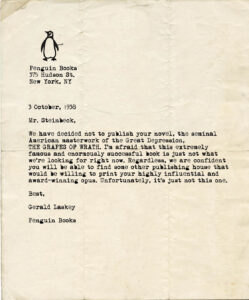
John Steinbeck, well –––.
The secret is to grow a thicker skin and keep working. Neil Gaiman, English author of short fiction, novels, comic books, audio theatre, and screenplays, suggests that rejection slips will always arrive, and, if you get published, you can pretty much guarantee that bad reviews will follow as well. Just learn how to shrug and keep going or “you stop, and get a real job.”
Let’s end with this quote.
“Starting when I was fifteen I began to send short stories to magazines like Esquire, and they, very promptly, sent them back two days before they got them! I have several walls in several rooms of my house covered with the snowstorm of rejections, but they didn’t realize what a strong person I was; I persevered and wrote a thousand more dreadful short stories, which were rejected in turn. Then, during the late forties, I actually began to sell short stories and accomplished some sort of deliverance from snowstorms in my fourth decade. But even today, my latest books of short stories contain at least seven stories that were rejected by every magazine in the United States and also in Sweden! So, dear Snoopy, take heart from this. The blizzard doesn’t last forever; it just seems so.” — Ray Bradbury
So how many rejection notices have you received? Dozens? Boxes delivered via dolly? Or is there one drawer in your desk that is the Dead Zone?
No matter. Keep at it and never give up
My all time “favorite” —
“We did review your proposal, and for some reason we don’t feel we can represent it. Some of them come close, and yours may well be one of those, but we do have our reasons for declining.”
They tend to stick in your mind. But because I got so many, my work improved with each submission.
I wish I had kept all my rejection letters for my novels that sometimes came by return mail in that SASE I enclosed. All that postage…
My short stories did better with Eleanor Sullivan, the editor at Woman’s World magazine who took pity on me when I submitted a 4500 word short story when she only asked for 2500. She bought the story and actually cut it to the required length. She was a gem.
My first editor, Annette Rogers, was the light that finally helped polish my work. She saw what I had, then helped made a number of suggestions I took to heart.
Best advice I ever received on rejections came from novelist David Cates. He said, “Make it your GOAL to get 100 rejections.” The psychological trick of turning rejections around and trying to earn more made them easier to endure. Another rejection letter? Oh goody, now I’m up to 63!
Funny thing is, trying to meet that goal, acceptances started arriving, too. Soon I was up to a one yes for every 10 no’s. When I asked other more experienced writers, they said their ratio was about the same, one in 10.
Long after achieving that goal, I quit keeping track. I estimate many 100s but It no longer mattered cuz I was too busy fulfilling assignments.
These day, most editors and agents don’t even bother to send rejections. They just say, “If you haven’t heard from us in XX weeks/months, consider it a pass.” That bugs me but that’s the writing life in the 21st century.
100 rejections is a great idea! What it means is that you haven’t given up, you’ve moved past your hurt feelings, and you’re determined to reach your goals. Fear keeps a lot of people from achieving their dreams. Thanks for sharing this.
Writers can take rejections personally. It’s a business, and if the quality of your output isn’t good enough, then the author has to work harder.
It’s the electronic world that fosters separation. Even a mimeographed notice is something physical. Hiding behind a screen is wrong.
“If you insist on rewriting this, cut out all that Indian stuff.” – Rejection letter to Tony Hillerman
“Never assume that a rejection of your stuff is also a rejection of you as a person. Unless it’s accompanied by a punch in the nose.” — Ron Goulart
Just be true to your art. Simple.
I built up a stack of rejections when I was submitting short stories to science fiction magazines back in the 1980s and 90s. They were standard form rejection letters, except for two, one from George Scithers at Amazing Stories and the other from Ellen Datlow at OMNI.
George explained my story about a horrifying world where chocolate was illegal 🙂 didn’t have enough narrative meat. He was right.
Ellen praised my submission to her for its evocative immediacy, or words to that effect even as she turned it down. That encouragement from the top SF short story market at the time, kept me going for years.
I used to peruse that stack periodically until one day, I decide to put it in the recycling bin, including the two personal notes. I went for a decade without submitting. Then I attended my first writers conference, began workshopping and working in a one-on-one mentor program with author Mary Rosenblum, and was published in a year—flash fiction to an online market.
As Tim Allen’s character in “Galaxy Quest” said, “never give up, never surrender.”
In the 1980s, I submitted a short story that was way too long to a science fiction magazine I can’t remember right now. They accepted it, despite the novella-size length, but sent me a letter two months later that the publication was going under.
I shelved it for decades, then dusted it off, cleaned up some horrible writing, and it was recently serialized in Saddlebag Dispatches magazine and will soon appear as a novella. In addition, the main character soun off into my third Hollow Frontier novel.
I didn’t give up.
I’m pretty sure Pat has heard this story before, but my first novel rejection was a doozy that almost stopped me in my tracks. The editor wrote “We only publish extraordinary writing and yours doesn’t rise to that level.” I bawled the entire time while making spaghetti for my family that evening. My husband kept coming in to see if I was okay. I assured him I was, but the spaghetti sauce was extra salty that night. However, the editor’s snooty response pushed me to prove him wrong. I never kept my rejection letters or bad reviews because those are the ones you remember. (Like Publishers’ Weekly’s review of my second romantic suspense novel No Child of Mine: “all the characters are unhappy Christians. The only likable characters are the kids.”
Some things don’t change. After publishing 30-plus novels and 9 novellas, I’m back at the starting line looking for a publisher. My agent is shopping a women’s fiction novel about the impact of family violence on multiple generations and a romantic suspense novel. The most difficult rejection I’ve ever experienced came recently regarding the women’s fiction novel. Here’s what the editor wrote:
“I had hoped to get back to Julie earlier, but in the end we had a few discussions in house re this. Kelly is clearly an extremely talented writer; the book is well written and structured. I really liked the different POVs and how we got to see the impact of abuse through the eyes of three generations of the same family.
Ashley and Maddie really moved me, but unfortunately there were a couple of places where I struggled to understand Becca’s decision making as a mother. There were a few moments where I felt conflicted on behalf of Ashley and Maddie, and so ultimately I didn’t fall in love enough with the book and key character at the centre of the story enough to progress to making an offer. I did agonised a little over this one! And as mentioned, apologies for the time taken to make a decision. I discussed the text at length with colleagues, but without fully sharing the author’s passion for all the characters, I don’t think we’re the right home to do it justice.”
While the editor was complimentary and my agent pointed out how very close we came, all I could see was how the editor perceived and decried the abused woman and mother’s decisions. Which is exactly what the world so often does to abused spouses. Having been the daughter/character living this experience, I know personally what I’m writing so it was a hard rejection to handle. My agent is optimistic that the editor’s complimentary response is a good sign we’re getting close. I’m not so sure. But I can’t change the story to force it in-line with misconceptions. So we’ll see. The waiting game continues!
I received a rejection from an agent who said something like this:
…I wouldn’t know which Amazon shelf it belongs on…”
🤔 Uh, women’s fiction?
I didn’t know which shelf her rejection belonged on.
😂
Of the 27 rejections I received when trying to find an agent for NATHAN’S RUN (and yes, I still have them all), only two really stand out in my memory.
1. The New York agent whose rejection letter I received three months after the book had been out on the shelves;
2. The New York agency whose rejection protocol was to send me back my original query (in the requisite SASE) with a stamp–you remember the rubber thing where you pounded it into an ink pad before pounding it on the target paper–that read, “NO”.