
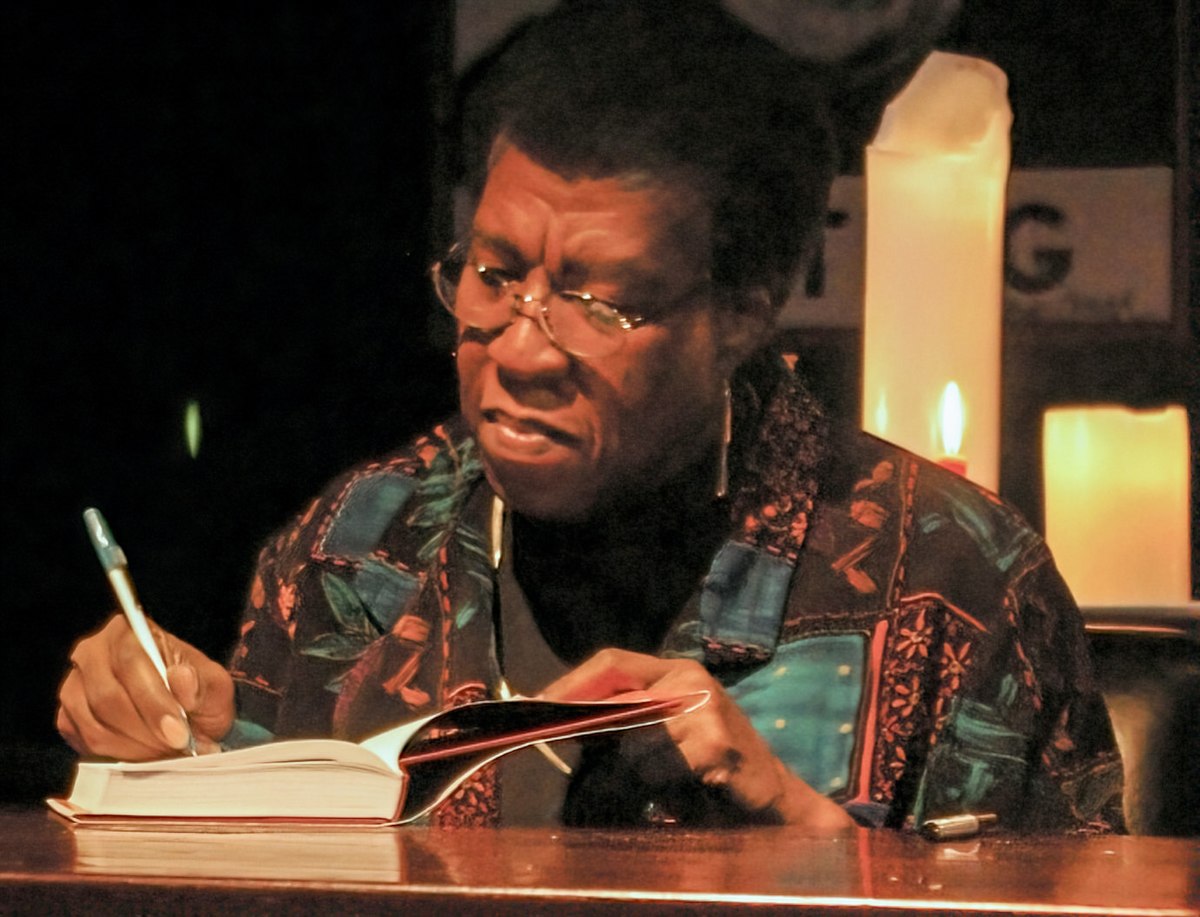
 “I tell would-be writers that there are three things to forget about. First, talent. I used to worry that I had no talent, and it compelled me to work harder. Second, inspiration. Habit will serve you a lot better. And third, imagination. Don’t worry, you have it.” — Octavia Butler
What are your thoughts on the mix of talent, work, and imagination?
What are your thoughts on the mix of talent, work, and imagination?
❦ There’s no substitute for any of the three, but imagination intrigues me. I believe that R L Stevenson was speaking factually when he wrote: “I thus drew steadily nearer to that truth … that man is not truly one, but truly two.”—From “Strange Case of Dr. Jekyll & Mr. Hyde.” Stevenson subscribed to French scientific journals and based his novel on actual cases.
❦ As he averred, the human brain is bipartite: Our consciousness or intellect resides in the frontal cortices. Our intuition or emergency response network is in the so-called “Unconscious.” It probably consists of several midbrain organs, the hippocampus, amygdalae, cingulate gyrus, and, very likely, other structures. By its design and its size and location, the emergency network is many times faster than the frontal cortex.
❦ Creativity is a survival tool. As such, it would be part of the brain’s protective core, a means of responding quickly to a wide variety of possible threats. The frontal cortex is not without creativity, but would lag far behind the protective core. Consistent with RLS’s story, the latter has no conscience.
❦ Both these parts of the brain have access to working memory. It was Carl Jung who said, “The creative process stems from the Unconscious . . . you usually end up by imagining that you yourself are the creator . . .”—From Kankeleit’s The Unconscious as Seedbed of the Creative: Testimonials from Scholars, Poets, and Artists, (1933; pp. 68f.)
❦ So how do we use this creative engine to write? It is willing to help. It enjoys taking control. Brainstorming is its natural element. Fifteen minutes of brainstorming will boost your creativity for at least another fifteen. The protective core also has access to general memory. Lin Rolens, the creative writing instructor at Ventura College, believes that using a thesaurus causes the brain to atrophy, so be patient when trying to find the right word. I go so far as to thank my creative engine for its output. It can’t hurt.
❦ The protective core is also deeply involved in addiction, so beware of drinking while writing.
I’m so glad you commented on this, JG. Your deep knowledge of brain function is enlightening.
I have a question for you (or anyone else who’d like to answer): What part of the brain does AI seek to emulate?
What part of the brain does AI seek to emulate?
❦ Thanks, Kay. An interesting question. I’m not sure I know enough about Aⵊ to give more than the easy answer: the entire frontal cortex, which is associated with intellect, including the prefrontal cortex, where conscience apparently resides.
❦ Based on results so far, Aⵊ lacks a conscience. It will glibly make up lies (“hallucinate”) and present them as fact, When called on them, Aⵊ will simulate an apparent apology.
❦ But generative Aⵊ, in particular, is aimed at creative output. So Aⵊ is also trying, to some degree, to emulate the creative center in the limbic region.
❦ This leaves unresolved the question of whether Aⵊ will attain consciousness. My short story, The Song of Jorex, explores this challenge. In practice, I think not. So far, what’s been achieved is neither artificial intelligence nor consciousness, but simulated intelligence. It may be that successful Aⵊ will ultimately require a bipartite brain. And now, I have an idea for a SciFi story.
I wish you had given this some thought before posting.😁
Seriously, good stuff
Haha, JSB. Many, many thanks.
❦ There’s always something new for me to learn. Over on “X,” today, Tim McKay offers a hint for boosting creativity:
❦ “If {brain fog} is really bad, I’ll open a book I really like and start typing it out word for word in a doc. Kinda tricks my mind into productivity while I study what the author was doing. I find either after that or the next day I’m able to jump into my own writing a little easier.”
❦ I suspect this may work because typing existing text relies on “muscle memory.” The frontal cortex can shut down, and you can run on auto. (Note that the optic nerves don’t go to the frontal cortex; they go to the limbic region, where the automatic aspects of the brain reside–protection, creativity, intuition.) It’s possible that you can warm up the entire mid-brain network with this exercise, if you can avoid critiquing. I’ll try it this weekend.
To me talent is a natural gift or ability. You’re not necessarily going to think about it, per se, but writers do typically strive to continually improve and build upon that natural talent. And of course that improvement will not come without us putting in the work and using our great imaginations. Frustrating thing for me with imagination is that while I’ve talked to many writers whose imagination picks up speed during times of stress (i.e. escape hatch), mine seems to slow down or be harder to draw out. I find imagination sometimes harder to draw out on a whim, depending on the circumstances. Those are the times when you are prone to write ‘dry’ – the material that will need more revising until you can get back in the flow.
Those who merely dream are at the mercy of those who do. Our future comes one choice at a time. Understanding our gifts helps us enhance what we have to work with. Diligence and perseverance, coupled with just showing up, can turn ordinary into extraordinary. Ten two-letter words are all it takes to nudge us toward our goals: if it is to be, it is up to me. Each writer can shape the lives of others. Do it!
Imagination and talent are so woven together I’m not sure how to separate them. I never thought about my imagination until someone asked me where I get my ideas, and my response was: From God.
I believe my imagination/talent is a gift from God. After all He is the Great Creator, and if I don’t use this gift, I’m wasting it and that leads to habit. Without habit I will be one of those who wants to “have written”.
Well said, Patricia. In my mind, wasting God’s gifts, whether it be money, talent, or compassion, is a sin. Those gifts have been given to us to share with others. I believe this so much that it’s a consistent theme in the books that I write about an FBI agent who is able to think like a murderer and thus able to outwit them. The agent wants to leave the FBI because he’s tired of the death and bad things he sees, but his girlfriend insists he stay, to find killers, to not waste the gift that God gave him. BTW, he doesn’t believe in God, so you can see where this is an interesting conundrum. But, the point it, God given gifts need to be shared.
I know I have imagination because (aside from the 35-plus fiction books) because I have a long narrow box from Amazon in my office awaiting the arrival of my 3-year-old grandson. My first thought when I saw it was that will make a great garage for Stanton’s hot wheels and monster trucks. (My husband thinks I’m off my rocker). When Stanton and I get together to play I have as much fun as he does pretending his snakes talk or can be curled up and given to Mommy as cinnamon rolls. We play carwash and garbage truck when neither is in sight. As far as talent, I do believe God gives some of us more writing talent than others. For reasons only known to Him. I sometimes debate whether He gave me much at all. For me hard work is the kicker. Those of us who persevere, polish our craft, plop bottom in chair, hands on the keyboard day after day will prevail. Have prevailed. I could have given up when an acquisition editor passed on my manuscript because his publishing house only published “extraordinary writing” and mine didn’t rise to that level. But I didn’t. His disdain only fueled my desire to persevere. So many people say they want to write a novel, but only some of us are crazy enough to do it–and keep doing it. So I’d say imagination, talent, and hard work are important, but so is a whole lot of crazy.
You have to DO the work. This is where the satisfaction comes from: I did this; I can do this again; it wasn’t there and now it is.
Humans have ALWAYS tried to find ways to get the REWARDS without doing the WORK. Poseurs pretend they’ve done the work – even they know they should claim the rewards by claiming they’ve done the work. They keep trying to do this even when found out (James Frey, anyone?).
You choose what kind of human you want to be.
Writing isn’t so different from vocal performance. Just because I have natural talent doesn’t mean I can read music. That takes work-practice, practice, practice. And imagination?
I like to imagine how the song will sound before I perform it.
And I like to imagine the book/story before I actually hold it.
Great discussion!
😉