
by James Scott Bell
@jamesscottbell
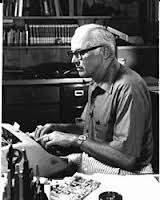
John D. MacDonald and his lunchpail
I have been musing about something of late. Call it a typology of writers. Here the categories I’ve come up with, recognizing there will be some overlap. Let’s discuss.
1. Nothing But Fun
There are some writers who believe writing fiction should be nothing but a joy, carefree, never a matter of sweat or concern. Under this category, there are two sub types. The first believes that a carefree first draft is the only draft it should be written. Cleaned up a bit for typos, perhaps, but left mostly alone. The other subtype writes that first draft and then looks at it and wonders what the heck to do with it, and tries to apply some actual craft and editing.
2. Hate Writing, But Love Having Written
I know a few colleagues who fit this category. They find writing a first draft to be a somewhat difficult trudge. Sometimes this is because their standards go up with each book. The bar is raised. And they seriously want to meet that challenge.
But when they are done with the whole process, including editing and polishing, and the book is the better for it, they find tremendous satisfaction.
3. Lunchpail Type
This is a writer who goes to work each day. They’re not looking for a rapturous experience, though that may happen when they’re not looking. They set out to write a certain number of words each day and do that job. They know their craft and care about it, because they want to sell to readers, and readers care about good stories. The great pulp writers of old were like this. They could type 1 million words a year, sometimes more, and sell their product for a penny or two per word.
4. Doesn’t Care About Sales
In truth, I think every writer cares about sales. Who wouldn’t appreciate a little green from what they write? There’s that famous Samuel Johnson quote: “No man but a blockhead ever wrote except for money.” But this type of writer rejects that notion and finds their satisfaction in writing alone. Nothing wrong with that. Writing can be a form of enjoyment, diversion, mental exercise, or escape.
5. Only Cares About Sales
Finally, there is the writer who is in this strictly for the money. There’s never been anything illegal about that. If somebody write something and there’s a market for it, that’s a fair exchange. But these days it’s possible to make money producing acres of “AI slop.” We all wish this weren’t true, but it is. This type shouldn’t even be categorized as a “writer.”
On the other hand, someone who sees writing as a way to make money, or at least side-hustle dough, and works to figure out how to write a good product, fine. I suspect this is the least populated category.
In reviewing this list, I would put myself as a #3. I’ve always written to a quota. I have also found tremendous satisfaction in learning my craft and getting better at it.
So what do you think about the above categories? Would you add one? Modify one? Where would you place yourself?
Interesting categories of writers. I am unsurprised to find that I don’t fit squarely into any one of these categories but find pieces of myself in all but the 5th typology—“Only cares about sales”.
While I don’t think writing should be nothing but fun, I sometimes wish it was less of a struggle (sometimes I want to be one of those folks who wakes up next morning with a fully plotted story in my mind). But by the same token, I love writing because it’s a challenge to solve plot problems and great satisfaction comes when you weave a strong, engaging story together. For the same reason, I slightly identify with “hate writing, but love having written” – sometimes I get so stuck at some point in a story I just wish I could solve the problem already and move on.
I most identify with “lunchpail type” in caring about craft and wanting to write good stories (though sometimes get stuck on perfecting a scene/story), but I fail considerably in the “goes to work each day” part. I aspire to that, but I’m not there yet. But I know working at it several days of the week (not necessarily every day of the week) is the most advantageous way to pursue writing.
Also identify somewhat with “doesn’t care about sales” – as you say, every writer cares about sales, including myself, but if I took it as strongly as I should, I’d be a lot better at marketing than I am. And truly, if I never sold a book, I’d still love writing.
The timing of this post is perfect. Today (Saturday), I just started re-reading “Plot & Structure” after several years since last read. And this first week of the new year I’ve done better at working on my story more than one day a week. And beginning the re-read through Plot & Structure, I began to feel something I haven’t felt in quite a while – that indescribable feeling of creative buzz and fire is rekindling. Was even able to brainstorm in a fresh way that has been escaping me for the last several months, even though I’ve been working on a story (but mainly spinning my wheels).
I have a tendency to fall into a rut with my writing – it becomes mechanical and the life gets sucked out of it. The best times of writing life are when it gives you a visceral feeling of energy and you’re excited to come back to the page again and again. That’s what I hope my writing life looks like for 2026. It’s time to end the long writing-energy draught.
“…that indescribable feeling of creative buzz and fire is rekindling.”
That’s so nice to hear, BK! That’s the feeling I often get when I look at a favorite writing book again. Onward!
#2. I came into writing in my 50s, so no life long passion for writing. I thought I would try writing a novel, and now I have 28 so I guess I far exceeded my goal. I’m a pantser so the struggle for words is real. I have (2) 2026 goals – learn to love my pantser soul and write 1K words a day. So far I’m failing at both.
That’s an awesome record, and two worthy goals. I have a weekly quota, so if I miss a day I don’t feel bad, I can make it up on other days. And if I don’t make a week, I forget about it. You can also bring down that word goal a bit, too. It should be a motivator and not a taskmaster!
I’d say I fall into 3 with some leakage into 4. Yes, I care about sales, but I still prefer to sell wide rather than exclusively even if it means fewer dollars. Helps that I’m not putting food on the table or a roof over my head with my writing. But I understand that not everyone, especially internationally, uses a Kindle, I want my books everywhere, so I make them available at the major distribution channels.
The good thing is you know what you want, and you’re making it happen. There’s definitely satisfaction in that.
If I make enough money to pay my house cleaner, I’m happy.
Last year was a rough year for us. No time for extraneous anything. Just trying to keep each other alive.
Hoping to get back to writing this year. That was my plan when I retired. It was supposed to be my new full time gig. Which makes me a wanna be lunch pail writer.
If all goes well we have a move coming up. Fingers crossed. We’ll be closer to the beach, which was always my best writing spot.
Happy New Year, everyone!
Hoping it all comes together for you, Cynthia!
Another wonderful post Mr. Bell. I would put myself at number 4. I had never even written a short story before writing my novel at 59 years of age. I finished it and self-published it. Is the writing on the level of Cormac McCarthy? Of course not. But I do think it was a wonderful story, and a story I needed to tell. It took a year of my life to write, getting up at 4 a.m. ( Thanks Dan Brown ) and I have to say it was the happiest time in my life, and writing it is one of the few things in my life that I’m proud of. Is it fun to check the Amazon sales report and see that I sold a few copies? Of course. But it was never about making money, just telling a story I needed to tell. ( Someone on a Facebook group had mentioned it and said it helped her get through a very difficult time – now that meant more to me than a few sales, and made the whole thing worth while! ) And thank you James Scott Bell for all your wonderful craft books that helped me pull it off.
Thanks for the good word, Robert. And you are so right about the wonderful feeling that comes when something you have written helps a total stranger. Priceless.
I’m a hybrid 2. Getting that first draft out is an epic struggle. Yes, epic. But once I have something to work with, I LOVE editing. Each round not only reveals flaws but uncovers new insights about my characters. There’s nothing like the experience of making a mess into a ms I’m proud to submit.
Making a mess into a worthy manuscript. That is so satisfying, making things better because you know the craft and can pull it off.
Speaking of generating ideas, how timely that the following random quote dropped into my inbox this morning:
“Getting an idea should be like sitting on a pin; it should make you jump up and do something.” ~ E.L. Simpson
I like it.
Thought-provoking post, Jim. I think your list captures many of the types of writers. I’ve been caffeinating and trying to think of any others, as well as where I fit.
The additional ones I’ve come up with so far:
6. “The wrestler” because this type wrestles with themselves as they also wrestle with the story. They often have very lofty aims for their fiction which makes themselves their biggest obstacle.
7. “Committed to writing” is someone who may not write every day, but who is writing regularly, who loves story and craft, is aiming to publish and once published, continues on the path. A variant of your #3, the lunchpail writer
Which brings me to myself. I’d say I’m a hybrid of #6/#7 becoming #3 when I’m under a hard deadline, such as a pre-order or a submission window. I’d like to become more of a lunchpail type without needing the hard deadline.
Lots of food for thought in your post today!
Good additional thoughts, Dale. Socrates said know thyself, and you do!
Dale, “The Wrestler” – definitely one I identify with!
I don’t know what type of writer I am. But I know which one I want to be.
A Lunchpail writer. And I like how it’s described here: “Goes to work everyday” to do their job. That’s who I want to be.
🙂
Go for it, Deb!
If they don’t care about sales, then why did the writer put words on paper? So, I would say that #1 and #4 could be considered the same, with the difference being better finishing.
As for the pulp authors, or #3, they were definitely concerned about sales. They had to sell their stories to publishers, whereas #5 can just self-publish. Both were looking for that check in the mailbox or account.
I’m a #3 because I have stories that are demanding to get out and I feel if a reader enjoyed them, then I won’t say No to having a copper thrown my way.
I’m not yet at the point where I don’t struggle with the words on the page. I want them to be the best that I can put out at this point.
I think wanting the words to be the best is always a good goal, providing we don’t make the perfect the enemy of the best. It’s a bit of a fine line.
I’m a lunch pail writer, Jim, who still occasionally finds great joy in writing. I’m luck to have work I love. Also, I’m in it for the money.
oops. I’m “lucky to have work I love.”
And we’re lucky to have proofreaders, LOL.
Is there an In-Betweener category? I do like to write as often as possible even if it’s not my fiction stuff. But I do hope to make some money at it but I’m not in it only for the money either. Writing brings me peace and joy, sticking with the characters along the way, getting them in and out of messes. I have written all my life. I just love it so. Editing was hard for me but I’m learning to like even that now as it makes the book better.
It took me a while to love editing, too. But when you know the craft and can solve issues, it’s a tremendous feeling.
You can enjoy the process of writing. That doesn’t mean you only write one draft or you only doing a little editing if that. I have always enjoyed all aspects of writing from the early creation process, the research, putting it on paper, and editing it later.
The only part I never enjoyed was the business, itself, because of the amount of idiots I had to deal with. I retired from writing after one of my publishers nuked any possibility of my book gaining any traction through their refusal to follow their main distributor’s contract, and my book disappeared into their backlist without a whimper.
In my advice to newer writers, I always tell them if they don’t enjoy the writing itself, they should find another way to use their creative energy or try to make money. The money is crap for most of us, and we must deal with so much stupidity.
Yeah, if there isn’t some aspect of enjoyment, why do this? Better if you love the process of creation, and then can tolerate or work around the business.
Call me Hybrid. Sometimes there are moments of pure joy. Other times it’s a struggle to get words out. I want to be the lunch pail type, but I’m realistic enough to know life can get in the way occasionally. Yes, I want to have a decent number of sales, but that’s not what drives me. I’m more interested in a job well done—a book that my family can be proud of.
I show up for work every day with my lunchpail but always try to pack in a little fun with the peanut butter sandwich.
I love writing and editing but hate marketing. Periodically I force myself to focus on selling books. Once I talk myself into doing promotions, they usually work, but I can’t sustain the effort for long.
If only I was as consistent with marketing as I am with producing words.