
Writing for Short Attention Spans

by James Scott Bell

My new Romeo thriller, Romeo’s World, is live today. Like all the others, it does not have chapters. It has scenes, as long or short as they need to be. Each scene is set off with a drop cap, like this (click to enlarge):
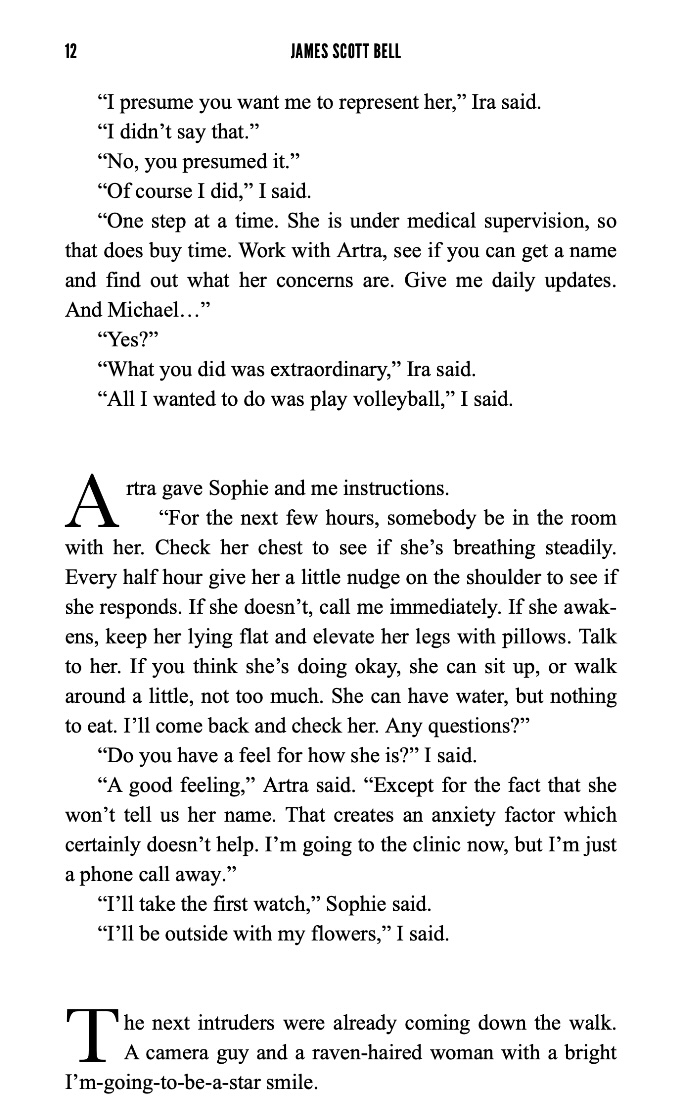
I find this freeing and cinematic (as in “jump cuts” to move to another scene).

In the thriller market, short, numbered chapters roared into fashion with Mr. James Patterson, who I predict will break out soon. I wrote my Try series this way, each book with well over one hundred chapters. I now find it a bit absurd to have a TOC with 191 chapters listed, like one would expect a reader to think, “Gosh, I want to read Chapter 148 again. It was so good!”

So I don’t do the number thing, though in a future stand-alone I might. Either way, we’re all dealing with shorter attention spans these days.

A recent PW article reported on the move in Middle Grade fiction toward shorter books:

In recent years, educational surveys, sales data, and anecdotal evidence from teachers and librarians have all pointed to the same discouraging fact: that the share of kids ages nine and up reading for pleasure is at a record low.

***

Conversations in middle grade have increasingly gravitated toward length. Page counts under 200 are cropping up more frequently on fall and spring lists.

“We have a new type of kid now,” says author and agent Jackie Garcia-Morales at Storm Literary Agency. “They’re reading, but they’re reading in different ways—the simplest form being memes and GIFs. In that in-between age of middle grade, they’re moving away not only from longer books but also from longer-form videos and entertainment.”

***

[Krista Vitola, executive editor at Simon & Schuster Books for Young Readers] echoes that sentiment. “Kids have so many time constraints and competing interests, including sports and other activities. They don’t have those long windows to get lost in books like previous generations had.” Creating books that can be read in shorter stretches is a strategy for helping them fit reading in.

All that applies to adults, too, does it not? We’re all on our phones 17/7, more if we have insomnia. Who has time and attention to just sit and “get lost in a book” anymore?

A commercial novel can be long, of course (looking at you JK “Robert Galbraith” Rowling), so long as the author knows how to make readers want/need to turn the page (a subject for another time). Like The Martian by Andy Weir, which started as an indie project and comes in at a hefty 105k words.

I write in the pulp tradition, which means crisp, fast-moving stories, rarely over 80k.

Thank you for your kind attention.

Now over to you. Do your books have an average length? Do you think “shorter,” or just let the words fall as they may?

How’s your reading time these days? When was the last time you got lost in a book for over an hour?

Bleeding for Your Book

by James Scott Bell
@jamesscottbell

JK Rowling (via Wikimedia Commons)

I hope you all had wonderful Thanksgivings. Ours was a joy, all of us together, including the three grandboys. I greeted them as they pulled up to the house. They tumbled out of the car like circus clowns. The two youngest held favorite toys. But the oldest, 10, had a thick paperback under his arm. It was Harry Potter and the Goblet of Fire. He’s about halfway through it. My heart sang.

Hard to believe that the Harry Potter series ended way back in 2007. JK Rowling did not publish another book until The Casual Vacancy in 2012. That novel was a stand-alone for adults, with the language and themes to prove it. Was Rowling worried about the abrupt change in genre? Not a bit. In an interview she put it this way:

Harry Potter truly liberated me in the sense that there’s only one reason to write, for me: If I genuinely have something I want to say and I want to publish it. I can pay my bills, you know, every day. I am grateful for that fact and aware of that fact. I don’t need to publish to make a living.

We both know what it takes to write a novel, we both know how much blood, sweat and tears go into writing a novel, I couldn’t put that amount of energy into something purely to say I need to prove I can write a book with swear words in it. So no, there was no nervousness – and again I don’t mean that arrogantly. I felt happy writing it, it was what I wanted to do.

I think we can all agree that JK Rowling can pay her bills. But what do you think of writing a novel as “blood, sweat and tears”? (Churchill actually said, “I have nothing to offer but blood, toil, tears and sweat.” But that was too long for a rock band, so it was shortened.)

It was not Hemingway who said writing was a matter of sitting down and the typewriter and bleeding (it was either Paul Gallico or Red Smith, or maybe both). But the sentiment is the same.

There does seem to be a small school of thought that says quality fiction knows not blood, sweat and tears. I don’t know about you, but I can tell a bloodless book within about 10 pages, if I haven’t set it aside by then.

I’ll add that you can’t just bleed on the page, as that only makes a stain. The sweat comes when shaping the blood into a narrative form readers can relate to. The tears indicate some frustration at times, and I contend if you don’t have those you aren’t pushing yourself beyond your current capacity. Of course, you’re not obligated to do that. But when asked what she aspires to as a writer, Rowling said, “To get better. I think you’re working and learning until you die. I can with my hand on my heart say I will never write for any reason other than I burningly wanted to write the book.”

There are also some who say you mustn’t let anyone else—editor or beta reader or spouse—opine about your story. Rowling doesn’t see it that way, and I daresay she’s sold a few books. Of her editor on The Casual Vacancy she said:

When he read the book, he singled out certain things about the book that I would have liked someone most to single out about it. I just knew I had the right person. It’s a very intangible thing. It’s like falling in professional love, isn’t it? And once you’ve got that, something clicks and you know you’re in safe hands.

We certainly made some cuts. I decided to move some things around, he made some great suggestions. The book is broadly what it was when I gave it to him. I didn’t change much but what we did change tightened it up a lot, which is what you want.

Rowling has, of course, gone on to write a hugely popular series of detective novels under the pseudonym Robert Galbraith. They are the product of, what do you know? Work.

I often start with a kernel of an idea then work out how to get there. I plan and research a lot and know far more about the characters than actually ends up ever appearing in the books. I have colour coded spreadsheets, so I can keep a track of where I am going.

It is how I have always worked. It was the same for the Harry Potter novels. It’s well documented the level of detailed planning that went into those.

JK Rowling is what I call a real writer. She could sit back and sip gin gimlets and collect sea shells for the rest of her life, but she won’t. She can’t. She writes.

What about you? Do you bleed for your stories? It doesn’t have to be absolute agony, a la Proust. But shouldn’t you have some “skin in the game”? Shouldn’t you “open a vein”?