

My new Romeo thriller, Romeo’s World, is live today. Like all the others, it does not have chapters. It has scenes, as long or short as they need to be. Each scene is set off with a drop cap, like this (click to enlarge):
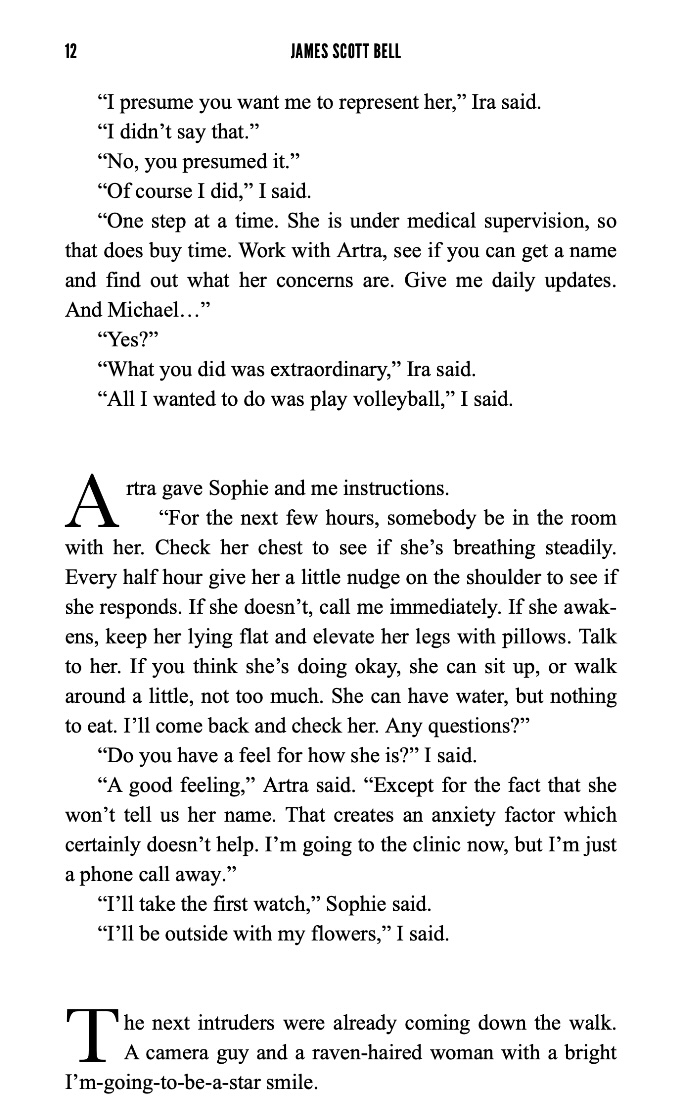
I find this freeing and cinematic (as in “jump cuts” to move to another scene).
In the thriller market, short, numbered chapters roared into fashion with Mr. James Patterson, who I predict will break out soon. I wrote my Try series this way, each book with well over one hundred chapters. I now find it a bit absurd to have a TOC with 191 chapters listed, like one would expect a reader to think, “Gosh, I want to read Chapter 148 again. It was so good!”
So I don’t do the number thing, though in a future stand-alone I might. Either way, we’re all dealing with shorter attention spans these days.
A recent PW article reported on the move in Middle Grade fiction toward shorter books:
In recent years, educational surveys, sales data, and anecdotal evidence from teachers and librarians have all pointed to the same discouraging fact: that the share of kids ages nine and up reading for pleasure is at a record low.
***
Conversations in middle grade have increasingly gravitated toward length. Page counts under 200 are cropping up more frequently on fall and spring lists.
“We have a new type of kid now,” says author and agent Jackie Garcia-Morales at Storm Literary Agency. “They’re reading, but they’re reading in different ways—the simplest form being memes and GIFs. In that in-between age of middle grade, they’re moving away not only from longer books but also from longer-form videos and entertainment.”
***
[Krista Vitola, executive editor at Simon & Schuster Books for Young Readers] echoes that sentiment. “Kids have so many time constraints and competing interests, including sports and other activities. They don’t have those long windows to get lost in books like previous generations had.” Creating books that can be read in shorter stretches is a strategy for helping them fit reading in.
All that applies to adults, too, does it not? We’re all on our phones 17/7, more if we have insomnia. Who has time and attention to just sit and “get lost in a book” anymore?
A commercial novel can be long, of course (looking at you JK “Robert Galbraith” Rowling), so long as the author knows how to make readers want/need to turn the page (a subject for another time). Like The Martian by Andy Weir, which started as an indie project and comes in at a hefty 105k words.
I write in the pulp tradition, which means crisp, fast-moving stories, rarely over 80k.
Thank you for your kind attention.
Now over to you. Do your books have an average length? Do you think “shorter,” or just let the words fall as they may?
How’s your reading time these days? When was the last time you got lost in a book for over an hour?