
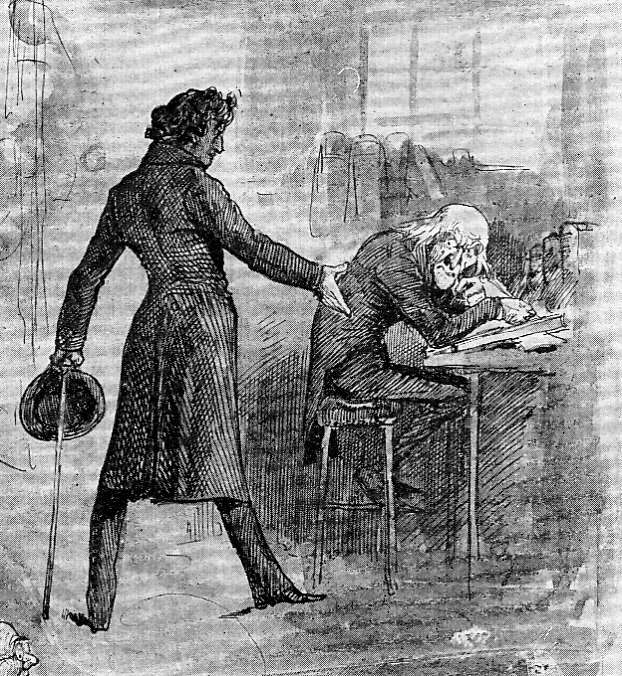
“A merry Christmas, uncle! God save you!”
In Super Structure, I explain a beat called “the argument against transformation.” It is the linchpin of the character arc. It pays off the end, when the character “proves their transformation” at the end.
In It’s a Wonderful Life, the young George Bailey argues against small town existence. He tells the two girls, Mary and Violet, that he’s going to be an explorer, maybe have a harem and a couple of wives. That desire to get away gnaws at George throughout, until he breaks and almost jumps off the bridge. At the end, of course, he realizes how much he loves his family and town, and how much they love him. He has overcome the argument against transformation, and proved it by crying out to live again.
This adds dimension to any story because readers anticipate a character journey. The character goes through the dark world, defeats death, and comes out a better version of himself.
There can be a negative transformation, as in The Godfather. At the opening wedding scene, Michael “argues” to Kay that he’s not going to be part of his father’s business. In the very last scene he proves his transformation into a ruthless crime lord by calmly lying to Kay’s face about ordering Carlo’s murder.
At the end of Casablanca, Rick has transformed from an angry loner to a sacrificial hero. Early in Act 1, however, he “argues” against that. “I stick my neck out for nobody.” That piques the readers’ interest. Will Rick ever stick his neck out? Boy, does he ever prove it at the end. He is ready to sacrifice his own life to get Ilsa and Victor out of Nazi clutches. A surprise twist saves him, and he walks off with his new BFF.
In Lethal Weapon, Martin Riggs (Mel Gibson) is a suicidal cop. His wife was murdered. He doesn’t care if he gets killed in the line of duty. Indeed, he longs for it. After getting a jumper off a roof in a most unorthodox fashion, his partner, Murtaugh (Danny Glover) pulls him aside and screams at him. “Do you want to die?”
Riggs screams back at him. Yes, he wants to die! He thinks all the time about eating a bullet. Riggs pulls out a hollow point that he carries around with him, holds it up, says this will blow the back of his head off. He tells Murtaugh he has to think of a reason not to do it, every single day.
Does he transform at the end? Indeed he does, and it’s proved with a beautiful visual—the bullet wrapped in a ribbon. He gives it to Murtaugh’s daughter, who he saved from the bad guys at the cost of his own life (almost). “Give this to your dad, okay? It’s a present for him. Tell him l won’t need it anymore.”
All that to say, the argument against transformation adds a secret ingredient to entice the reader onward. And that is more important now than ever, because of (you guessed it) AI-slop.
Now, let’s agree that AI-slop novels are not horrible. Soulless, but competent. The argument against transformation and the transformation proved adds the soul.
Readers are consumers. We writers are producers. Our books are our goods. Amazon is our distributor. KENP is one aspect of that distribution. I think we all know that the supply of goods has exploded because of AI-slop. What has not increased is the supply of readers and the time they give to reading.
Thousands (tens of thousands?) of books are added to the Kindle pool every day. But a reader’s time stays the same. And because of the slop more and more of that time is spent sampling the ever-increasing supply.
The argument against transformation early in your book (so it shows in the Kindle sample) is an added inducement to read on.
A small thing? Perhaps, but we need to use every advantage we can muster in the war with the machines.
What is Scrooge’s opening argument?
“Merry Christmas! Out upon merry Christmas! What’s Christmas time to you but a time for paying bills without money; a time for finding yourself a year older, but not an hour richer; a time for balancing your books and having every item in ’em through a round dozen of months presented dead against you? If I could work my will,” said Scrooge indignantly, “every idiot who goes about with ‘Merry Christmas’ on his lips, should be boiled with his own pudding, and buried with a stake of holly through his heart. He should!”
Of course at the end, he loves Christmas, and proves it by buying the prize turkey for the Cratchits, going to church, reconciling with his nephew, and becoming a “second father” to Tiny Tim.
He became as good a friend, as good a master, and as good a man, as the good old city knew, or any other good old city, town, or borough, in the good old world.
And that’s why A Christmas Carol is the one of the most beloved stories ever written.
Can a machine do that?
Humbug!
Comments welcome.