
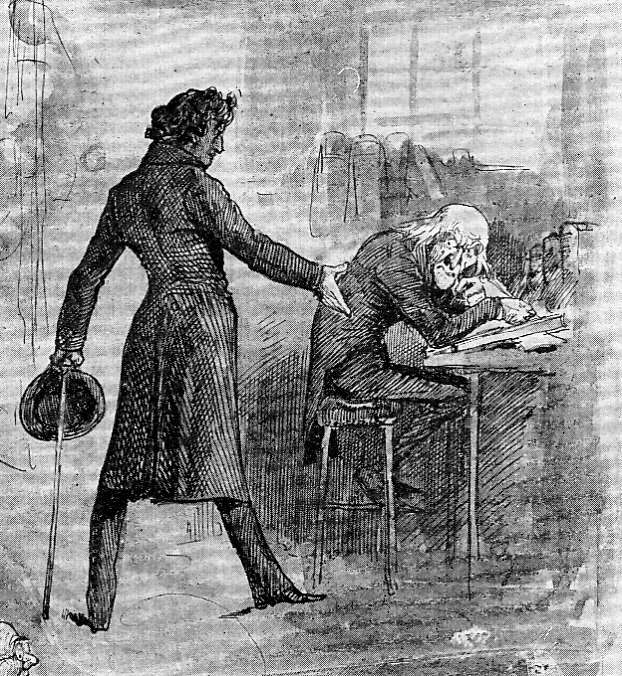
“A merry Christmas, uncle! God save you!”
In Super Structure, I explain a beat called “the argument against transformation.” It is the linchpin of the character arc. It pays off the end, when the character “proves their transformation” at the end.
In It’s a Wonderful Life, the young George Bailey argues against small town existence. He tells the two girls, Mary and Violet, that he’s going to be an explorer, maybe have a harem and a couple of wives. That desire to get away gnaws at George throughout, until he breaks and almost jumps off the bridge. At the end, of course, he realizes how much he loves his family and town, and how much they love him. He has overcome the argument against transformation, and proved it by crying out to live again.
This adds dimension to any story because readers anticipate a character journey. The character goes through the dark world, defeats death, and comes out a better version of himself.
There can be a negative transformation, as in The Godfather. At the opening wedding scene, Michael “argues” to Kay that he’s not going to be part of his father’s business. In the very last scene he proves his transformation into a ruthless crime lord by calmly lying to Kay’s face about ordering Carlo’s murder.
At the end of Casablanca, Rick has transformed from an angry loner to a sacrificial hero. Early in Act 1, however, he “argues” against that. “I stick my neck out for nobody.” That piques the readers’ interest. Will Rick ever stick his neck out? Boy, does he ever prove it at the end. He is ready to sacrifice his own life to get Ilsa and Victor out of Nazi clutches. A surprise twist saves him, and he walks off with his new BFF.
In Lethal Weapon, Martin Riggs (Mel Gibson) is a suicidal cop. His wife was murdered. He doesn’t care if he gets killed in the line of duty. Indeed, he longs for it. After getting a jumper off a roof in a most unorthodox fashion, his partner, Murtaugh (Danny Glover) pulls him aside and screams at him. “Do you want to die?”
Riggs screams back at him. Yes, he wants to die! He thinks all the time about eating a bullet. Riggs pulls out a hollow point that he carries around with him, holds it up, says this will blow the back of his head off. He tells Murtaugh he has to think of a reason not to do it, every single day.
Does he transform at the end? Indeed he does, and it’s proved with a beautiful visual—the bullet wrapped in a ribbon. He gives it to Murtaugh’s daughter, who he saved from the bad guys at the cost of his own life (almost). “Give this to your dad, okay? It’s a present for him. Tell him l won’t need it anymore.”
All that to say, the argument against transformation adds a secret ingredient to entice the reader onward. And that is more important now than ever, because of (you guessed it) AI-slop.
Now, let’s agree that AI-slop novels are not horrible. Soulless, but competent. The argument against transformation and the transformation proved adds the soul.
Readers are consumers. We writers are producers. Our books are our goods. Amazon is our distributor. KENP is one aspect of that distribution. I think we all know that the supply of goods has exploded because of AI-slop. What has not increased is the supply of readers and the time they give to reading.
Thousands (tens of thousands?) of books are added to the Kindle pool every day. But a reader’s time stays the same. And because of the slop more and more of that time is spent sampling the ever-increasing supply.
The argument against transformation early in your book (so it shows in the Kindle sample) is an added inducement to read on.
A small thing? Perhaps, but we need to use every advantage we can muster in the war with the machines.
What is Scrooge’s opening argument?
“Merry Christmas! Out upon merry Christmas! What’s Christmas time to you but a time for paying bills without money; a time for finding yourself a year older, but not an hour richer; a time for balancing your books and having every item in ’em through a round dozen of months presented dead against you? If I could work my will,” said Scrooge indignantly, “every idiot who goes about with ‘Merry Christmas’ on his lips, should be boiled with his own pudding, and buried with a stake of holly through his heart. He should!”
Of course at the end, he loves Christmas, and proves it by buying the prize turkey for the Cratchits, going to church, reconciling with his nephew, and becoming a “second father” to Tiny Tim.
He became as good a friend, as good a master, and as good a man, as the good old city knew, or any other good old city, town, or borough, in the good old world.
And that’s why A Christmas Carol is the one of the most beloved stories ever written.
Can a machine do that?
Humbug!
Comments welcome.
Compelling argument, Jim! 😉
How about a character who’s heavily invested in AI and totally embraces it? Until it proves their ruination. Then they undergo a transformation and turn their skills around to fight AI.
Unfortunately that story falls into the fantasy category. Or maybe noir.
Somebody’s going to write that for sure, or maybe already has, with the help of AI. Or maybe AI will refuse to write it!
“I’m sorry, Dave, I can’t write that.”
I feel a short story coming on…
That’s more hopeful the 2014 film “Ex Machina,” a science fiction thriller which did a great job handling both the science fictional ideas and the building suspense. I do like your idea—it would make for great satire.
Maybe call it “Fatal Attachment.”
😁👍
I need to go re-read Super Structure. The tricky thing to me is how to do this in cozies where there aren’t drastic arcs for the lead. Hmmm…..
BK, an arc doesn’t have to be “drastic.” Little changes in a series character (e.g., Bosch) work, too. In a cozy series, the arc does not usually change the lead fundamentally. The case itself is the challenge, and the transformation is the lead becoming a stronger sleuth. So that’s what I’d emphasize…the new case is the most challenging of their career!
Brilliantly stated, Jim. Great advice on applying the argument against transformation to cozy mystery. What I call the “cozy subplot,” which is usually focused on some sort of relationship such as a romance, a family member, a rival business owner etc etc can also have an argument transformation because change is possible there, too IMHO.
I face this situation in all of my series mysteries. The main character may not be transformed completely (like Scrooge), but may learn something along the way that will change her attitude or approach to life.
I approached the issue of transformation in my middle grade series by having the two young (10- and 9-year-olds) protagonists quizzed in the last chapter about what they learned from their adventure. The two girls usually come up with some good life lessons.
I used to struggle with how to keep a series character changing. I discovered that I was thinking too narrowly about change. Probably the most impactful change is the internal change to a strongly held belief about self: I’m unlovable, I’m incompetent, I’m powerless. You’d have to start with a character who was a neurotic mess to get through very many of those in a series. Another category of change is the external core belief: Others aren’t trustworthy, religion is the root of all evil, the moon is made of green cheese and anyone who says otherwise is lying. There are also the categories of behavior/state. Perhaps the character gets the bad news that they’re on the way to heart failure and finally goes on a healthy diet. Perhaps the character moves to a new location, either because their current location is damaged/destroyed, or simply to put distance between them and old memories (the fresh start) or to escape a toxic relationship. Cozy series characters need to hold on to their basic shape, but life events should still cause change to their thinking, beliefs, and behavior. Bonus points if those changes are triggered by/tangled up in the crime plot.
That is a superb analysis, KS. I love it.
Thanks, Dr Bell for an interesting start to the day as I hunker down while the Nor’easter entertains us on the east coast.
–
I’m an experimentalist at heart. Witness that at the age of 12 I did battle with an army of field rats ravaging the family’s vegetable garden. Threatening our food supply that was supposed to feed us through the winter during those hard times. A capital offense, I felt.
–
True I blew up the garden shed in the process with the sound echoing across my small 9 by 9 block hometown. Thinking back, perhaps that was why I got banished to spend the next summer with my grandmother 300 miles away in the middle of the Oklahoma prairie. Three miles from the nearest neighbor. My hometown needed a rest from me.
–
I have spent considerable time chatting with ChatGPT and find it very useful. I have it tasked as if it were 5 administrative assistants keeping track of things out in the world and summarizing them for my Monday briefings.
–
I’ve found it can do a passable job as a developmental editor where it provides back and forth opportunities for discussion rather than a $4,000 dollar once and done, “Here’s my opinion.” It can also do a passable job of marketing analysis for a fraction of the $3,000 to $5,000 cost of human performed services.
–
As far as writing fiction, particularly my kind of layered fiction, eh, not so much.
–
I have come to regard AI as if it were one of my most brilliant new hires right out of college. Someone who has read everything in the university library with a photographic memory and has been trained on the latest cutting edge technology. A fantastic hire but zero real world experience. I could take them in the field and point at various pieces of equipment, asking them simply, “What’s that?” And they would be unable to answer. They could point at a blueprint and identify the symbol representing various pieces of equipment but were clueless out in the real world.
–
AI has access to practically everything that has been written and converted to digital format. It can estimate the average and very remote likelihood of me being attacked and the advisability of me carrying a weapon. But it cannot know the absolute terror of being unarmed while having the bark splinter off a tree you are hiding behind as bullets zip by. It will never know what it feels like to be on the ground while others try to kick and stomp the life out of you. Yes, I grew up in a bad place written up in Life Magazine as the murder capital of the world (on a per capita basis, it was.)
–
In my experience AI can grasp first order cause and effect dynamics, I throw a brick at a window and it breaks. But I have seen it repeatedly miss second and third order effects, or effects with long delays as in foreshadowing. It does a passable job of converting a manuscript with a soul into a Cliff’s Notes or Reader’s Digest version, if that is what you want.
I like that analysis, Lars, esp. the distinction between first order effects and deeper levespecially. Thanks.
The argument against transformation is such a human thing, and, IMHO, a crucial part of affecting the reader emotionally. A large-language model/probability generating algorithm can’t do that. There’s no “there there” emotionally or even consciously.
Obviously we can’t stop people from deciding to read AI generated text, that’s up to them, but what we can do is great a compelling emotional narrative ride for them. It might be epic, it might be quiet, but either way, if the reader experiences emotions while being immersed in the fictive dream, we’ve succeeded.
Well stated, Dale. We’ve got to give them the “there”!
“A probability generating algorithm.” You nailed it, Dale. If this, then the probability of that is high, so that’s what it tells you.
Yes! Humbug to AI.
There’s another transformation that AI can’t reproduce: the change in the author through the work of developing a story. Like Flannery O’Connor said, “I write because I don’t know what I think until I read what I say.”
Great point, Kay! Each book becomes a little exploration of its own, for the author. That adds extra non-machine juice to the project!
Excellent, Jim. I’ve never heard it put that way—the argument against transformation—but I know it when I write, read, or watch it. It’s a pivotal scene when the character finally transforms.
It’s just something I noticed over and over in classic movies. Serves us novelists as well.
Great discussion here, Jim. Some points I’ve never considered. I guess all of us humans butt up against the same decision throughout life.
Speaking of AI…I heard the other day that there is a nefarious author (probably more than one) who is stealing novels and using AI to change the setting and characters’ names, keeping the plot, graph structure chapter titles, section titles, etc. & re-publishing under her own author name. These are well-known authors’ books being stolen. She even did the same to one author’s SERIES of novels.
What a world. 🤯
Indeed. Another avenue for frauds and thieves. Oh, the humanity.
…’the argument against transformation adds a secret ingredient to entice the reader onward.’
From the beginning of Pride’s Children: PURGATORY, it is evident that Irish actor Andrew O’Connell, 35, rising star of his generation, is making no permanent commitments – he needs, as a film star, to be free of attachments so his fans’ fantasies can be fulfilled in their minds, and they will pay to see his movies.
He flirts outrageously with the host of Night Talk, a NY city late night show, as he answers her questions, and the audience at the same time. He is known to date – and send flowers, making no promises. ‘Permanent’ isn’t in his vocabulary.
—
By the end of PC: NETHERWORLD, where he has persuaded the right woman he means it (and while the wrong woman is lying in a hospital bed in California to keep from miscarrying his twin daughters), he has changed his tune: “Could always see a personal life ‘later.’ It’s later now.”
—
By the end of PC: LIMBO (under construction) we will know how this train wreck played to its conclusion.
The fun will be in the ‘how’ – because it seems impossible.
Purely human-written.