
If your story’s middle sometimes feels like a long, suspiciously quiet hallway…good news: the midpoint is where the lights flip on and the music changes. This is the hinge that turns a character’s inner journey from their Lie to the Truth, and it fuels the entire back half of your plot.
Characters have three things pushing them through the story:
- The lie they believe about themselves or the world.
- What they want. Their want is often a plot goal like money or power.
- Their true want. What they need to be the best version of themselves or.
All three things make up their character arc.
But the midpoint is where your protagonist moves from operating from his lie to his true want. He thinks and acts differently from that point. This midpoint shift can be confusing because it sounds like the character arc is finished halfway through the story.
The midpoint isn’t the end of the character arc—it’s the turning of the arc. Before midpoint, your protagonist is run by his lie. At the midpoint, something forces a reframe. He glimpses his true want and pivots his intentions and strategy. But knowing his truth and living it under pressure are not the same thing.
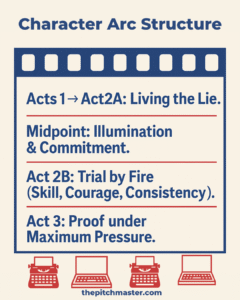
Think of the character arc in four beats:
Acts 1 → Act 2A: Living the Lie. They chase goals with lie-based tactics. These work short-term but generate deeper costs.
Midpoint: Illumination & Commitment. A revelation/defeat/victory reframes reality. The hero consciously commits to a new approach that aligns with his true want. This is the cognitive and directional switch: new plan, new tactics, new why.
Act 2B: Trial by Fire (Skill, Courage, Consistency). The world now tests that commitment. The hero practices what he needs but doesn’t stay there. He wins some, backslides some, and pays rising costs. Enemies adapt. Consequences tighten.
Act 3: Proof under Maximum Pressure. After the Dark Night of the Soul, the hero must operate from what he needs when it’s hardest. The climactic choice is the final exam: no help, no safety net, high stakes. Here is the arc complete.
So: midpoint = conversion; climax = consecration. Midpoint says, “I know what I need; I’ll act on it.” Climax says, “I’ll pay the price to become the best version of myself.”
Why Have the Turn at the Midpoint?
Story fuel: A mid-story pivot prevents the saggy middle. The protagonist shifts from reactive to proactive with a new plan, which launches fresh complications.
Meaningful escalation: If the hero didn’t change until the end, the climax would be a speech, not a decision. The midpoint gives time to test, fail, adapt, so the finale feels earned.
How it Plays
Romance: Midpoint: one lover risks honest vulnerability (her need), leading to deeper connection and scarier stakes. Act 2B tests that honesty. All is Lost beat tempts a retreat to self-protection (lie). Climax: they choose openness even when it could cost the relationship.
Thriller: Midpoint: hero rejects “ends justify the means,” and switches to a lawful strategy. Act 2B: slower, riskier progress; allies doubt; villain presses. Climax: hero refuses the illegal shortcut that would guarantee victory—and still wins because others now trust/help.
Diagnosis Your Midpoint
Make sure the scene delivers these five functions:
1. Revelation: New information reframes the core conflict.
2. Intention flip: The protagonist makes a clear choice to pursue a Truth-aligned plan.
3. Strategy change: Tactics visibly change (different allies, methods, rules).
4. Stakes reset: Costs and consequences increase because the Truth is harder.
5. Point-of-no-return: The new course ends the old one.
And for Act 2B (after the midpoint)
Aim for: practice → pushback → price.
- Practice: shows competence growing, not perfected.
- Pushback: antagonistic forces adapt; the world hits harder.
- Price: the want demands sacrifice (time, status, safety, love).
Common pitfalls
- Premature perfection: If the hero stops struggling after the midpoint, the arc feels finished. Keep the cost of living the truth rising.
- Vague pivot: If the new plan isn’t concrete, the audience won’t feel the turn. Put the change onstage.
- External-only change: Tie each plot beat to belief consequences. Otherwise, the midpoint reads like a plot twist, not an inner turn.
Worksheet
- Midpoint event: What fact or loss makes the lie untenable?
- Midpoint vow (one sentence of dialogue or thought): “From now on, I’ll ______.” You don’t have to have the character say their vow, which can sound on the nose. Instead, make sure the shift is obvious in the way your character speaks and acts.
- New tactics: List 2–3 Truth-aligned actions the hero tries next.
- Backslide temptations: Name 2 moments that lure them back to the Lie.
- Climactic proof: What single risk would only make sense if they fully believe the Truth?
Wrap Up
Give your protagonist the mid-book “aha,” then make them earn it—one tested choice at a time. When the climax arrives, their final decision won’t just sound true; it will prove who they’ve become under pressure. That’s how you banish the saggy middle and deliver a finale that lands with heart, heat, and holy-cow satisfaction.
Dive Deeper
How to Build Better Characters: Start with Their Biggest Lie
Secrets of Story Structure: Third Act Structure
Love a good structure discussion, Lindsey. I’ll add that the “mirror moment” (see Write Your Novel From the Middle) is of two types. One is character change (“the arc”). There’s a transformation at the end (which must be shown, not told). The other is recognizing the imminence of death (physical, professional, or psychological). Protag thinks, “I’m probably going to die. The forces against me are too great. But I can’t go back.” Examples: Richard Kimble in The Fugitive. He beat the odds and stayed alive, and is the same decent man as at the beginning. Same with Katniss in The Hunger Games. What’s cool about the latter is there’s a transformational arc in the trilogy, with that mirror moment where it should be, in the middle of Book 2.
Sorry for the late replies, everyone! I was in a communication workshop all weekend and out of town for the day today.
I love the term “mirror moments”! I hadn’t heard that before, but I’ve been using them instinctively in my own stories and with my clients.
I’m at that middle point and struggling. This helps me see what my character needs to do. Thanks!
Sorry for the late replies, everyone! I was in a communication workshop all weekend and out of town for the day today.
I’m so glad you found it helpful! I think midpoints are just magic when it comes to the character’s story and your plot.
Thanks for this penetrating discussion, Lindsey!
Got a question. “Lie” implies a conscious act or belief by a character. But aren’t there also unconscious misconceptions or false beliefs a character bases their life or behavior on? They are not necessarily aware of them yet they govern life choices they make.
In that situation, is the midpoint shift caused by the character’s realization of their false beliefs?
Sorry for the late replies, everyone! I was in a communication workshop all weekend and out of town for the day today.
I see what you mean, Debbie. Lie can be a loaded word. A lie is another way of saying a limiting belief that a character has about herself. She thinks she’s fine on her own and doesn’t need love, or that she’s safe or hiding in her house instead of being out in the world. The evil comes to her house. It’s just another way of the lies we tell ourselves, but we don’t always know they are lies.
In life and in our characters, when we change our beliefs about ourselves or the world, we grow as people. The lie that a character tells herself at the beginning of the story is refuted for her at the end, and she has consciously changed her outlook.
Excellent advice on structure, Lindsey. Thanks.
Sorry for the late replies, everyone! I was in a communication workshop all weekend and out of town for the day today.
I hope this helps you, Elaine. Figuring out the big change that the characters go through makes the plot obvious when you’re brainstorming.
Great discussion, Lindsey!
The midpoint, where the protag “flips”, reminds me of a boomerang sailing along, then reversing course.
Thanks for learnin’ me!
Sorry for the late replies, everyone! I was in a communication workshop all weekend and out of town for the day today.
I love the boomerang metaphor because it’s visual! Thanks for that, Debbie. I hope this helps you brainstorm your next story. Midpoints, I think, are the secret when you’re having trouble figuring out your plot or your character arcs.