
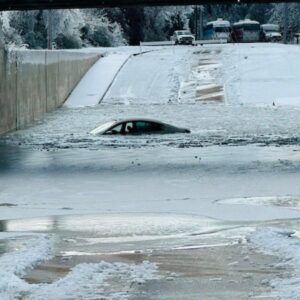
I don’t normally scroll on Facebook. I don’t have time, but during the “Icemageddon” in Mississippi last week with no electricity and my computer dead, I suddenly found myself on my phone, scrolling Facebook every hour (make that every 15 minutes). Trust me, I was not meant to be a pioneer. That said, I did learn a thing or two.
One, people do crazy things when roads ice over. I don’t know how many videos I saw of grown men flying down a hill on a garbage can lid. I guess that’s my home state’s idea of a sled. And then there was the guy who ignored the barricades in front of an underpass that was flooded…that’s the photo at the top of the page…
I also landed on a post where readers were dissatisfied with a book that everyone raved about. Over and over there were comments like: “I’m having the hardest time getting through this book.” Or “I found it took me several chapters to get into and then it ended up being an all time favorite.” “Or If you can struggle through this one then the next two are so much better.”
I don’t know about you, but I’ve never stayed with a book I couldn’t get into even if people told me that I’d love it after XX amount of chapters if I stuck with it. I’m sorry, but If a story doesn’t interest me by the end of Chapter 1, I’ll put it down. And before I buy a new author, I always read the sample chapters. That way I know if I’ll like it.
Does that mean I won’t like a story that isn’t action-packed? Or that a writer can’t open with a slow start? No. An example is Raymond Carver’s short story “Put Yourself in My Shoes”. It doesn’t start with a bang, and every sentence doesn’t advance the story the way I usually like. It’s a story about a writer who has writer’s block. He gets a call from his wife and agrees to meet her at a bar. Here’s an early paragraph:
Myers put the vacuum cleaner away. He walked down the two flights and went to his car, which was in the last stall and covered with snow. He got in, worked the pedal a number of times, and tried the starter. It turned over. He kept the pedal down.
Shortly after that paragraph is another one:
As he drove, he looked at the people who hurried along the sidewalks with shopping bags. He glanced at the gray sky, filled with flakes, and at the tall buildings with snow in the crevices and on the window ledges. He tried to see everything, save it for later. He was between stories, and he felt despicable.
No big problem in the opening. The character was doing mundane, boring things. So, why did I keep reading? Because I’d been where the character was–not between stories, but no idea where I was going in the story I was working on. He captured how I focused on everything but the story. it also described how I felt when I didn’t want to deal with a problem I was facing, and I think readers identify with that.
I’d like to say I came up with the idea of this post, but it came from a post on Jane Friedman’s blog by Seth Harwood. You can read it here. Sometimes we do need to slow down our stories to invoke mood, or theme, or develop a character. But as Harwood noted, the character is doing something–he put away, he walked, he drove…
Okay TKZers, how about you? Would or have you read the rest of Carver’s short story “Put Yourself in My Shoes”?
That’s a tough sell with Carver’s work. Only the fact that it’s a short story might have kept me reading.
I don’t normally require car chases or swordfights as story openers, but I do expect some form of engagement.
That being said, I usually give a story a chance or three past a slow opening, especially if other readers give it high praise. Sometimes it’s a debut author who published too soon but still has a great story. Sometimes the story would seem contrived with a splashy opening hook.
But I do expect to be entertained in some fashion after that, whether it’s fast action plot-driven or slow burn character-driven.
Since I read for pure enjoyment, Cyn, if a character doesn’t appeal to me after a couple of pages, I’ll put it down. On the other hand, I’ve finished a few poorly written books because I liked the character and wanted to find out what happens to them.
Reader expectations play a role here. Coming to a literary short story, like Carver’s, we expect a subtle unfolding of details. But if we’re looking for novel-length commercial entertainment, an opening of this type will have a hard time grabbing us.
I took a workshop with Carver in college, and the thing I remember most is that a) I wasn’t cut out for literary fiction; and b) the “telling detail” is powerful. On the latter, a Carver story is full of them. For me, if I can place one or two in the middle of a book to intensify emotion, I’ll take it.
I knew right off the bat I would never be a literary writer, Jim, and I rarely read literary. Could not get through any of Faulkner’s works and I tried since he was a Mississippi writer whose home is less than two hours from me.
Knowing that it’s a short story, I would continue reading to see if it grabbed my interest. Not sure I would if it was a full length work. But I was also discombobulated by the opening for reasons that probably don’t impact other readers. Since historical fiction is my cup of tea, when I see the word “stall” I’m thinking horses, not cars. But he also mentions vacuum cleaners–definitely not historical. LOL!
I think this post dovetails well with an email I was reading from author Janice Hardy in her “Narrative Nuggets”. The essence of the post was that anticipation matters more than the payoff. Does whatever opening you use give readers that anticipation to want to turn the page? It’s a fine line to walk. And it’s easy to fall into extremes either way–too mundane an opening with no anticipation, or overdoing it by killing your victim in the opening in a way that doesn’t really grab since they haven’t had a chance to care about it. But who ever said writing was easy? 😎
I read a lot of times that if writing was easy, everyone would do it. 😉 I’ll have to find that article on anticipation even though I’m not sure if I agree that anticipation matters more than the payoff. If I don’t like an ending, I’m not likely to read another book by the author.
Genre matters, as others have said. When someone said The Girl With the Dragon Tattoo got good after 200 pages … nope. Not sticking with a book that long.
I like the “advice” I saw years ago. Take 100, subtract your age, and that’s how many pages you should give the author to make you want to keep reading.
I don’t need, or particularly like, books that start with a ‘bang’ before giving me a reason to want to follow the character.
I agree that genre matters, Terry, Although I read The Girl with the Dragon Tattoo, it was a tough read, but something about it kept me from putting it down.
I read Carver b/c a writing teacher assigned his stories but it was a slog. Not my choice.
Pat, your mention of men riding garbage can lids is a great analogy. For a slower story start, put a character on a lid sliding down a gentle slope. Then the hill gets steeper and soon the character is heading for a cliff.
For a faster start, someone or something pushes the character on the garbage can lid in the wrong direction. Almost immediately they careen onto a busy street. They want to roll off but they’d be crushed under speeding cars. They can only hope to veer to avoid disaster. Pretty quickly, the reader is leaning sideways trying to help the character swerve out of danger.
For me, a story can start slowly if there’s an esp. compelling voice. W/o that, I close the book.
Oh, wow, Debbie, that’s a great teaching point, and one I will come back to.
I read to be entertained, to escape what’s happening in the real world. If a novel doesn’t grab me in the first couple of chapters, then I’ll put it down. There are too many choices out there for me to spend time slogging through something I don’t like, or constantly figuring out how many more pages I have to read until it’s finished. I don’t need an explosion on the first page, but if it’s not imminent at the end of Chapter 3 or 4, then I’m on to something else. I suppose I liken it to going to a buffet at lunch. If I try a small scoop of something and it doesn’t strike me as, “Oh, I like this”, then why take more? I move on to something else.
My feelings exactly, James. I have too many books on my TBR table to spend time on one that doesn’t interest me.
I’d probably finish Carver’s short story since it’s short and a story about writer’s block. I’m not sure I would tackle a novel with that beginning.
I’m reading Faulkner’s As I Lay Dying now. I considered putting it aside, but I’m more than halfway through so I should probably go the distance. So many characters and such difficult dialect to boot. (I do wonder what criteria the Nobel committee uses to award their coveted prize. 🙂 )
We visited Faulkner’s home in Oxford, MS some years ago. It didn’t look anything like the house in AILD.
I commend you for reading As I Lay Dying. I did finish it, but often wondered just how early in the day Faulkner started drinking.