
My new Romeo thriller, Romeo’s World, is live today. Like all the others, it does not have chapters. It has scenes, as long or short as they need to be. Each scene is set off with a drop cap, like this (click to enlarge):
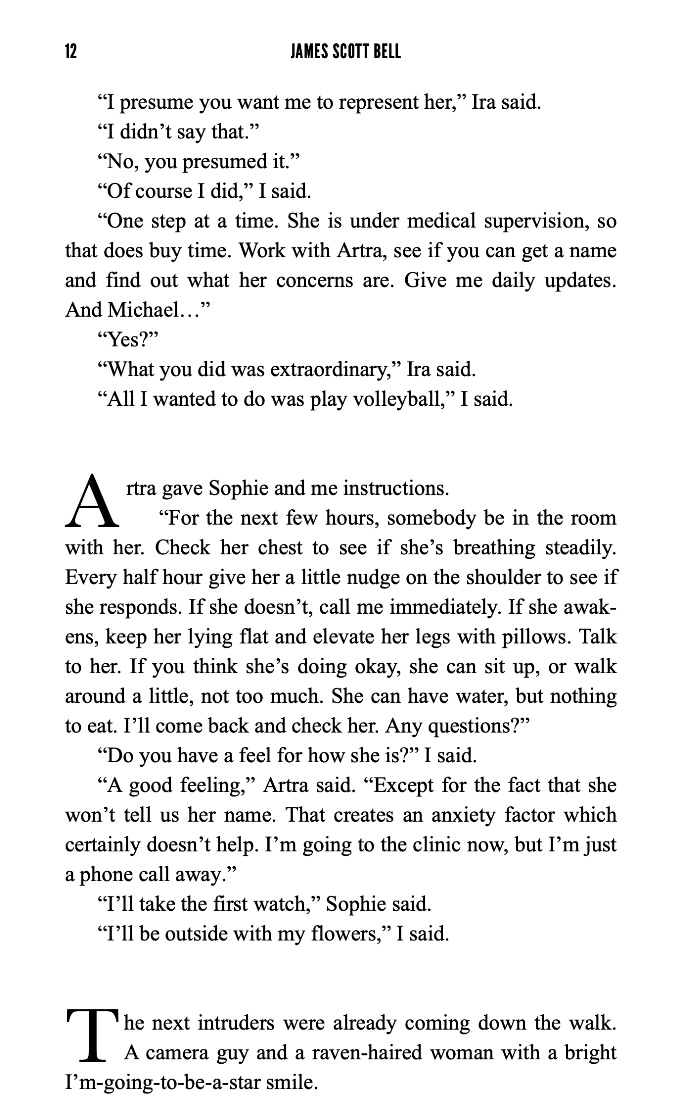
I find this freeing and cinematic (as in “jump cuts” to move to another scene).
In the thriller market, short, numbered chapters roared into fashion with Mr. James Patterson, who I predict will break out soon. I wrote my Try series this way, each book with well over one hundred chapters. I now find it a bit absurd to have a TOC with 191 chapters listed, like one would expect a reader to think, “Gosh, I want to read Chapter 148 again. It was so good!”
So I don’t do the number thing, though in a future stand-alone I might. Either way, we’re all dealing with shorter attention spans these days.
A recent PW article reported on the move in Middle Grade fiction toward shorter books:
In recent years, educational surveys, sales data, and anecdotal evidence from teachers and librarians have all pointed to the same discouraging fact: that the share of kids ages nine and up reading for pleasure is at a record low.
***
Conversations in middle grade have increasingly gravitated toward length. Page counts under 200 are cropping up more frequently on fall and spring lists.
“We have a new type of kid now,” says author and agent Jackie Garcia-Morales at Storm Literary Agency. “They’re reading, but they’re reading in different ways—the simplest form being memes and GIFs. In that in-between age of middle grade, they’re moving away not only from longer books but also from longer-form videos and entertainment.”
***
[Krista Vitola, executive editor at Simon & Schuster Books for Young Readers] echoes that sentiment. “Kids have so many time constraints and competing interests, including sports and other activities. They don’t have those long windows to get lost in books like previous generations had.” Creating books that can be read in shorter stretches is a strategy for helping them fit reading in.
All that applies to adults, too, does it not? We’re all on our phones 17/7, more if we have insomnia. Who has time and attention to just sit and “get lost in a book” anymore?
A commercial novel can be long, of course (looking at you JK “Robert Galbraith” Rowling), so long as the author knows how to make readers want/need to turn the page (a subject for another time). Like The Martian by Andy Weir, which started as an indie project and comes in at a hefty 105k words.
I write in the pulp tradition, which means crisp, fast-moving stories, rarely over 80k.
Thank you for your kind attention.
Now over to you. Do your books have an average length? Do you think “shorter,” or just let the words fall as they may?
How’s your reading time these days? When was the last time you got lost in a book for over an hour?
WOW. Your post hits at exactly the time I’m pondering attention spans and chapter lengths. (And I just got my email notification from Amazon last night that my digital copy of Romeo’s World is available in my Kindle!) 😎
This is something that affects me as a reader and as a writer. I still prefer chapter numbering, but as I was going through a manuscript yesterday, I realized I needed to make several of my chapters shorter.
The current manuscript is not done yet because I’m wrestling with a few points in the story, but even so, it is on the too-lean side of the equation in terms of word count. While I can understand an overall reduction in ‘typical’ word count for novel length fiction these days, as a consumer who has to watch every penny, if I’m looking on Amazon at a potential book and see it’s a small book, I’m probably going to pass over it in favor of something that feels like it gives me more bang for my buck (i.e. word count).
And there’s the rebellious part of me that fights the trend of shorter fiction, because it seems like that only feeds the inattention habit. But reality for me thus far is that (as far as I recall) I haven’t written anything above 75k words and most under that. But overall, when it comes to addressing attention span, I find shorter chapters more valuable than shorter word count.
Though none of my manuscripts have achieved that goal yet, I long to write a novel one day that is one of those 100k plus epics! That would be soooooo awesome! And I’m going to throw myself a party when I do! 😎
My longest book, Glimpses of Paradise, is a historical at 135k. And is the book I’m proudest of in terms of research and writing. I wish I had more time…
My editor, someone I’ve used only once before, suggested longer chapters and a greater word count as being expected in the genre (romantic suspense). However, my previous editor said shorter is better, so I kept my chapters the way they were, which I’d changed from 2 POV scenes to one a few books back. My first books came in at around 100K, but now they’re about 75-80.
Back in the pre-ebook day, when I was buying print books, I sought out longer ones. More words for my bucks.
I like chapters because it lets me see how far I’ve come, and how far I have to go.
And yes, there are some authors that will keep me reading to the exclusion of all else, chores be damned.
I read a Dan Brown book in a couple of days a few weeks ago. I have a swing in the back yard and it’s my favorite reading spot. Cherry coke, birdsong, easy to kill an afternoon there, but it seems like minutes.
I remember several years ago teachers and librarians saying that kids wouldn’t read anything long. Then Harry Potter came out. Kids will read if they have something worth reading.
My mysteries run around 75K, while my earlier urban fantasies ran around 68-70K. Those respective word counts felt like the right lengths for their stories. My chapters tend to be multi-scene, but may change that up in the future.
It has been tough lately to devote even an hour at a time to reading. Yesterday, though, I did just that, giving myself a couple of hours as I read Lawrence Block’s collection of Bernie Rhodenbarr stories, The Burglar in Short Order. Time very well spent and something I will do regularly once more.
Reading is good, both in general, and for the inner writer.
My novels come in at around 60-70K words. I like that length for mysteries – long enough to tell a good story, but short enough that readers don’t get lost in the maze. My MG books are shorter – a little over 30K words each.
I do have a question about this subject of length. I’m reading a novel now that is very long. A few nights ago, I thought I was getting close to the climax, but when I looked at my progress on my iPad, I was only 1/3 of the way through! Turns out the book is around 145K words. I will read to the end because it’s an interesting, well-structured story and the characters are relatable, but I have the feeling that the author was padding the word count.
Now why would a well-known author add unnecessary scenes, etc to a book when we all know it’s better to cut unnecessary words? Maybe it’s because I write mysteries that I tend to look for motive in everything. If royalties in Kindle Unlimited are based on number of pages (words?) read, is that incentive for authors who place their books in KU to add to the size of their work?
Padding for KU…that’s a very good point, Kay! If one has a good following and a “name” maybe they can get away with it. Some readers may, perhaps, skip the next one if they feel this one’s been a slog. But the analytics probably say padding works in this instance. It’s sort of like the analytics that now dominate baseball. Everyone swings for home runs now, not singles and doubles and, God forbid, bunts. Yet those are the very things that made the game truly watchable. Ack!
When I write cozy mysteries they’re 60-65k with fairly short chapters, usually 5 pages long. And when I write women’s fiction they’re 75kish with longer chapters. I agree with Terry – chapters give me placemarks, but scene breaks can too. I usually have to back up a few pages and refamiliarize myself with the book the next day anyhow.
I write the story. Sometimes that takes 80-90K words and sometimes over 100K. I’m sure lots could be cut in edits.
As for reading, as I’ve mentioned here before, I read 5-6 books every week. I don’t choose what to read by length, but rather by recommendation or a description that interests me. If the story is compelling, the writing competent, I can, and have, read for six hours straight or even all night. For the first time in my life, however, I have stopped reading if the book is bad, and these seem to be only Kindle Unlimited books. So many of them appear to have been written by AI, because they contain the same tired content, and I refuse to waste my time with them.
On a high note, my elementary and middle school grandchildren are avid readers, and I’m pleased that they’re excited to share the stories with me.
Is ‘attention span’ really the thing we’re looking at? I don’t doubt the research that shows kids (and adults) read in shorter chunks and that everyone has a wide array of other choices for their leisure. I’m curious about the ‘why’ of those choices. Don’t people gravitate to where they get the highest and most frequent rewards?
People of all ages will spend endless consecutive hours playing a video game. The pattern I’ve seen indicates they stay with the same game for weeks or months before they move to a different game. I have a working theory about why they display this behavior. Games these days are built on human psychological studies, and have everything to do with the frequency of emotional rewards gamers experience while playing. We as authors don’t spend time actively tracking the rate and depth of emotional rewards in our stories. Are we going a page or a paragraph too long before we dole out the next hit of dopamine? If we increase the size and frequency of rewards, can we keep readers with us for a longer work? What’s the optimum word count between rewards for the average reader? While the type of reward might change between genres, I suspect the intensity and frequency wouldn’t vary by much. Psychology has a pretty good understanding of how reward systems work.
I have to ask whether writers are losing out to other forms of entertainment because of shorter attention spans, or do we need to ensure that our stories drive relentlessly forward? Writing books and teachers already advise we leave out the boring bits. Maybe it’s time to look more closely at what we leave in to see if it’s properly rewarding the reader brain in both intensity and frequency?
Really good questions, KS. Deserve a deep dive.
The one novel I’ve written (pitching next Sunday) came in at 97k, I’ve been told that’s about right for adult fantasy. My target for the WIP is 80–85k words. I don’t want to be one of those authors who cram a 90k word story into a 150k book.
I never get as much reading time as I’d like. It’s always at the expense of something else not getting done. However, the night before last, I stayed up late with one of Lindsey Davis’s mysteries instead of working on the pitch package. No regrets.
The visual look of the page has changed drastically with both the advent of the ebook as well as shorter attention span. More open space on the page. Much shorter paragraphs. Even I who spent her youth reading massive Victorian and American novels with their ponderous prose and page-long paragraphs have been known to look at a massive volume of a block paragraph and have gone “Nope.”
Personally, I would never write for short attention span because those who have it don’t read novels. They have trouble reading graphic novels. I make the visual look of the page more inviting and leave it at that.
Me!!! Hand waving to your question of who gets lost in a book for more than an hour. Every night, I usually read at least two hours and have been known to read until 3 a.m. Tonight I will be reading Romeo’s World.
The length of my romantic suspense books is guided by my contract, currently 80,000-90,000 words. They usually come in at about 83,000. And I write in short chapters of between 1,000 and 2,000 words.
I wish I could read in bed. 2-3 pages, and I’m out!
Now over to you. Do your books have an average length? Do you think “shorter,” or just let the words fall as they may?
—
Writing a mainstream epic here – somebody has to write them!
Pride’s Children: PURGATORY is 167K words, 490 pages in print.
Pride’s Children: NETHERWORLD is 183K words, 529 pages in print.
LIMBO will be comparable, for a total of around 500K words, about the length of GWTW.
Amazon has recategorized PURGATORY as:
Kindle Store›Kindle eBooks›Literature & Fiction›Literary Fiction›Mystery, Thriller & Suspense
I don’t agree with ‘thriller’, but am okay with SUSPENSE! – because that is what I aim for. You have to, or no one will read books this long.
One of my reviewers wrote: “…The pace is unhurried, almost meditative at times. By contrast, the tension is considerable, and the reader is kept in suspense all the way to the disappointing end. I have to call it disappointing because Ms. Ehrhardt has clearly planned the whole story across a trilogy, and this is therefore only the first part. Disappointing, because by the time one reaches the end of this first book, one is aching for resolution. Well, I was, at least.” David Rose, Amazon reviewer
And the third book is coming along nicely in the same vein. And each of the three volumes comes to a satisfying end – of its own.
As for all – the length is whatever you need to tell the whole story.
Getting a potential reader, with the shorter attention span, to pick up a 500-page book is the real problem. Once they do, good writing takes over and well thought out, logical, pause points satisfies the need to read in bursts.
It looks like we need to take into consideration modern reader psychology as well as what they might find of value in our efforts to entertain.