
 I love the play and movie Amadeus. (I saw the play in L.A. with the great David Suchet as Salieri.) The gist of the plot is simple. Salieri has dedicated his life to music and managed to rise to the position of court composer in Vienna. Suddenly, a crude young man appears on the scene, with no social graces, and claims to be a composer. Salieria despises this buffoon, but then! Mozart’s music is so lovely, so transcendent, that Salieri cannot deny he is a genius. But undeservedly so! He, Salieri, who lived only for music, was denied the the divine gift, yet it was given to this loutish youth. A fatal case of jealousy takes root. So much so that Salieri declares…well, watch:
Yikes!
Which reminds me of the chapter on jealousy in Anne Lamott’s Bird by Bird.
If you continue to write, you are probably going to have to deal with jealousy because some wonderful, dazzling successes are going to happen for some of the most awful, angry, undeserving writers you know—people who are, in other words, not you … You are going to feel awful beyond words. You are going to have a number of days in a row where you hate everyone and don’t believe in anything. If you do know the author whose turn it is, he or she will inevitably say that it will be your turn next, which is what the bride always says to you at each successive wedding, while you grow older and more decayed. It can wreak just the tiniest bit of havoc with your self-esteem to find that you are hoping for small bad things to happen to this friend—for, say, her head to blow up.
Okay, funny, not funny. Envy is a real B. Fortunately there is a morsel of good we can find in the green-eyed monster. As I say in my book The Mental Game of Writing:
Here’s a surprise for you: Envy is 5% positive. That’s the 5% that tells you that you care deeply about what you’re doing, that you want it to matter to other people, the way some other writers matter.
The other 95% is toxic. Fifty-seven percent of that toxicity wishes something bad would happen to the object of your envy (see Anne’s passage, above). The other 38% of toxic envy is you feeling bad about yourself and your writing, thinking you’re no good and you don’t have what it takes, and maybe never will.
(By the way, those percentages are from my own unscientific imagination, so don’t envy my methodology).
Envy tries to sneak into your head. You mustn’t let it take up residence there. If it tries, write something about it, just for yourself. Getting a confession down on paper helps. Tell yourself not to hold anything against the other writer. The other writer is just doing his thing and getting his own reward.
But what if he really is a rotten human being?
Then go ahead and wish that his head would explode.
For five minutes.
Then forget all about it and immediately get to work on a project of your own.
Festering envy can lead to ugly behavior. There have been several cases in the recent past of authors creating sock-puppet accounts to review-bomb rival authors. You can read about some of them here, here, and here.
Back in the good old days of paper pages, author feuds were slow boils in printed media. I recall journalist Renata Adler’s takedown of her fellow New Yorker writer, Pauline Kael. At the time Kael was the most respected film critic in the country. Adler wrote an 8,000-word review of Kael’s book When the Lights Go Down, declaring it “piece by piece, line by line, and without interruption, worthless.”
Barbara Grizzutti Harrison took a literary hatchet to no less than Joan Didion: “Sometimes her tricks appear to be merely cheap, when in fact they are pernicious…Didion is the lyricist of the irrational. Some people find that charming. I do not.”
But all that was child’s play compared to the years-long feud between Norman Mailer and Gore Vidal, both of whom seemed to love punching (Mailer, literally) other writers, e.g., Vidal v. Truman Capote; Mailer v. William Styron and Saul Bellow. The Vidal-Mailer discord began in 1971 with Vidal’s review of Mailer’s book about feminism, A Prisoner of Sex. Vidal grouped Mailer with Henry Miller and Charles Manson (!) as examples of malignant male aggression.
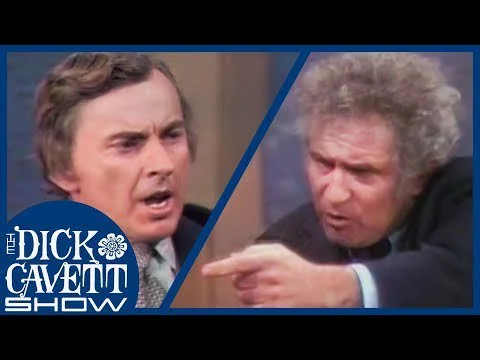
Shortly after this, Dick Cavett had the grand idea of hosting the pair on his show (along with famed journalist Janet Flanner). It didn’t go well for Mailer, who reportedly had a few snorts before going on. Nor did he possess the rapier-like wit of Vidal. One exchange:
Mailer: “Are you ready to apologize?”
Vidal: “I will apologize if it hurts your feelings, of course I will.”
Mailer: “No, it hurts my sense of intellectual pollution.”
Vidal: “Well, as an expert, you should know about that.”
Mailer kept emphasizing his superior intellect, and at one point moved his chair further away from the others, prompting Cavett to ask, “Perhaps you’d like two more chairs to contain your giant intellect.” The audience howled. Mailer had lost the room. But instead of taking the L and moving on, he accused the audience of being unfairly hostile toward him. He looked at them and said, “Are you really all truly idiots, or is it me?” The audience shouted, “YOU!” (You can watch the whole interview here.)
A few years later, at a New York party for the literati, Mailer went up to Vidal, threw a drink in his face, and punched him. Vidal wiped his face and said, “Once again, words fail Norman Mailer.” Mailer demanded the hostess kick Vidal out. She refused. So Mailer left. Later asked about the incident, Vidal expressed “sympathy” for his rival. “After all, it’s not easy being a failure like Norman.” [Note: In their later years Mailer and Vidal did reconcile.]
So why am I bringing all this up? Because we are awash in 24/7 vitriol, thrashing around just to survive in the “mood slime” of digital discourse. (Mood slime was the New York subterranean muck created by all the hate and anger up top, in Ghostbusters II.) Don’t let it get into you. If you feel the tendrils of envy tickling your anterior insula (the part of your brain that processes unpleasant feelings), stop it in its tracks.
Do what you do—write!
Had never heard of the Mailer/Vidal feud. Not sorry I missed it.
As to the green-eyed monster of envy, I think the closest I come is being envious of people who seem to have bottomless energy (for writing or anything else). But I rejoice for their energy rather than wishing them ill will.