
by Debbie Burke
For farmers, weather makes the difference between payday and bankruptcy.
They are at the mercy of Mother Nature who can wipe out all their hard work in an instant. The US Department of Agriculture (USDA) offers insurance that gives some protection. But unscrupulous, greedy people find ways to take advantage of it.
According to a June 2026 article by Chris Bennett in agweb.com:
“Federal Rainfall Index Annual Forage Insurance Plan…is based on rain amounts—not crop performance. Producers pick a two-month period (they can obtain multiple two-month slots), pay for insurance, and receive payments if precipitation falls below normal historic levels.”
Two Colorado farmers hatched a scheme to cash in on that insurance to the tune of $6.5 million. Ed Dean Jagers and Patrick Esch owned farms in southeast Colorado and southwest Kansas that appeared to never receive rainfall.
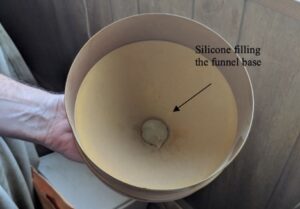
Rain gauge plugged with silicon
The reason: in 2016 and 2017, they and two accomplices tampered with weather stations that track data reported to government agencies. The men plugged rain collection funnels with silicon, cut wires, punched holes in gauges, and placed metal disks and cake pans over collection surfaces.
No rain equals payday. They filed multiple fraudulent claims with the government, collecting millions of dollars.
One accomplice, farmhand Mark Fox, was a career criminal and a frequent resident in local jails. Fox decided he wanted a bigger cut of the proceeds. He threatened to blow the whistle on the scheme if Esch didn’t bail him out. Then he demanded hush money. Each time he went to jail (on unrelated charges), the extortion escalated.
Esch gave into the blackmail. On several occasions, he wrote false affidavits saying Fox hadn’t been involved in damaging weather stations and paid cash to Fox’s two girlfriends who facilitated the transactions.

Ed Dean Jagers, Mark Fox, Trey Jagers. Esch not pictured
Public domain photo
Meanwhile, the National Weather Service (NWS) noticed strange anomalies in weather reports from 16 stations in Colorado and Kansas, located on property owned by Jagers and Esch. Additionally, they recorded tremendous increases in vandalism of their measuring equipment, costing thousands of dollars to repair or replace.
NWS investigators zeroed in on Jagers and Esch as the likely perpetrators. Jagers’s son Trey had assisted in the damage. Officials convinced him to wear a wire, hoping to trap the fraudsters, but apparently Trey couldn’t bring himself to be an informant.
Mark Fox was back in jail again. This time he changed his strategy, claiming to Esch that he had immunity from prosecution and could “fix” the problems facing Esch and Jagers…for a price.

In a bizarre twist, Fox broke out of jail and went on the lam, prompting a federal manhunt.
By now, Esch and Jagers knew their scheme was up. They were facing both civil penalties for defrauding the government as well as criminal charges. They negotiated plea deals with short jail sentences and promised to pay back more than $6 million they had received for false claims.
Per Bennett’s article:
“Trey signed a plea agreement in 2022 and served no jail time; Esch and Jagers signed plea agreements in 2023. Esch served two months in prison; Jagers served six months in prison. The pair was ordered to pay a combined $3.1 million in criminal restitution, and settled civil charges for $3.5 million. Total: $6.6 million.”
Fox remained missing.
Then in August, 2023, his badly decomposed body was discovered in a barn but cause of death couldn’t be determined.
This story has a final weird twist. Because of his death, charges against Fox for extortion, assault, and vandalism were dropped.
However, his role as a whistleblower meant his estate received $500,000 from the federal settlement.
Hmmm. Apparently under certain circumstances, crime does pay.
Thank you, Chris Bennett, for permission to quote from your article.
~~~
TKZers, agricultural fraud crimes were new to me until I read Bennett’s article. Were you aware of them? Please share what you know.
It amazes me what people will do to steal and then cover up their crimes.
I know, Pat. Some criminals have imaginations as amazing as those of writers.
Thanks for this, and it’s definitely writing fodder if I have another ranch setting. So far, I’ve just dealt with cattle ranches, but farming might show up in a future novel.
Terry, glad the story gave you ideas for a future book. When people believe rural locations are crime free, they just haven’t dug deep enough.
Amazing how people concoct new ways to cheat. If they’d put their imagination into legit ways to make money — well, then they wouldn’t be criminals.
BTW, don’t you think Mark Fox has a vulpine face?
Mike, vulpine is a great word. I’ll remember that the next time I describe a crafty, foxy character.
You can’t live in a farming state and not know about schemes to defraud the government. The mindset seems to be that our government is sending billions overseas instead of helping our own citizens, so why not grab some of it for ourselves? One guy from my husband’s hometown got millions in payouts from a program by putting parcels of farmland in other names, like his wife, his children (including an infant daughter), and even his dog (true story). He used the money to buy more land and came up with even more names to continue collecting. My husband said it would probably shock people to know how many landowners were and are doing this.
This is not government fraud, but my husband (career law enforcement) was called to a farm because the owner said someone had stolen his new tractor. This tractor was worth over $200K. It had been raining quite a bit that week, so my husband, being the keen investigator he was, followed the obvious tracks through the mud to an unimproved road. This means that there was no maintenance, no gravel, just dirt. Or in this case, mud. The tracks disappeared over a hill. He had 4-wheel drive on his patrol unit but knew enough not to try going down the road, so went up into the adjoining field and followed the tracks by driving on the grassy edge. It didn’t take long to find the tractor. Powerful as it was, it had still gotten stuck in the mud in the road. And the weird twist? The perps, brothers who apparently hadn’t been blessed with high intelligence, had decided they needed to pull it out. With an ATV. They had no tow rope, so looked around and spied a guy cable bracing a powerline pole and decided it would be strong enough. One of them stood on the ATV and managed to reach the lowest of the spikes used by line crews and climbed to the top of the cable to detach it. Having trouble getting a grip, he went higher, around 20 feet in the air. His head came in contact with wires and he was thrown off. When my husband got there, he was on his back on the ground, unconscious. The top of his head was fried, and his fingertips had been blown off. His brother denied having anything to do with the tractor theft. The zapped brother lived (the rescue operation was wild), and they eventually admitted to the theft when confronted with the overwhelming evidence.
Wow, Becky, what a story! Those brothers truly didn’t qualify as criminal masterminds. If the electrocuted one had died, he’d be nominated for a Darwin Award.
Thanks for adding a bonus to today’s post.
I wonder if there’s a college curriculum out there called Crime 101…and how many flunk it?
Asking for a friend…
🥸
Deb, I think the prerequisite for that crime class might be “Cheating with AI 101.”
Wow, Debbie, what a story! Thanks for sharing.
Huh. My profile pic disappeared. Hmm…
Sounds like a mystery called “The Case of the Missing Thumbnail.”
Ouch!!
You’re welcome, Sue.
Theo cảm nhận cá nhân thì cricfy tv ios dùng ổn định hơn mình nghĩ ban đầu. TONY08-28
In the Uk, during the mad cow disease crisis, farmers were given compensation for the number of cows they had. A inspector would turn up, count the number of cows in the field and the farmer would get a cheque to compensate them for the loss of value of their herd. Some farmers moved their herd of cows together, and moved them from farm to farm so the inspector was counting the same herd of cows two or three times over whilst the farmers collected larger cheques.
Thanks for sharing that fascinating story, Sandy. When “free” money is offered, people always find imaginative ways to get more than they’re entitled to.