
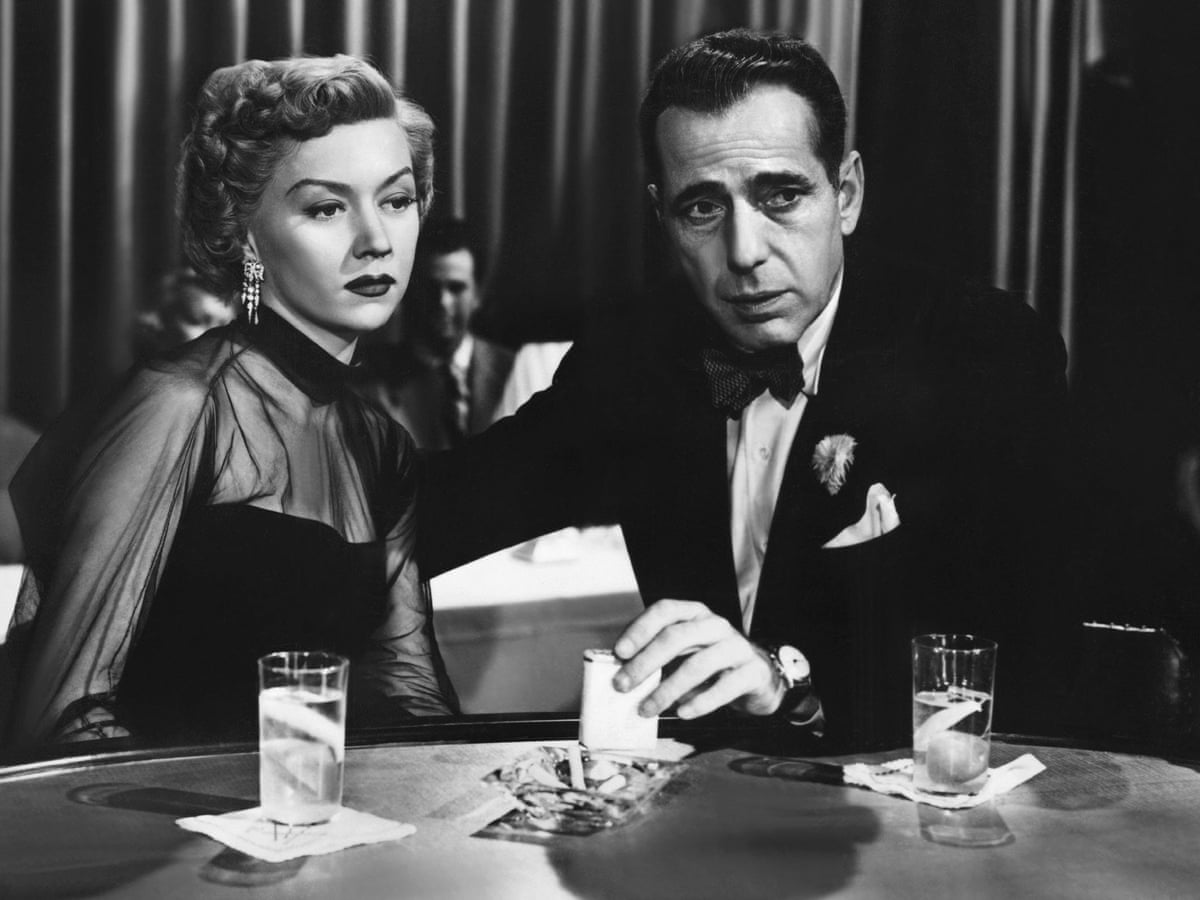
“I was born when she kissed me. I died when she left me. I lived a few weeks while she loved me.” — Dix Steel In A Lonely Place.
By PJ Parrish
I was sleepless in unsettlement — it had been a rough week what with apocalyptic smoke-sulphuric skies and gut parasites — so as usual I turned to my private Ambien — Turner Classic Movies. Eddie Muller was just coming on to introduce In A Lonely Place.
Two hours later, I was still wide awake and in awe. How in the world had I missed this movie? I devour old noir films yet this one had somehow always eluded me, even though it’s considered a classic. I come to you today, fedora in hand, deeply ashamed.
Humphrey Bogart, in what might be his finest performance, sheds his heroic armor to play the boozy, trigger-temper screenwriter Dix Steele, suspected of murder and captivated by his failed-starlet neighbor Gloria Grahame (who can say more with one raised eyebrow than most of today’s actresses can do with their lines.)
This isn’t your conventional noir. It’s more a psychological thriller and a heartbreaking love story. There’s no happily-ever-after, just what one writer called “an epitath for love.” It’s also a meditation on movies and screenwriting, and male cruelty. In the end, it also has an oddly feminist undernote.
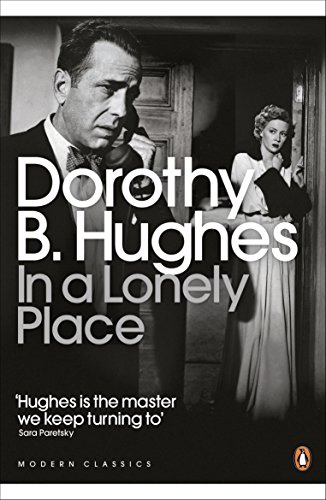
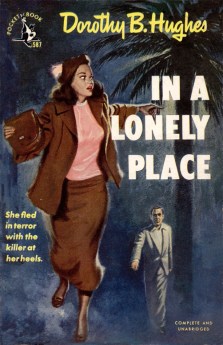
I was so entranced by the movie that the next morning, I hied over to my library where I found the source material — Dorothy B. Hughes’ 1947 book. (It was re-issued three years ago by Penguin Modern Classics). Okay, again I confess shame, as I had never read the book. I’ve been making my way through the oldies for years now, But this one…wow.
I’m not alone here in my ignorance. The critic John Powers wrote:
It’s something of an axiom that good novels make bad movies, but one of my favorite exceptions is In A Lonely Place. For years, I lazily assumed that [director Nicolas Ray] had turned a lousy pulp thriller into a silk purse. Then one day, I finally read it. And I discovered that the novel is more groundbreaking than the film. And that Hughes belongs in the crime writing pantheon with male icons like Dashiell Hammett and Raymond Chandler.
Now I have to turn to crime novelist Megan Abbot, who wrote the afterword for the re-issue::
Reading In a Lonely Place for the first time is like finding the long-lost final piece to an enormous puzzle. Within its Spanish bungalows, its eucalyptus-scented shadows, you feel as though you’ve discovered a delicious and dark secret, a tantalizing page-turner with sneakily subversive undercurrents. [Its] influence on crime fiction is unsung yet inescapable. From Patricia Highsmith and Jim Thompson to Bret Easton Ellis and Thomas Harris, nearly every “serial killer” tale of the last seventy years bears its imprint—both in terms of its sleek, relentless style and its claustrophobic “mind of the criminal” perspective.
But its larger influence derives from Hughes’s uncanny grasp of the connection between violence and misogyny and an embattled masculinity. And its importance extends beyond form or genre and into cultural mythos: the birth of American noir.
That last part about toxic masculinity is important. Because while that aspect is present in the movie in the form of Bogart’s seething anger, the book is where the violence really boils over.
I was taken by how different the film is from the book. (Yes, we can name dozens of cases where this is true in crime fiction — and please feel free to weigh in here). But it’s really striking here.
In the book, Dix Steele is an actual serial killer, but in the movie he is a mere suspect in one hat-check girl’s death. In the book Steele is a true psychopath, who fakes being a crime novelist so he can sponge off a wealthy uncle. An ex fighter pilot, Steele is frustrated that his post-war life is so lifeless and emasculating, Steele turns to stalking and killing women for kicks. “They were all alike, cheats, liars, whores,” Steele says in the book. “Even the pious ones were only waiting for a chance to cheat and lie and whore.”
In the movie, Steele is still hot-headed but more as a screenwriter poisoned by temper and his desperation for another hit. And he is fatally capable of falling in love.
As Megan Abbott sagely noted, Hughes has always been fascinated by the loners who lurk on society’s edge. Hughes’ 1963 thriller The Expendable Man tackled American racism. With In A Lonely Place, she plunges us deep into Dix’s warped psyche. It reminds me somewhat of Patricia Highsmith’s Tom Ripley, in that we almost want to root for the guy because he’s so damaged.
Then there’s that feminist note I mentioned. The book, unlike the movie, is a scathing indictment of toxic masculinity. And while the movie ends on plaintive note, the book is a twisty paen to post-war girl power. Again, I’ll quote Megan Abbott:
Dix’s story reveals the essence of being a violent hater. He tries to control his feelings of sadness and powerlessness, not through self-knowledge or personal change, but by finding someone to blame and erase — in this case, women. But far from bringing him salvation or even relief, his hatred turns out to be the loneliest place of all.
To his mind, the enemy is not the war, its trauma, but what men face upon their return: staid domesticity, the strictures of class, emasculation. And these threats are embodied wholly in women. Women, whose penetrating gazes are far mightier than his sword.
In case you haven’t seen or read either, I won’t give them away the two endings. I’ll leave that for you enjoy.
So, which is better — book or movie? I loved them both, for different reasons. The central theme is there in both, that the lonely place is not without, but within. Well, let’s let Hughes, via Dix Steele, tell you what that feels like:
Fear wasn’t a jagged split of light cleaving you; fear wasn’t a cold fist in your entrails; fear wasn’t something you could face and demolish with your arrogance. Fear was the fog, creeping about you, winding its tendrils about you, seeping into your pores and flesh and bone. Fear was a girl whispering a word over and again, a small word you refused to hear although the whisper was a scream in your ears, a dreadful scream you could never forget. You heard it over and again and the fog was a ripe red veil you could not tear away from your eyes.
In A Lonely Place. Watch it. Read it. You’ll thank me.
Kudos to Gloria Grahame, a fave, who was married to director Ray at the time, a troubled marriage, which added nuance to what many consider her best performance.
Eddie Muller mentioned the marriage. He said Ray was detemrined to have Grahame in the part, despite their marital discord. He went so far as to have a studio home built on the set so he could live there while filming yet still keeep his distance. Such dedication!
Wow! Now I want to watch/read, and this isn’t even my usual genre! (But I do LOVE classic movies, so there’s clearly a part of me who craves it!)
Thank you for the fascinating comparison!
Hi Cyn….hope this shows up. Am having trouble seeing commments on my computer this morning. Thanks for visiting.
I love Humphrey Bogart and noir films. I’ll definitely look for the movie and the book.
I am a big fan of Highsmith’s Ripley books. It amazed me how both the movie with Matt Damon and the TV series with Andrew Scott cleaved so closed to the book. Even the oldie French film En Plein Soleil with Alain Delon kept true to it. But In A Lonely Place the movie is so different from the book. Makes for a fascinating comparison. I read somwhere while researching this that Hughes did not mind the changes and publically praised the movie.
Bravo, Kris. Thanks for an amazing blog. Bogart is one of those actors, like Michael Caine, who command the screen.
Indeed….re Caine. One of my top five. He had an amazing technique. I heard an interview with him once wherein he said to him, acting always started with the eyes. Also it’s in his book about acting:
1. Pick One Eye. Instead of letting your gaze drift between both of your scene partner’s eyes, focus on just one. Choose the eye that is closest to the camera lens. This trick ensures your face remains “open” and your performance is perfectly angled for the lens.
2. Never “Change Eyes.” Caine emphasizes that darting between your partner’s left and right eye is something people rarely do in real life.
3. Let Your Eyes “Listen.” Rather than trying to “show” an emotion, Caine advises actors to simply hang on to their partner’s eyes and listen,
I watched him in “Sleuth” recently. You can see him using his eyes!
It’s not surprising that SUNSET BOULEVARD, essentially the same story with the woman as the crazy killer, is much better known.
Yeah and Norma was a unique femme fatale. An old spiderwoman who lured the desparate screenwriter into her lair and offed him when he rejected her. And yet, there she is — a victim, too, of Hollywood’s cruel agism.
Astounded to find that my small town library has the book!
I know! I was fully prepared to order it from my local indie store. But the library had the new edition.
Sehr guter Beitrag! Für Text-to-Song mit KI empfehle ich TextSong: /. TextSong
Gern geschehen!