
I’m a writer who’s writing books, and therefore, I don’t want to die. You’d miss the end of the book wouldn’t you? — Terry Pratchett
By PJ Parrish
A while back, I blogged here about a writer from one of my workshops named Jess who was having trouble taming her backstory. It was engulfing her main plot and you guys weighed in and helped her straighten things out. Heard back from her this past week and while things are going better, she still is having a hard time getting a firm grip on her plot.
I told her to go back in our recent archives and read Lindsey Hughes’ excellent post on Cause and Effect. In a nutshell, to quote:
Cause and Effect: The Story Chain Reaction
A story is not just a string of things that happen. A story is a chain reaction.
This happens, therefore that happens.
- A character makes a choice, therefore something changes.
- A secret is revealed, therefore a relationship blows up.
- A plan fails, therefore the hero has to try something riskier, scarier, or stupider.
I thought Lindsey’s post was very revealing for helping anyone who is struggling to get their plot under control. Click here to read the whole thing. But it got me to thinking about back copy. You know, the pithy summary of a book that usually appears on the dust jacket,
So let me ask you today: Can you boil down your story in three or four graphs?
But why should I? (I can hear you taunting me.)
Well, if you’re self publishing, you have to come up wtih a succint and tantalyzing summary of your book to post on Amazon or on the back of your tree book. Or maybe you’re going to a conference and want to do a five-minute pitch to an editor. Or you’re querying an agent and you want to seduce him into reading your manuscript.
BUT…more to the point of this post today: You’ve driven your plot ball into the fescue and can’t see a clear path out. You need to re-focus your story. There is nothing more eye-opening than trying to condense the essence of your story down to a couple paragraphs that employ cause and effect. And as Lindsey suggests in her post, it can help you stop just ambling around and set you on the true plot path again.
I’m actually good at boiling down a story, probably because I once made my living writing newspaper headlines. It’s no accident that some pretty good novelists — Fay Weldon, Joseph Heller, Don Delillo — started out in the ad industry. F. Scott Fitzgerald wrote streetcar sign slogans for $35 a week. Dorothy Sayers made a name for herself writing a mustard slogan before she got hot with crime novels. Salman Rushdie, who wrote ad copy while trying to finish his first novel, recalls taking a test for the J. Walter Thompson agency where, “they asked you to imagine that you met a Martian who mysteriously spoke English and you had to explain to them in less than 100 words how to make toast.”
So whenever I read good back copy, I get all a-tingly. Like this one:
A father and his son walk alone through burned America. Nothing moves in the ravaged landscape save the ash on the wind. It is cold enough to crack stones and when the snow falls it is gray. Their destination is the coast, although they don’t know what, if anything, awaits them there. They have nothing; just a pistol to defend themselves, the clothes they are wearing, a cart of scavenged food – and each other.
That’s on the back of Cormac McCarthy’s The Road. It’s good because it captures not just the plot but also mimics style and mood of the novel.
On the flip side, there’s a lot of bad back copy out there. In the New York Times book review yesterday, there was an ad for a DIY “publisher.” Some sample “back copy”:
In the summer of 1863, an eighteen-year-old Amish farm boy feels trapped between his religious heritage and his fascination with the world outside his small Pennsylvania town. His solution is to leave home. And so begins his unforgettable adventure that will change his life forever.
Abused and mistreated, Jane grew up in the field of restraints which she calls a prison. And she hopes there is still an ounce of sanity left in her which leaves her with the choice of breaking away from the [title redacted].
[Name redacted] returns from the war minus a a leg and discovers that his wife has left him and his engineering business has shut down. Forced to re-invent his life, he and his family battle to overcome war’s damage.
None of these entice readers or capture the tone or mood of the books. They are wordy (“feels trapped”), filled with cliches (“unforgettable adventure”), vague on plot points, filled with generalities (“struggle to cope”), confusing, and devoid of any hint of conflict or suspense. And I suspect, that if I read any of these novels, they might all suffer from unfocused, meandering plots.
There’s no therefore there.
So, let me ask you again. Can you boil your book down to three or four graphs? Does your back copy reflect CAUSE AND EFFECT? Again, to get a grasp on your plot, as Lindsey said, you must:
- Think dominoes, not beads on a string. A weak plot is often a bead necklace. Pretty scenes, one after another, threaded together because they all belong to the same story.
- A strong plot is a domino line. Each piece knocks into the next.
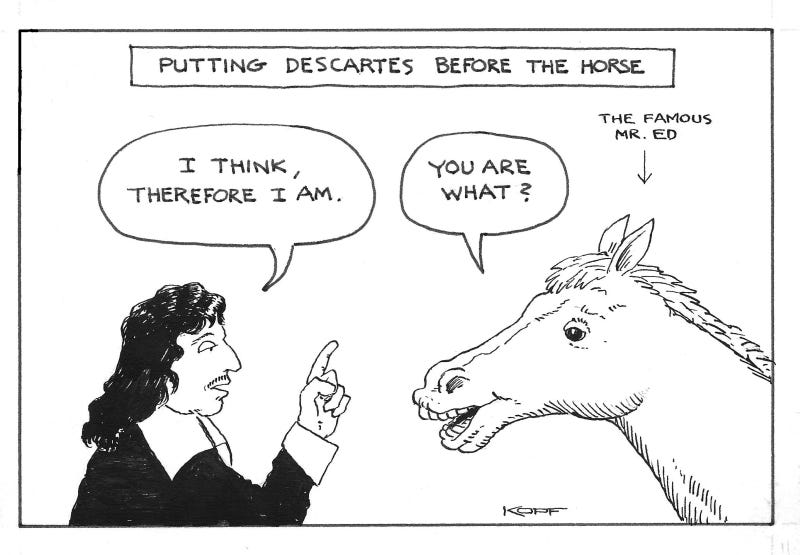
In back copy, you’ll often see certain trigger words used to set up the domino effect. Therefore is a fine word — nice for Descarte and Shakespeare — but a little high-falutin for us mere crime dogs. But…
BUT is a good alternative: Look at all the BUTS I have highlighted here in back copy I found on my shelf:
The Reverend Ronald Kemp came to the East End of London with definite ideas of right and wrong, which was only fitting for a minister of God. BUT the people of the East End had a few ideas of their own and the Rev. Kemp quickly finds his world torn asunder. — John Creasey’s Parson With a Punch:
FBI agent Kelly Jones has worked on many disturbing cases in her career, BUT nothing like this. A mass grave site unearthed on the Appalachian Trail puts Kelly at the head of an investigation that crosses the line…Assisted by law enforcement from two states, Kelly searches for the killers. BUT as darkness falls, another victim is taken and Kelly must race to save him before he joins the rest…in the boneyard. — Michele Gagnon’s Bone Yard:
Mickey Haller gets the text, “Call me ASAP – 187,” and the California penal code for murder immediately gets his attention. Murder cases have the highest stakes and the biggest paydays, and they always mean Haller has to be at the top of his game. BUT when Mickey learns that the victim was his own former client, a prostitute he thought he had rescued and put on the straight and narrow path, he knows he is on the hook for this one. — Michael Connelly
Here’s back copy for Sherrilyn Kenyon that’s corny as all get out but it it sets up some nice dominos:
He is solitude. He is darkness. He is the ruler of the night. Yet Kyrian of Thrace has just woken up handcuffed to his worst nightmare: An accountant. Worse, she’s being hunted by one of the most lethal vampires out there. And if Amanda Devereaux goes down, then he does too. BUT it’s not just their lives that are hanging in the balance. Kyrian and Amanda are all that stands between humanity and oblivion.
The buts set up the dominos.
As I was finishing this up, my student Jess emailed me. She read Lindsey’s post on CAUSE AND EFFECT and is excited to go back and give it another go. She is looking to jettison distracting subplots, But more important, she’s looking for missing buts.
It isn’t easy. But it can mean the difference between a meandering muddy brook and a clear swift-flowing river. Thanks for the piggyback ride, Lindsey.
Postscript: It took me a while but I found the story behind Dorothy L. Sayer’s mustard slogan.While working for S.H. Benson’s agency in the 1920s, Sayers created the hugely popular “Mustard Club” campaign for Colman’s Mustard. Her campaign featured the ubiquitous slogan “Has Father Joined the Mustard Club?”. She also created the “Three Mustardeers” for the brand.
For me, this ties into what I took away from a Deb Dixon workshop long ago. Give your character choices. If I do A, then B happens. If I do C, then D happens. And those choices should be between “it sucks” and “It’s suckier.”
Good post (as always)
Thans Terry. I was inspired….by Lindsey.
Yes, a crucial step to a solid foundation. I have a 3 para elevator pitch “formula” where the second para begins “But when…” (the Doorway of No Return) and the third begins “Now…” (Death stakes). I don’t start writing without it.
“But then…but THEN?”
“…along came Jones!”
A novel is a series of chain reactions? I think I like that. I’ve got to think on that a little more, but it makes sense to me. It reminds me of Newton’s Third Law – For every action, there’s an equal and opposite reaction (or something like that). I’ve never thought about a novel being one action causing a ripple effect, but it sure makes sense. Thanks for sharing. I believe you’re made me a better writer.
Aw geez, Henry. I believe you’ve made my day. Make sure you go back and read Lindsey’s earlier post. It is very clarifying.
I like to say about real life, “actions have consequences,” and it’s absolutely necessary in fiction that they do*. In a three or four paragraph book description/pitch, “actions will have consequences, along with plenty of stakes as things worsen–“but” points at those stakes (brilliantly so!).
*While actions have consequences in fiction, I think Lindsey’s “cause and effect” is more useful way of framing it for plotting and pitching purposes.
I wish someone had told me the action/reaction idea when I was just starting out. It took me many false starts to figure it out on my own. Like, my first attempt to write a mystery, I had nothing happening for 3 chapters….mainly my ex-cop sitting in a fishing boat remembering and mourning how she had lost her job, her husband, her career….blah blah blah. I so wish i still had that awful manuscript. It would be such a great lesson in what not to do.
Enjoyed the post as always, and the examples of good back copy. Writing that is an art form.
Thank you for the shout out P.J.!
Thanks for the inspiration.
That cartoon is a hoot, Kris!
Back cover copy is always the hardest for me to write. Now I’ll rethink how to frame that description using cause and effect.
My English grandmother enjoyed Colman’s Mustard. She used a tiny spoon to mix the powder with water in a little cup. The smallest taste would clear out my sinuses. Way too hot and spicy but brings back fond memories.
Ha! Never heard of Colman’s before I wrote this. And I am a mustard freak.
I’m revising the opening chapters of my WIP so this is a handy reminder of what needs to happen. Bookmarking the post, and I went back and reread Lindsey’s.